

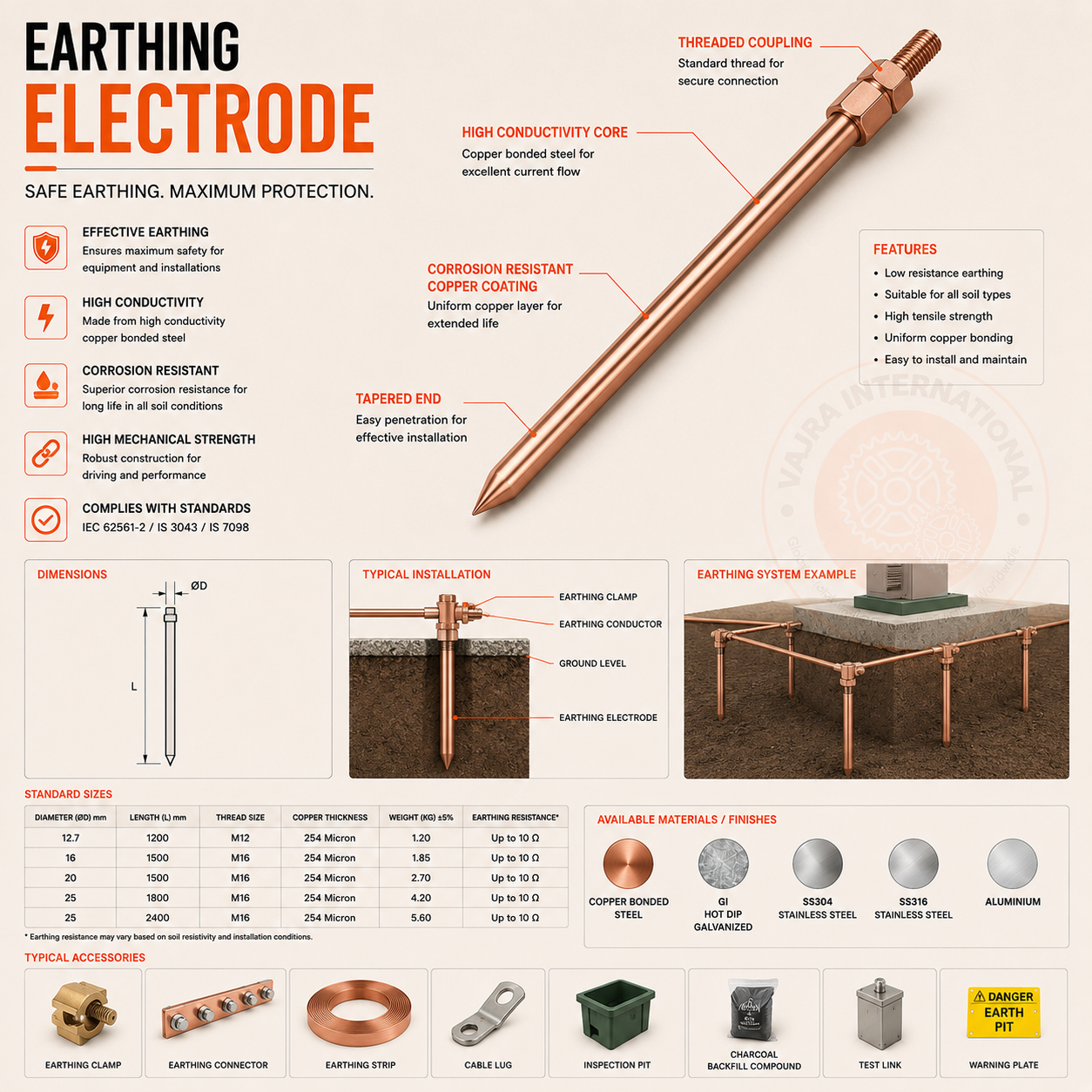
The copper-bonded earth rod specification most widely used across the Middle East and Africa, 14.2 mm diameter with 0.25 mm copper bond, was originally derived from a US standard written for temperate soil conditions in the 1960s. When that same rod is installed in saline coastal sand in Abu Dhabi or laterite soil in Ghana, environments the original standard authors never modelled, the copper bond can deplete by galvanic corrosion in 8–12 years, leaving a bare steel rod with no meaningful cathodic protection. Understanding this gap changes what you specify and what you need to verify from your Indian earthing manufacturer before the goods ship.
The soil-electrode interaction most buyers never think about
Copper-bonded rods work because copper is cathodically protected in most soil types, it is noble relative to iron and most soil minerals, so it corrodes extremely slowly. But in two conditions, copper becomes the anodic material and begins to dissolve: (1) when buried adjacent to a large mass of more noble metal (rare in practice), and (2) when soil pH drops below 4.5 (acid soils common in tropical laterite regions, peat bogs, and mining-affected land). In those conditions, a copper-bonded rod actually corrodes faster than an uncoated GI rod, because the copper bond creates a galvanic couple with the steel core. This is why IEEE 80-2013 Appendix B recommends soil chemistry testing before specifying electrode material, not just soil resistivity. We flag this to all project buyers who specify copper-bonded rods for tropical Africa and Southeast Asia installations.
The main earthing products we export, with the specifications that matter
- Copper-bonded earth rods (14.2 mm and 17.2 mm diameter, 1.5 m and 3 m lengths): electrolytic copper bond, 99.9% purity, minimum 0.25 mm thickness per IEC 62561-2. Salt-spray tested to ASTM B117 for 1,000 hours. Thread and coupling for deep driving to 9 m+.
- GI pipe electrodes (40 mm and 50 mm NB, IS 1239 medium duty, 3 mm wall): hot-dip galvanized inside and outside per IS 4759 after cutting to length. Funnel, perforated section, and end cap supplied as a set.
- Earth plates (600×600×6 mm GI, 600×600×3.15 mm copper): buried horizontally with bentonite-coal backfill compound. Complete pit-in-a-box package available.
- GI flat strip (25×3, 25×6, 40×5 mm, IS 2062 Gr. A, HDG post-fabrication) and copper strip (25×3, 32×6 mm, IS 613 electrolytic grade): horizontal earth grid conductors and equipment bonding.
- Exothermic welding cartridges and graphite moulds (Cadweld-compatible): for permanent, code-compliant conductor-to-rod and conductor-to-structure connections.
- Lightning air terminals and down-conductors (NFC 17-102 / IEC 62561-1): ESE (Early Streamer Emission) type for mast-mounted installations; conventional Franklin rod type for rooftop and structure protection.
- Maintenance-free earthing compounds (bentonite-graphite backfill): reduces soil-electrode interface resistance in high-resistivity ground; adds moisture retention between rainfall events.
Which standard applies, and what to write on your PO
Write the standard on the purchase order. Not as a reference, as a binding requirement. This one discipline eliminates 80% of supplier qualification problems. For Indian domestic projects: IS 3043. For GCC countries: IEC 62561 series (Parts 1–7 cover different components) plus IEEE 80 for substation design. For UK and Europe: BS 7430 (2011) and BS EN 62561. For Australia and New Zealand: AS/NZS 3000 and AS 1768. For North America: IEEE 80 / NFPA 780. We manufacture to IS 3043 as default and test to IEC 62561 where specified. Third-party test certificates from a NABL-accredited lab or SGS can be arranged for any product line.
Sectors and projects we supply to
Domestic: Power-generation EPCs including BHEL, L&T Projects and Tata Projects source GI conductor strip and earth plates from us for thermal and hydro substation earthing. Substation contractors including KEC International and Kalpataru Power Transmission specify copper-bonded rods for 66 kV–400 kV overhead line terminal substations. Telecom and 5G tower operators, Indus Towers and ATC across India, specify our copper-bonded rod systems with ESE lightning protection for tower earthing. Export: Refinery and petrochem project buyers in Kuwait and Oman specify maintenance-free earthing systems with exothermic connections. African telecom tower contractors (IHS Towers, Helios Towers supply chains) take copper-bonded rod packages for tower rollouts across Nigeria, Ghana and South Africa.
What to ask before ordering, seven questions that separate qualified suppliers from traders
- 1. What is the electrolytic copper bond purity (should be 99.9% minimum) and bond thickness (should be 0.25 mm minimum per IEC 62561-2)?
- 2. Is the bond applied by electrolytic deposition (correct) or mechanical cladding (inferior, strips at the cut tip during driving)?
- 3. Do you provide a batch MTC referencing the raw steel heat number and the copper deposit certification?
- 4. Can you provide a salt-spray test report to ASTM B117 (minimum 500 hours, preferably 1,000 hours)?
- 5. Do you test resistance-to-corrosion in soil simulation (ASTM G57 soil box method)?
- 6. Are exothermic welding materials included in the package, or separate-quoted?
- 7. Can you provide an installation manual compliant with IEC 62561-2 Annex A for end-user reference?
An earthing system is only as good as the weakest connection in the chain. We supply conductors, clamps, exothermic welding materials and complete installation documentation as a single package, because the rod that passes the test and the joint that fails in service are both your problem until the system is proven.
We export copper-bonded rods, GI pipe electrodes, earth plates and exothermic welding kits with full IEC 62561 / IEEE 80 documentation to UAE, Saudi Arabia, Nigeria, Australia and 30+ countries.