

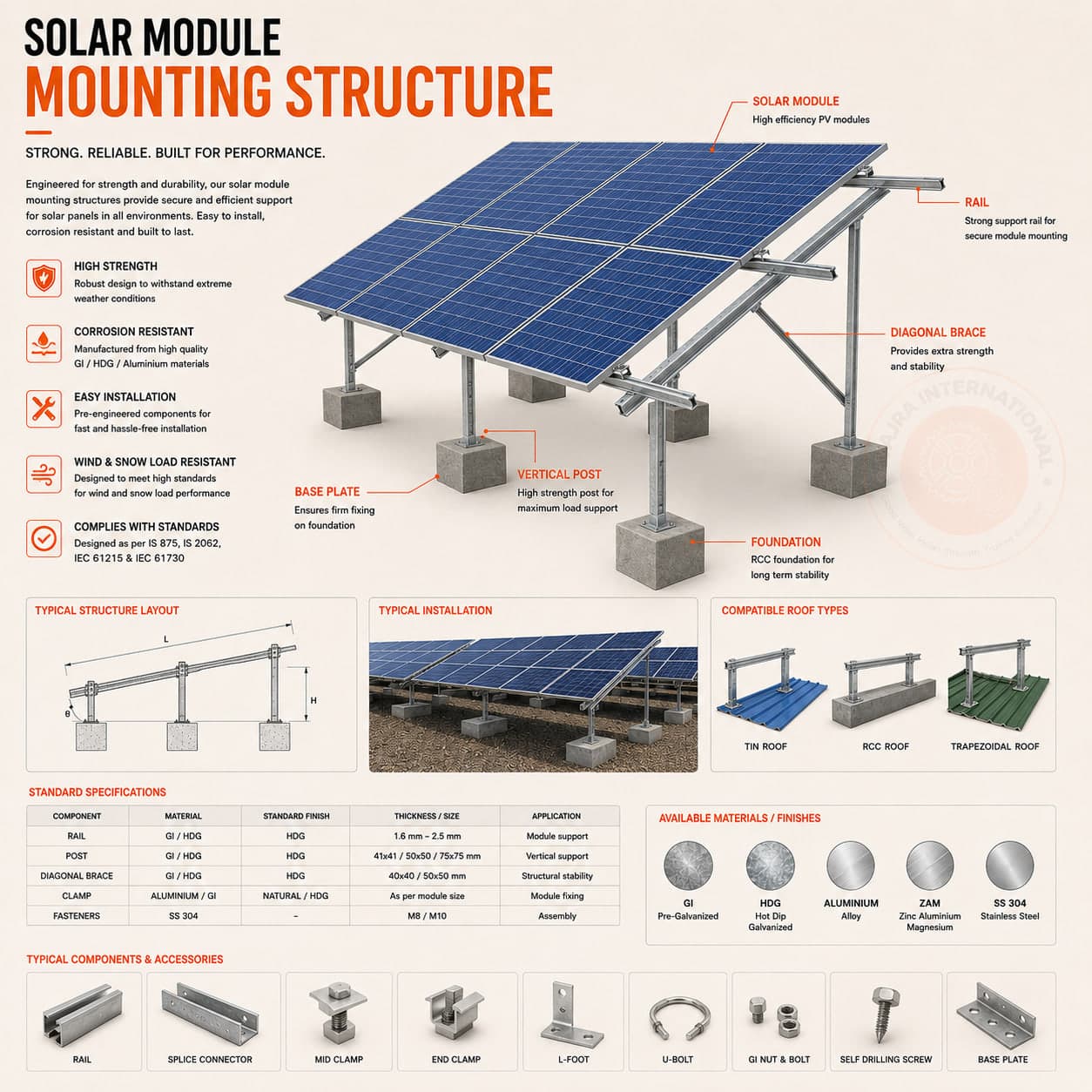
The contractors who win re-orders in GCC, Southeast Asia and Australian solar projects are not the ones who buy the cheapest structures. They are the ones whose structures arrive on site with stamped engineering drawings, correct pre-drilled hole patterns, and no site-cut corrections. The difference between a smooth installation and a 6-week site rework almost always traces to one decision made at procurement stage: did the buyer specify the wind zone and module dimensions correctly, or did they send a 'solar mounting structure' enquiry with no engineering input? This guide gives you the specification language, the wind-zone numbers and the material decision tree you need to get it right before the factory starts production.
Material choice: the decision tree that saves installation cost
Aluminium extrusions (6061-T6 or 6063-T5 alloy) and hot-dip galvanized mild steel (IS 2062 E250) are not interchangeable. The choice is driven by application type, site environment and total lifecycle cost, not unit price.
- Aluminium (6061-T6): yield strength 276 MPa, tensile 310 MPa. Density 2.7 g/cm³, one-third the weight of steel. Naturally oxide-film corrosion-resistant without any coating; maintains structural integrity in coastal and desert environments over a 25-year project life with zero maintenance. Preferred for all rooftop projects: the structural dead load on the roof slab is the constraint, and aluminium saves 60–70% of the structure weight vs steel. Premium material cost (aluminium extrusions are currently 3.5–4× the price of HDG steel per kg) but lower total installed cost on rooftops due to reduced structural loading and easier field handling.
- Hot-dip galvanized mild steel: yield strength 250 MPa (IS 2062 E250), density 7.85 g/cm³. HDG coating at 85 µm minimum (ASTM A123) provides 25–40 year corrosion protection in standard industrial atmosphere (C3 per ISO 9223). Preferred for all utility-scale ground-mount projects where structural weight is not a constraint and cost per MW is the primary driver. 50–60% lower material cost per kg than aluminium. HDG zinc coating must be undamaged at all cut and drilled edges, the critical site discipline.
- Pre-galvanized (GI) steel: DO NOT USE for solar mounting. Pre-galvanized coil is zinc-coated before fabrication; every site cut, every drilled hole, every field weld exposes bare steel at the edge. In outdoor solar environments, daily thermal cycling, moisture condensation, UV exposure, those cut edges rust within 18–24 months and the rust tracks into the zinc coating laterally. Pre-galvanized solar structures are the single most common source of early structural failure in 3–5 year old solar farms in humid and coastal zones. We do not supply pre-galvanized for any solar application.
Wind-load engineering: the specification that decides whether structures survive monsoon
A solar structure failure in high wind is not a maintenance event, it is a total loss of panels and structure across the affected rows, plus potential safety incidents. Correct wind-load engineering is the most important specification decision in solar procurement. In India, IS 875 Part 3 divides the country into basic wind speed zones: Kolkata and coastal West Bengal sit in Zone IV (50 m/s basic wind speed); Rajasthan and Madhya Pradesh are Zone III (47 m/s); Kerala and coastal Tamil Nadu are Zone V (55 m/s). For international projects, the local wind standard applies: AS/NZS 1170.2 for Australia; BS EN 1991-1-4 for UK and Europe; ASCE 7-22 for the US; MBMA for GCC steel structures.
- Always provide the project location (district/governorate/county) or the basic wind speed in m/s, not just 'standard wind loading'.
- Tilt angle changes wind pressure significantly: a 10° tilt adds ~15% wind uplift vs flat; a 30° tilt adds ~40% uplift vs flat for the same basic wind speed.
- Tracker systems require dynamic load analysis, not standard static table design.
- We issue stamped structural calculation reports for wind-load design on all projects above 1 MW. For smaller projects, preliminary calculations are provided as part of the RFQ response at no charge.
- Pile type: driven C-channel or I-section piles for standard soil; ground screws for rocky or shallow soil; concrete anchors for weak soil or high-water-table sites. Pile length and gauge depend on both wind load and soil bearing capacity, provide a soil report if available.
Module compatibility: the two numbers that prevent field rework
The solar module market has shifted from the long-dominant 72-cell format (2,094×1,038 mm) to the current mainstream 182 mm and 210 mm cell formats. Common current module sizes: Longi Hi-Mo 6 / Jinko Tiger Neo 72HL4 at 2,278×1,134 mm; BYD HiKu6 Mono PERC at 2,279×1,134 mm; Trina Vertex S+ at 2,172×1,096 mm. The mounting rail spacing and mid/end clamp design must match the module frame width and height. If you order mounting rails before confirming module dimensions, you risk field-drilling every rail to reposition the clamp slots, a 2–4 man-day per MW penalty. Provide the module model and datasheet in your RFQ. We design the rail spacing and clamp selection to match.
Export: what we supply from Howrah and how it ships
We manufacture HDG steel solar mounting structures at our Sankrail Industrial Park facility in Howrah. Typical export volume is 1–5 MW capacity per 40-foot container (structure only, not panels). Lead time for standard configurations with buyer-confirmed drawings: 3–5 weeks. Aluminium extrusion systems for rooftop projects are sourced from qualified extrusion partners and assembled with our in-house fittings.
- HS codes: 73089090 (galvanized steel structures and parts); 76169900 (aluminium structures and parts).
- Standard documentation: MTC per IS 2062 (steel) or 6061-T6 mill certificate (aluminium), HDG report per ASTM A123, wind-load structural drawing with stamp, CoO, packing list.
- Incoterms: FOB Kolkata (INKOL) or FOB Haldia (INHAL) standard. CIF/CFR available for all major Middle East (Jebel Ali, Dammam, Salalah), Southeast Asia (Port Klang, Tanjung Pelepas, Manila), and Australian (Brisbane, Fremantle) ports.
The complete solar structure RFQ checklist
- Application: rooftop (flat, ballasted or penetrating) or ground-mount (fixed tilt or tracker).
- Module model and datasheet (for clamp and rail compatibility).
- Total project capacity in MW and number of modules.
- Tilt angle (degrees) and orientation (south-facing, east-west, bifacial layout).
- Modules per row and table configuration (2P, 4P etc).
- Project location or basic wind speed (m/s) and terrain category.
- Foundation type available on site (driven pile, ground screw, concrete anchor).
- Material preference (HDG steel or aluminium) with reason.
- Destination port and preferred Incoterm.
- Do you need stamped structural drawings for permit submission? (Specify jurisdiction.)
Send us module datasheet, tilt angle, wind speed (or project location), total MW and foundation type. We return a preliminary BOM, structural drawing and FOB/CIF price within 48 hours. No engineering estimate fees.
Need solar mounting structures for ground-mount or rooftop? Send us your module datasheet, tilt angle and site wind speed. We return a preliminary BOM and FOB/CIF price within 48 hours.