

Most buyers sourcing cable trays from India for the first time focus on price per metre and coating description. Both are almost meaningless without three other numbers: steel thickness (gauge), coating weight (not just 'galvanized'), and span-to-load table conformance. The two procurement mistakes that cost buyers 20–40% extra, or result in a full container return, both trace to ignoring these three numbers at the enquiry stage. Here is the complete guide for cable management buyers in the UAE, UK, Australia, Philippines and Africa who want to get the order right before the container is loaded.
The two specification numbers most buyers miss
Before you request a price, get these two numbers from every supplier: (1) the base steel thickness in millimetres for the tray side rail, and (2) the zinc coating weight in g/m² or thickness in µm. 'Heavy-duty 2 mm galvanized' and '1.2 mm hot-dip galvanized' are both 'galvanized cable trays' on a quotation sheet. The first is 67% heavier, carries 2.8× the load at the same span, and will last three times as long outdoors. The second is cheaper per metre but requires two support points where the first needs one. Run the total installed cost, tray + support steel + labour + replacement, not just the tray unit price.
Types of cable trays made in India and who each suits
- Ladder cable trays (50–1000 mm wide, 2.5 m standard length, 1.2–2.5 mm base steel): power distribution, substations, transmission projects. Rung spacing 150 mm or 300 mm. Specify rung spacing. 150 mm is required for cables under 25 mm² to prevent sag between rungs.
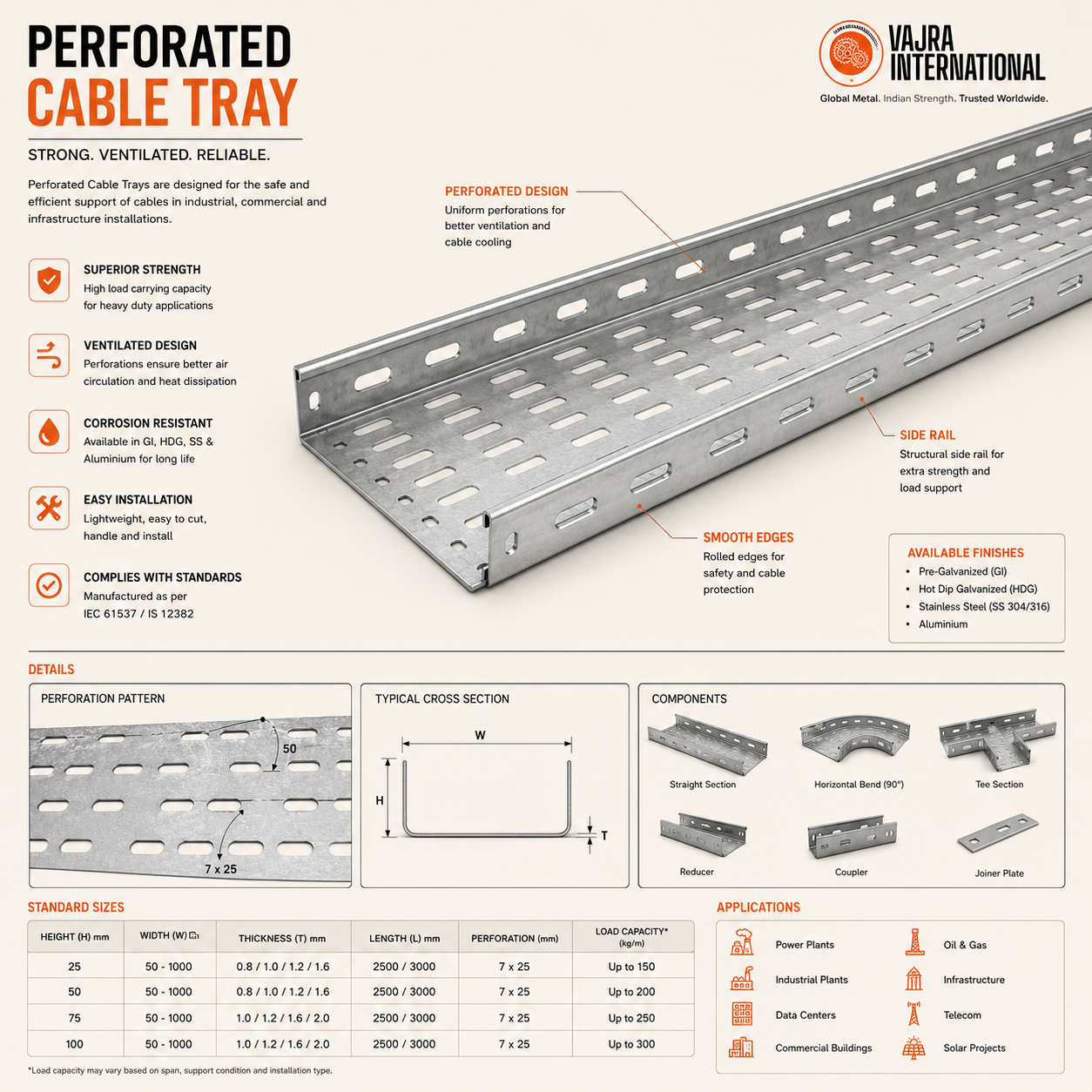
- Perforated cable trays (50–600 mm wide, 1.0–1.6 mm base steel, 30–40% perforation): control cabling, instrumentation, small power, telecom. Data-centre applications where cable weight per metre is low and neat routing matters.
- Wire-mesh / basket trays: quick to cut and install, high ventilation, popular in European data-centre fit-out. Not made at Vajra, we direct buyers to specialist suppliers for this type.
- Raceways / trunking (25×25 mm to 150×100 mm): enclosed routing through occupied areas and switch rooms. Snap-on covers; DIN rail mounting inside for panel internal wiring.
- FRP/GRP trays: non-conductive, non-sparking, marine and chemical plant. Not manufactured by Vajra, source separately for hazardous-area applications.
Standards that actually affect your order and customs clearance
IEC 61537 is the primary international standard for cable trays and ladder systems, it sets load capacity test methods, deflection limits, and dimensional tolerances. Indian domestic IS 12352 aligns closely with IEC 61537. For DEWA-approved projects in the UAE, DEWA specification D-EN-04-030 references IEC 61537 with additional requirements for coating and labelling. For UK projects, BS EN 61537 (the European adoption) applies. For Australia/NZ, AS/NZS 3000 cable management provisions apply. NEMA VE 1 is the US standard, used for projects in North America and by some Southeast Asian buyers who follow US specification. We test to IEC 61537 and can issue a third-party test report from a NABL-accredited lab. If your project requires DEWA pre-approval submission, we have supplied that documentation package before and can prepare it.
Finishes: what each coating specification actually means
- Pre-galvanized Z275 (IS 277): 19 µm per side, indoor dry only. Recognised standard. DO specify the Z-grade, not just 'GI'.
- Hot-dip galvanized ASTM A123 Grade 65 (structural sections): minimum 85 µm average. Specify the grade. Grade 65 means ≥65 µm minimum, not just average.
- Hot-dip galvanized IS 4759: Indian domestic equivalent. Specifying both ASTM A123 and IS 4759 on your PO removes ambiguity.
- Stainless 304L: 18% Cr, 8% Ni, low carbon. Suitable for 99% of corrosive industrial environments. Only use 316L if you have free chloride contact (marine spray zones, bleach chemical environments).
- Powder coat: must be OVER a pre-galvanized or phosphate base, never directly over bare MS. Specify 60 µm minimum DFT.
What documentation to request, and exactly why each matters
- MTC (EN 10204 Type 3.1) referencing the specific steel heat number: proves the raw material grade, not just the finished product claim.
- Certificate of Origin (non-preferential or preferential under India-UAE CEPA): determines import duty in destination country, not optional.
- Third-party dimensional compliance report to IEC 61537 or NEMA VE 1: the only proof that load and deflection claims are tested, not calculated.
- HDG coating thickness report (XRF measurement per BS EN ISO 1461 Annex A): average AND minimum coating thickness per batch.
- Packing list with gross/net weights and CBM per bundle: your freight forwarder and customs broker need this before the vessel books.
How we supply and ship cable trays from Howrah
At our Jalan Industrial Complex facility in Howrah, West Bengal, we run four ladder-tray roll-forming lines producing approximately 5,000 metres per shift. Standard widths from 50 to 1,000 mm in 25 mm steps. Standard lengths 2.5 m and 3 m (custom lengths to 6 m on request). The HDG bath on-site processes cable tray and accessories together, so fittings, bends, tees, reducers, coupler plates, leave the facility in the same coating batch as the tray runs they serve. This matters: mixed batches from different suppliers galvanized at different times produce visually mismatched zinc appearances and slightly different corrosion timelines, which is visible within 18 months outdoors. We export on FOB Kolkata (INKOL), FOB Haldia (INHAL), CIF and CFR to all major destination ports. Transit time to Jebel Ali (UAE): 12–16 days. Singapore: 16–20 days. Felixstowe (UK): 22–28 days. Sydney: 24–30 days.
The cable tray market has hundreds of Indian suppliers. The qualification question is: does your supplier own their galvanizing bath, punch before dipping, and issue a 3.1 MTC referencing the raw material heat? If not, you are buying uncertainty.
We manufacture ladder, perforated and trunking cable trays from our Howrah facility with in-house HDG. ISO 9001:2015 certified, IEC 61537 tested, FOB/CIF/CFR documentation standard.