

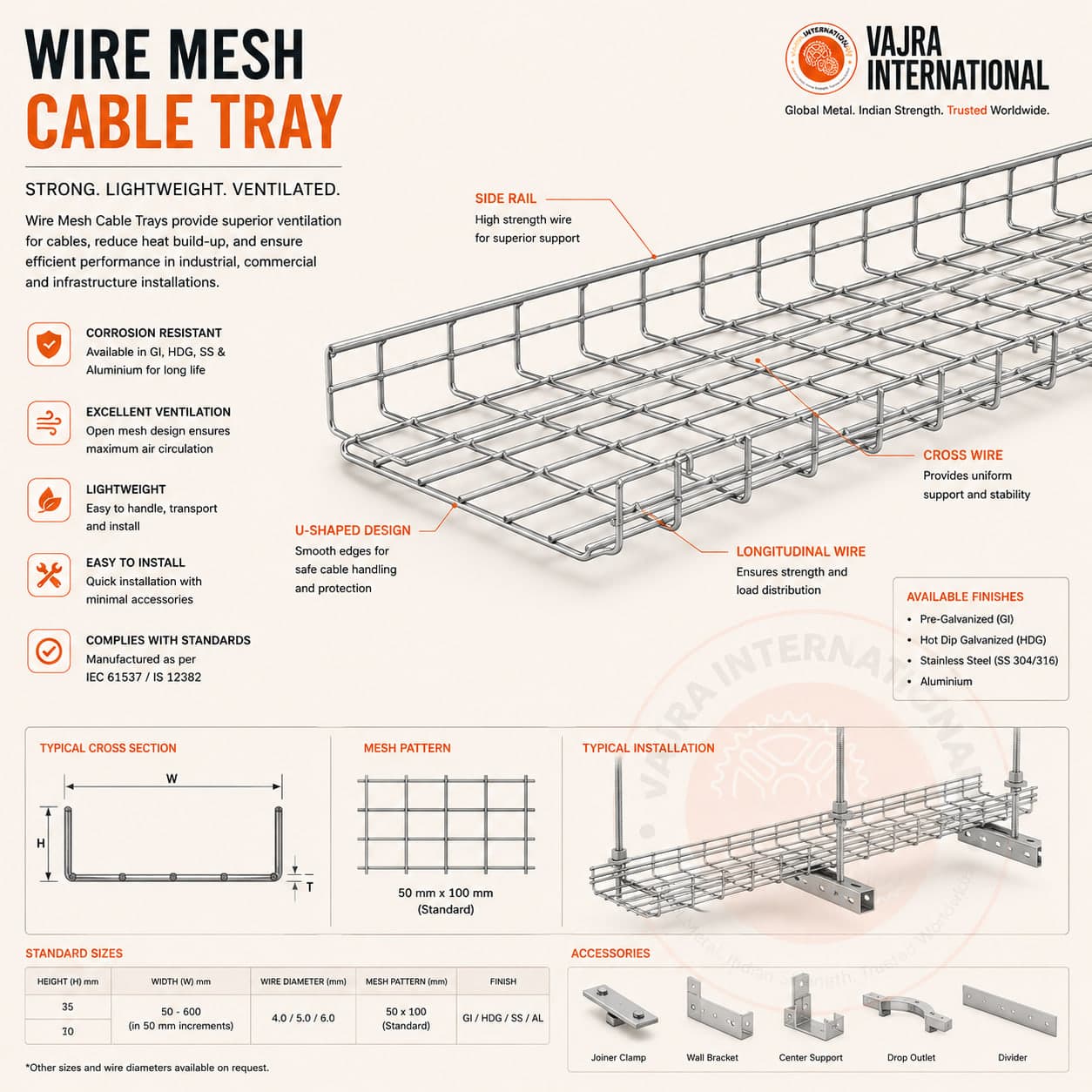
A data centre fit-out contractor in Hyderabad rang us last year, halfway through a 4,000 metre control-cabling job, asking to switch the rest of the run from perforated tray to wire mesh basket. The basket was costing him a little more per metre, so it was not a price decision. His crew was laying basket at close to double the speed of the perforated runs, and his client's IT team could trace any circuit just by looking at the tray. That is the case for wire mesh tray in two lines: quicker to install, and honest about what it carries.
What a wire mesh tray actually is
It is a grid of steel wires, welded where they cross, formed into an open U-shaped basket. Standard depths run 50 to 150 mm, widths from 50 to 600 mm, with a mesh pitch of roughly 50 by 100 mm. There is no solid or perforated bottom, just the wire grid. Wire diameters of 4 to 6 mm cover most jobs. Finishes decide the life: electro-zinc plated for dry indoor use, hot-dip galvanized to IS 4759 for outdoor and industrial plant, and 304 or 316 stainless for clean rooms, pharma and food lines. Because there is so little steel in it, a basket section weighs far less than the ladder tray it replaces, so freight and handling cost less too.
Where basket tray earns its place
- Install speed: cut to length on site with a bolt cutter or a cutting disc, joined with splice clips, no drilling and no separate couplers. Crews routinely run 30 to 50 percent faster than with ladder tray.
- Heat and visibility: the fully open grid holds almost no heat, so cable de-rating is negligible, and every cable stays visible for fault tracing and future additions.
- Data and light current: it is the natural home for Cat6A, fibre, control and instrumentation cabling in data centres, hospitals, laboratories and commercial fit-outs.
- Clean environments: there is no flat surface for dust to gather, which is why semiconductor and pharma specifications lean on stainless basket.
Where it is the wrong tray
Basket is not a heavy-power workhorse. For large LT or HT power cables on long support spans, ladder tray still wins on load capacity and span. Do not drop a bundle of 240 sq mm armoured cable into a 100 mm basket on 3 metre supports and expect the run to stay level. Skip basket too where falling tools or impact are a real risk, because there is no cover guarding the cable. And anywhere near the coast, only HDG or 316 will survive. An electro-zinc basket within a couple of kilometres of salt air will show rust inside the first year.
The cut-edge rule nobody puts on the drawing
Wire mesh has its own version of the bolt-hole problem that ruins ladder tray. Every time the crew cuts a basket to length or notches it for a bend, fresh steel is exposed at the wire ends. On a zinc-plated or galvanized basket those bare ends will bleed rust within months. Two things are not optional on site. First, deburr every cut wire so it cannot bite into cable insulation during the pull. Second, brush cold galvanizing compound over the cut ends. With 316 stainless the corrosion worry goes away, but the deburring still matters for cable safety. We ship edge caps and a tube of zinc-rich touch-up with export basket orders so the site crew has no excuse to leave a raw end.
Spans, load and the weld that holds it all
A loaded 300 mm wide by 100 mm deep galvanized basket carrying control cabling will usually sit on supports at 1.5 metre centres, with a safe working load somewhere between 30 and 60 kg per metre depending on wire gauge and weld quality. Notice that last phrase. A basket tray is only as good as its cross welds. The cheap imported baskets that fail in service almost always fail at a cold or half-made weld, either sagging under load or letting go when the cable puller leans on the run. We pull sample baskets from every production batch and test the welds to destruction, then record the weld shear value on the test report that travels with the order.
On a basket tray the weld is the product. A 6 mm wire on the datasheet means nothing if the cross welds let go the moment the cable puller takes up tension.
Need wire mesh cable basket in electro-zinc, hot-dip galvanized or 316 stainless, with a weld test report per batch? We manufacture basket tray and splice hardware at our Howrah works and ship FOB, CIF or CFR to 30+ countries.