
Defence-grade metal supply is a supply chain that is nearly impossible to enter and almost impossible to exit once you are qualified in it. A DPSU, a Defence Public Sector Undertaking like Hindustan Aeronautics, BEML, or an OFB ordnance factory, does not re-qualify suppliers casually because the process is expensive for the buyer as well as the supplier. The barrier to entry is not technical capability: almost any reasonable fabricator can hold tight tolerances on a good day. The barrier is traceability, the documented proof that every dimension, every heat of material, every inspection step is recorded and retrievable years after the part ships. Here is exactly what that documentation looks like, and why most fabricators cannot replicate it on demand.
What defence auditors actually inspect, in order of priority
When a quality auditor from a DPSU or an overseas defence contractor walks into a supplier's facility for a vendor qualification audit, they do not go to the production floor first. They go to the document room. A production floor can be cleaned and arranged for a visit. The document room cannot be faked. Here is the audit sequence we have experienced across 50 years of domestic defence supply:
- 1. Raw material traceability: Every heat number on every MTC must be traceable to the specific batch used in a named production order. If a MTC from JSW Steel references heat H24-3891, that number must appear in your incoming inspection register, your material issue note, and your finished-goods inspection record, all cross-referenced. If any of those links is missing, the audit fails for that part.
- 2. Process qualification records: Can you show the qualified weld procedure (WPS), the welder qualification certificate (WQC), and the last calibration record for the welding equipment used on this order? All three must be in-date. Expired welder certs are one of the most common audit failures.
- 3. Dimensional inspection with calibrated instruments: Every critical dimension on the drawing must appear in the inspection record with an actual measured value, not just a 'pass' tick. Instruments must reference a calibration cert from an NABL-accredited lab.
- 4. Finish and coating: Coating thickness measured with a calibrated instrument, recorded per-piece or per-batch, against the specified value. Salt-spray test report from a third-party lab for any corrosion-protection critical parts.
- 5. Non-destructive testing (NDT): For structural weldments, dye penetrant (PT) or magnetic particle (MT) inspection reports signed by a Level II NDT technician. Radiographic (RT) reports for pressure-bearing welds.
- 6. First-article inspection (FAI): For new parts, a First Article Inspection Report (FAIR) signed by QC and countersigned by the customer's representative before batch production begins.
The confidentiality layer, build-to-print under NDA
Most defence components are designed by the OEM or DPSU and the supplier receives a controlled drawing, numbered, revision-tracked, with a CONFIDENTIAL or RESTRICTED marking. The supplier must maintain a controlled drawing register: who received what revision, when, and where those drawings are stored. Superseded revisions must be destroyed or returned, not filed in a general folder. At Vajra, all defence drawings are held in a controlled-access document store, revision-tracked per ISO 9001 Clause 7.5, and operated under NDA. We do not disclose customer names, part numbers, or drawing content from any defence relationship.
Why 50 years of domestic supply is an irreplaceable qualification
Qualification in the Indian defence supply chain requires a documented track record, references from DPSUs or MoD-registered integrators, and in many cases a factory visit by the customer's QA team. A new fabricator starting today needs 2–4 years of domestic supply history before a major DPSU will consider them for direct qualification. Vajra's group has that history going back to the 1970s. For international defence buyers. UK MoD supply chain, Australian ADF contractors, GCC defence ministry procurement, the domestic track record is the fastest route to qualification: it demonstrates the document controls and process discipline that an overseas audit would require, without requiring the buyer to build that capability from zero.
A defence supplier is qualified on the quality of their records, not the quality of their machines. Any modern machine shop can hold ±0.01 mm. Very few have 50 years of documented traceability behind every batch.
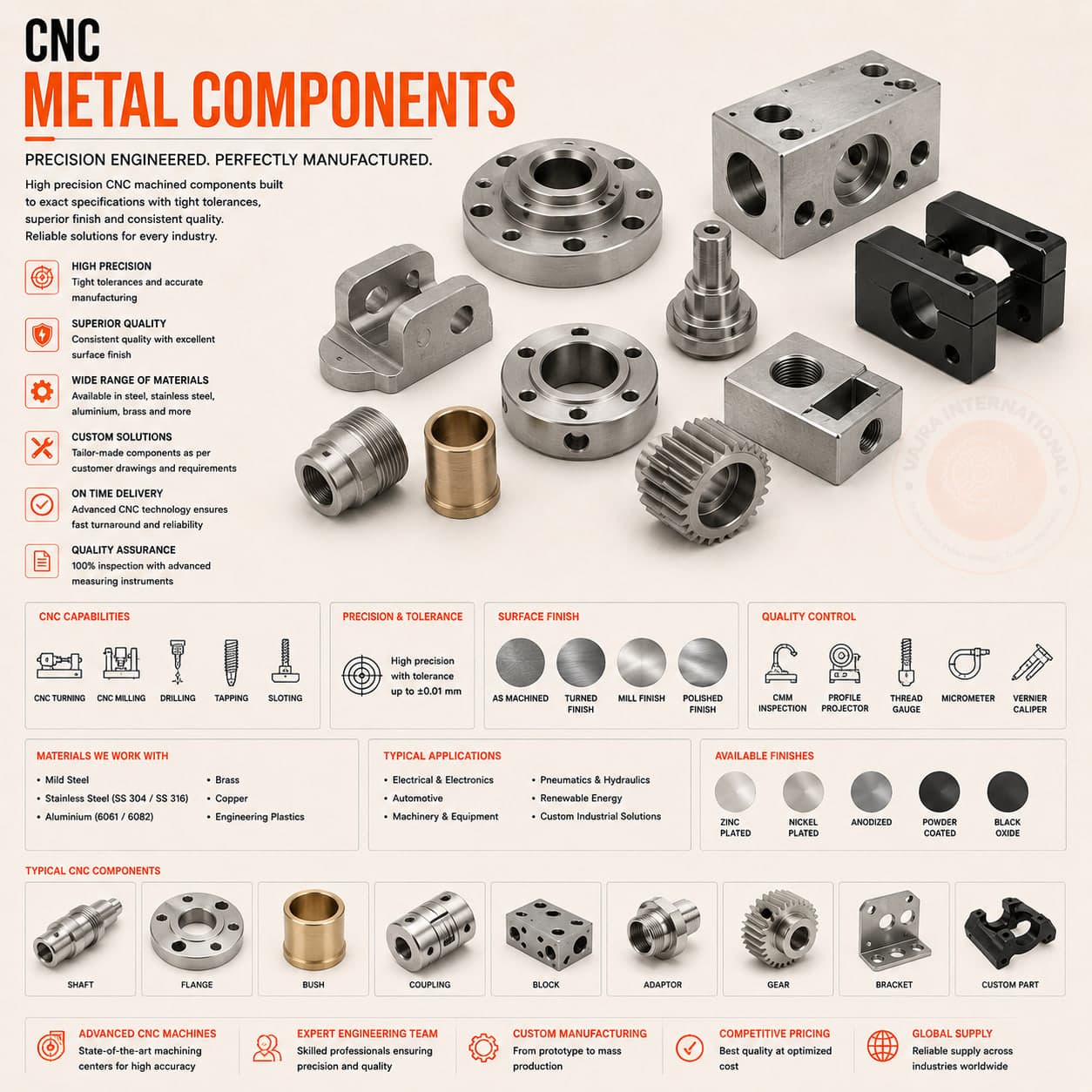
Vajra's group has supplied DPSUs and defence-sector EPCs since the 1970s. Enquire about precision CNC components, sheet metal fabrication or structural assemblies with full traceability documentation.