

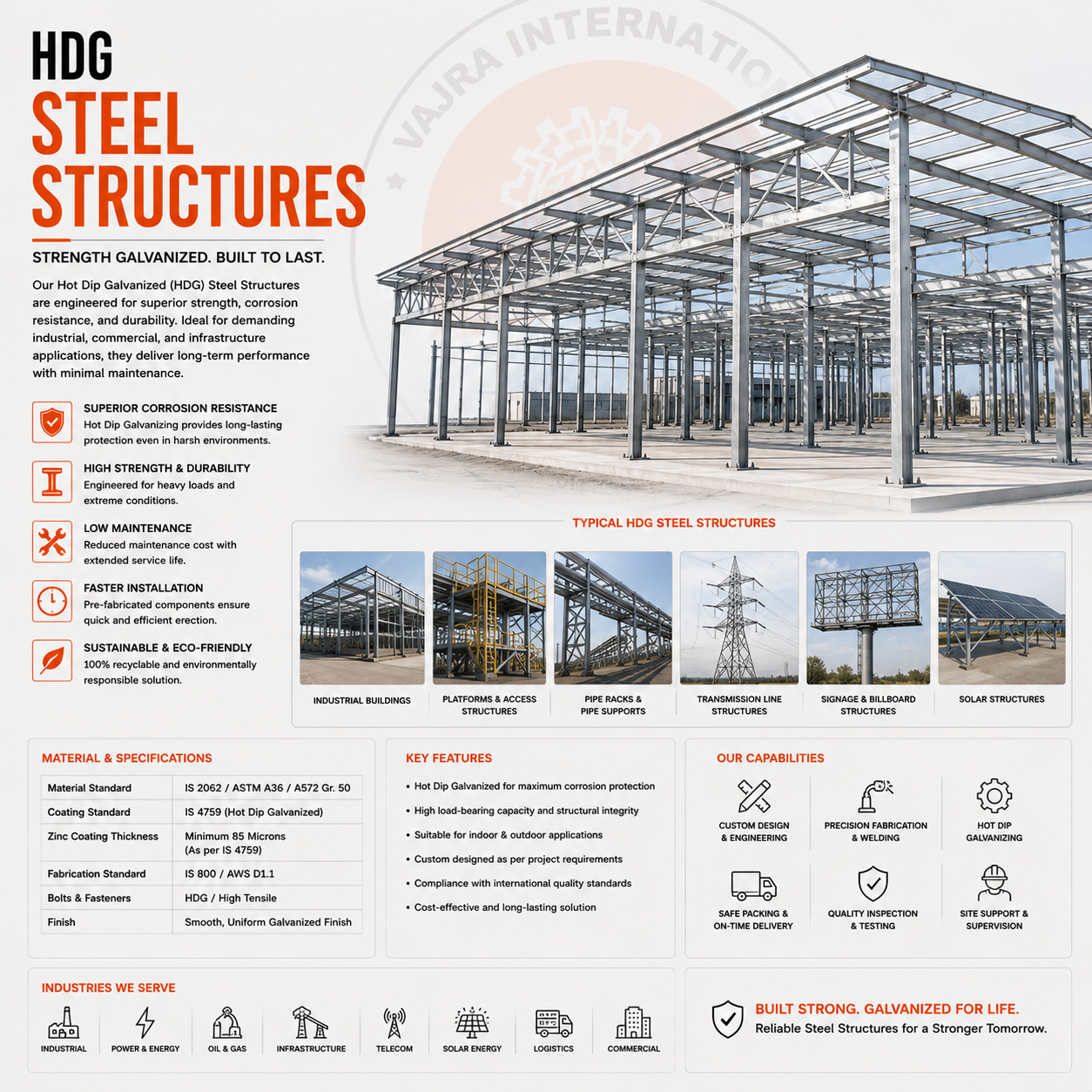
The difference between pre-galvanized and hot-dip galvanized steel is not primarily a cost question, it is a question of where the money goes and when. A UAE substation contractor told us they saved 12% on a cable tray order by switching to a pre-galvanized supplier. Three years later, they spent 400% of that saving replacing corroded runs on a coastal section 4 km from the Gulf. The mistake was never about price; it was about understanding the physics of what each process actually produces and where each fails first.
Pre-galvanized (GI): what the process actually does
In pre-galvanizing, a continuous steel coil is passed through a molten zinc bath before it is cut, punched, formed or welded. The zinc is applied at the mill, under controlled tension, giving a thin, smooth, visually perfect coating, typically 70–130 g/m² (Z120–Z275 per EN 10346 / IS 277). Then the steel is fabricated. Every cut exposes raw steel at the edge. Every punch hole removes zinc around its perimeter. Every weld burns off zinc in the heat-affected zone and releases zinc oxide fumes. The finished product has large unprotected areas at every point of fabrication. Red rust at cut edges can appear within 18–24 months outdoors in humid climates. Inland, dry, climate-controlled environments, data centre raised floors, switch rooms, indoor panel plant, are where GI performs correctly.
Hot-dip galvanized (HDG): what the process actually does
In hot-dip galvanizing, the finished steel article, fully fabricated, punched, drilled, welded, is cleaned by degreasing and acid pickling, fluxed, and then submerged in a bath of molten zinc at 445–455°C for 3–5 minutes. Zinc and iron metallurgically bond. The coating that forms is not a surface layer: it is four intermetallic layers (Gamma, Delta, Zeta, Eta) growing into the steel surface itself. This structure self-heals minor scratches by cathodic protection, zinc sacrifices itself to protect exposed steel up to 1.5 mm from the cut edge. To ASTM A123, the minimum average coating thickness is 85 µm for structural steel sections. At Vajra's Howrah facility, our in-house HDG bath produces 90–110 µm average across cable tray and grating batches, which we confirm by XRF gauge measurement and report on the MTC.
The numbers that matter for your specification
- Zinc mass: GI Z275 coating = 19 µm per side (39 µm total). HDG average = 85–110 µm all around. That is 4–6× more zinc.
- Edge protection: GI has zero zinc at cut or punched edges. HDG covers all edges, welds, internal corners and bolt holes, the failure points.
- Service life (ISO 9223 C4 industrial atmosphere): GI typically 8–12 years to first maintenance. HDG: 25–40 years.
- Cost delta: HDG adds approximately 18–25% to the unit price of a cable tray run.
- True lifecycle cost: In any outdoor, coastal or industrial environment, HDG is 40–60% cheaper over 25 years due to eliminated replacement and labour.
- In-house control: Vajra owns the HDG bath. No outsourced dipping, no third-party scheduling. Coating runs are batch-logged with dip time, bath temperature and XRF measurement on every production order.
Specify the finish to the environment, not the budget line. Pre-galvanized saves 15% on day one and costs 300% by year five outdoors. Hot-dip galvanized is the only specification for any cable tray or grating that will see rain, salt air or industrial atmosphere.
Vajra runs an in-house HDG bath with XRF-verified coating on every batch. Request a quotation for hot-dip galvanized cable trays, gratings or steel supports with documented MTC.