

Early Streamer Emission air terminals are not recognised by IEC 62305-3, the primary international standard for lightning protection system design, as providing any additional zone of protection beyond a conventional Franklin rod. IEC 62305-3:2010 Annex A explicitly states that no enhanced or early streamer terminal type has demonstrated repeatable protection improvement under controlled test conditions. ESE terminals are recognised by NFC 17-102 (French standard) and UNE 21186 (Spanish standard), and they are commercially common in GCC markets. But if your project specification cites IEC 62305 as the design basis, an ESE-only system will not pass an independent technical review by an IEC-experienced engineer. Understanding this distinction before the design is fixed prevents expensive post-approval redesigns.
IEC 62305-3 LPL classification, the four levels explained
- LPL I (Lightning Protection Level I): R = 20 m rolling sphere radius. Collection efficiency ≥ 98%. Required for: petrochemical facilities, ammunition stores, critical data centres, hospitals. Maximum down conductor spacing 10 m perimeter.
- LPL II: R = 30 m. Collection efficiency 95%. Required for: industrial facilities with fire risk, large public buildings. Maximum down conductor spacing 10 m perimeter.
- LPL III: R = 45 m. Collection efficiency 90%. Typical for: commercial buildings, warehouses without explosive content. Maximum down conductor spacing 15 m perimeter.
- LPL IV: R = 60 m. Collection efficiency 80%. Used for: residential and low-risk structures. Down conductor spacing 15 m.
- Selection rule: any structure with flammable or explosive content must be classified LPL I or II minimum. A telecom tower in Zone 2 classification is LPL I. A solar inverter room is LPL II minimum.
The rolling sphere method, applied correctly
The rolling sphere is a conceptual sphere of radius R that is rolled over the surface of the building. Any point that the sphere can touch is a point that a lightning stroke can reach, and therefore requires an air terminal to intercept the stroke before it reaches the surface. For a flat roof building 10 m tall with LPL II (R=30 m): the sphere clears the roof corners with air terminals at roof perimeter. For a building with a higher projection (rooftop plant, antenna mast): the sphere contacts the projection first, an air terminal on the projection protects the surrounding area by the geometry of the sphere. The protection angle method is an approximation valid only for simple structures below 60 m height, use rolling sphere for all structures with complex geometry or projections.
Conventional vs ESE air terminals: what specifiers need to know
- Conventional Franklin rods: accepted by IEC 62305-3, BS EN 50164-1, and all IEC-aligned project specifications including Saudi Aramco, Shell, BP, and most European and Australian engineering authorities. Zone of protection determined solely by rod height and rolling sphere method for the chosen LPL. These are the correct default for all projects citing IEC 62305.
- ESE air terminals (NFC 17-102): accepted in France, UAE (some DEWA projects), and French-standard markets. ESE terminals claim an additional protection radius (ΔL) beyond the conventional rod, typically 40–60 m claimed for LPL I ESE terminals vs 20 m for conventional. This extended radius is not validated by IEC and is rejected by most insurance underwriters for petrochemical risk unless the project authority specifically accepts NFC 17-102 as the design basis.
- Recommendation: unless your project specification explicitly permits or requires ESE (or the authority having jurisdiction is NFC 17-102 compliant), specify IEC 62305-3 conventional air termination. An ESE design rejected during construction review requires full redesign, remanufacture and re-installation.
Conductor and electrode specifications. IS 3043 and IEC 62305-3
- Air terminal rods: minimum 10 mm diameter copper (all LPL) or 12 mm GI (LPL III/IV only). Height above highest protected point determined by rolling sphere analysis, not a fixed standard.
- Down conductors: 50 mm² copper flat strip (preferred) or 50 mm² stranded copper; alternatively 100 mm² GI flat strip for LPL III/IV. Copper required for LPL I/II and for corrosive environments (coastal, chemical plant).
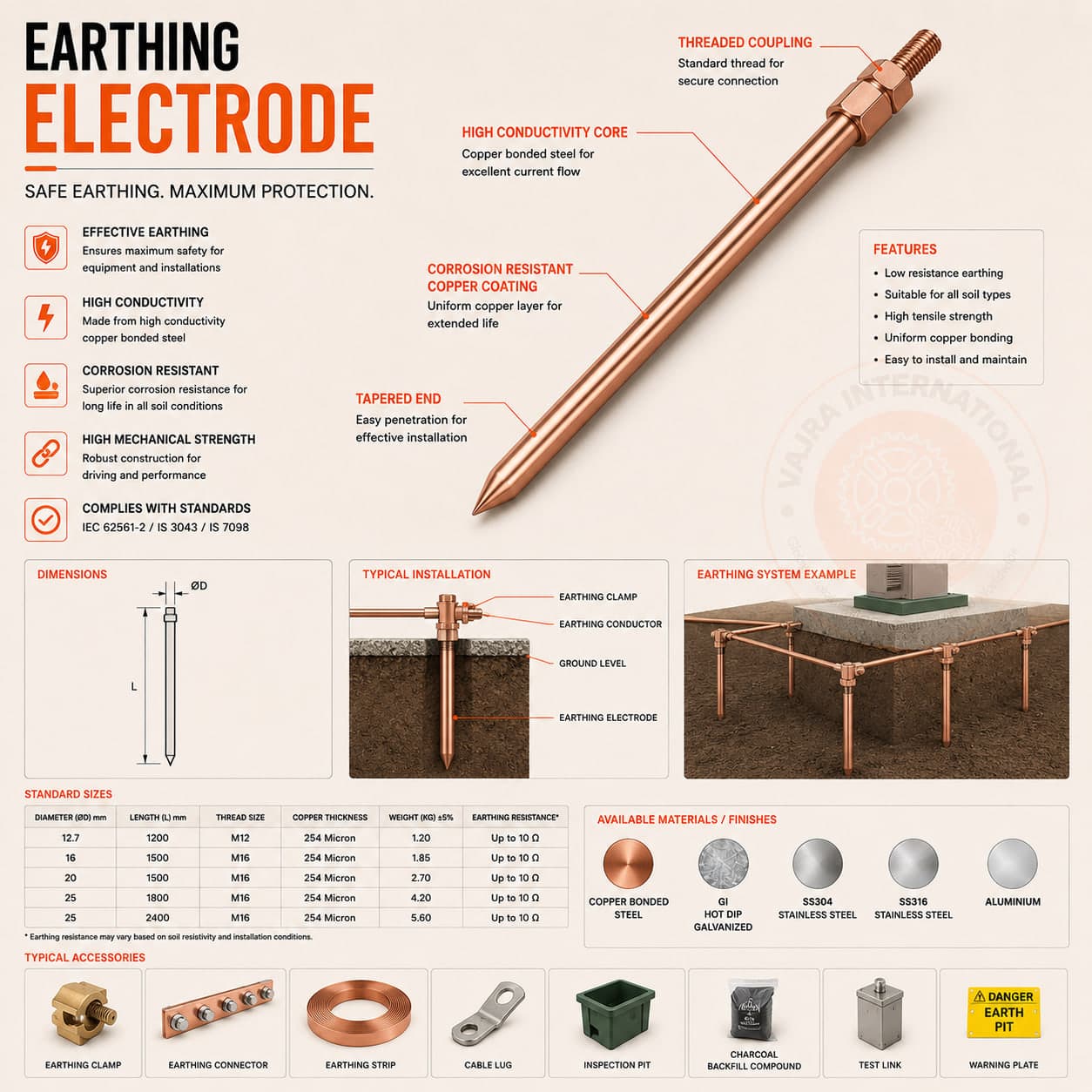
- Type A earth (rods): copper-bonded earth rods minimum 14.2 mm diameter and 1.5 m drive depth. Minimum two rods per down conductor for LPL I/II unless measured soil resistance confirms single rod achieves <10 Ω.
- Type B earth (ring electrode): 25×4 mm minimum copper flat strip or equivalent aluminium, encircling the building perimeter at ≥0.5 m depth and minimum 5 m from building face.
- Bonding at every metallic service penetration: gas pipes, water mains, cable conduit, HVAC, all must be bonded to the LPS at entry to the structure, per IEC 62305-3 Cl. 6.2.
We supply complete lightning protection material packages, air terminals, copper and GI down conductors, earth rods, bonding conductors and clamps, and prepare the IEC 62305-3 technical data sheet for authority submission. Tell us the building dimensions, LPL classification and soil resistivity estimate; we return a compliant material schedule.
We supply IEC 62305-compliant lightning protection packages with full material schedules and data sheets. Tell us your building dimensions and LPL classification to receive a compliant quote.