
We manufacture cable trays in India and we are not a neutral commentator on this question. But there are situations where Chinese-origin cable trays are the correct procurement decision, and there are situations where they are not. We will give you both sides of the comparison, because the buyer who understands the real difference makes better decisions, and better decisions eventually bring them to a manufacturer who is honest with them rather than one who tells them what they want to hear.
Price: where China wins and where it does not
On pure ex-works price for standard pre-galvanized Z275 cable trays in standard widths (100–400 mm), Chinese manufacturers in Jiangsu and Guangdong are typically 8–15% cheaper than Indian manufacturers at comparable order volumes. This is primarily a steel cost and labour cost differential. Where the gap closes or reverses: hot-dip galvanized cable trays (Indian HDG lines are well-established, competition from ISO mills is strong), stainless steel trays (Indian SS supply chain from Jindal SS and domestic rolling mills), and custom widths or non-standard finishes. On a landed cost basis at Gulf ports (adding sea freight, insurance, import duty): the price gap narrows to 3–7%. On landed cost at UK, Australian or US ports with longer transit: it narrows further, sometimes to parity or reversal.
Documentation: where India wins decisively
- MTC traceability: Indian manufacturers from SAIL, JSW, Tata and Shyam Steel coils carry EN 10204 Type 3.1 MTCs with actual heat chemistry and mechanical test values. Chinese mill certificates (often called 'quality certificates') are frequently Type 2.1 compliance statements, they state that the material meets a standard without providing actual tested values or identifying the testing lab or inspector.
- Certificate of Origin: EEPC India-issued COO is accepted without question at UAE Customs, Saudi Customs (SASO), and Australian Border Force. Chinese COO for Gulf markets frequently requires additional verification and is subject to scrutiny under anti-dumping measures in force against Chinese structural steel in several Gulf countries.
- India-UAE CEPA 0% duty: available only for Indian-origin goods with a valid P-CoO from EEPC India. Chinese-origin cable trays attract standard 5% UAE MFN duty, a 5% landed cost disadvantage on every order that Indian-origin goods avoid.
- Anti-dumping duties: the EU, UK, USA and Australia have in force, or have investigated, anti-dumping duties on certain Chinese steel products including structural steel and fittings. Indian-origin products are not subject to these measures.
Transit time: depends entirely on your destination
- UAE (Jebel Ali): India (Nhava Sheva / Kolkata) 12–16 days. China (Shanghai / Ningbo) 10–14 days. Advantage: roughly neutral.
- Philippines (Manila): India (Kolkata) 18–22 days. China (Guangzhou) 7–10 days. Advantage: China, by 10+ days. This matters for urgent projects.
- Australia (Fremantle/Perth): India (Haldia) 18–22 days. China (Shanghai) 16–20 days. Roughly neutral.
- UK (Felixstowe): India (Kolkata) 22–28 days. China (Shanghai) 25–32 days. Advantage: India.
- Nigeria (Apapa/Lagos): India (Kolkata via Suez) 17–22 days. China (Shanghai via Suez) 25–30 days. Advantage: India.
Quality at port: what buyers actually find
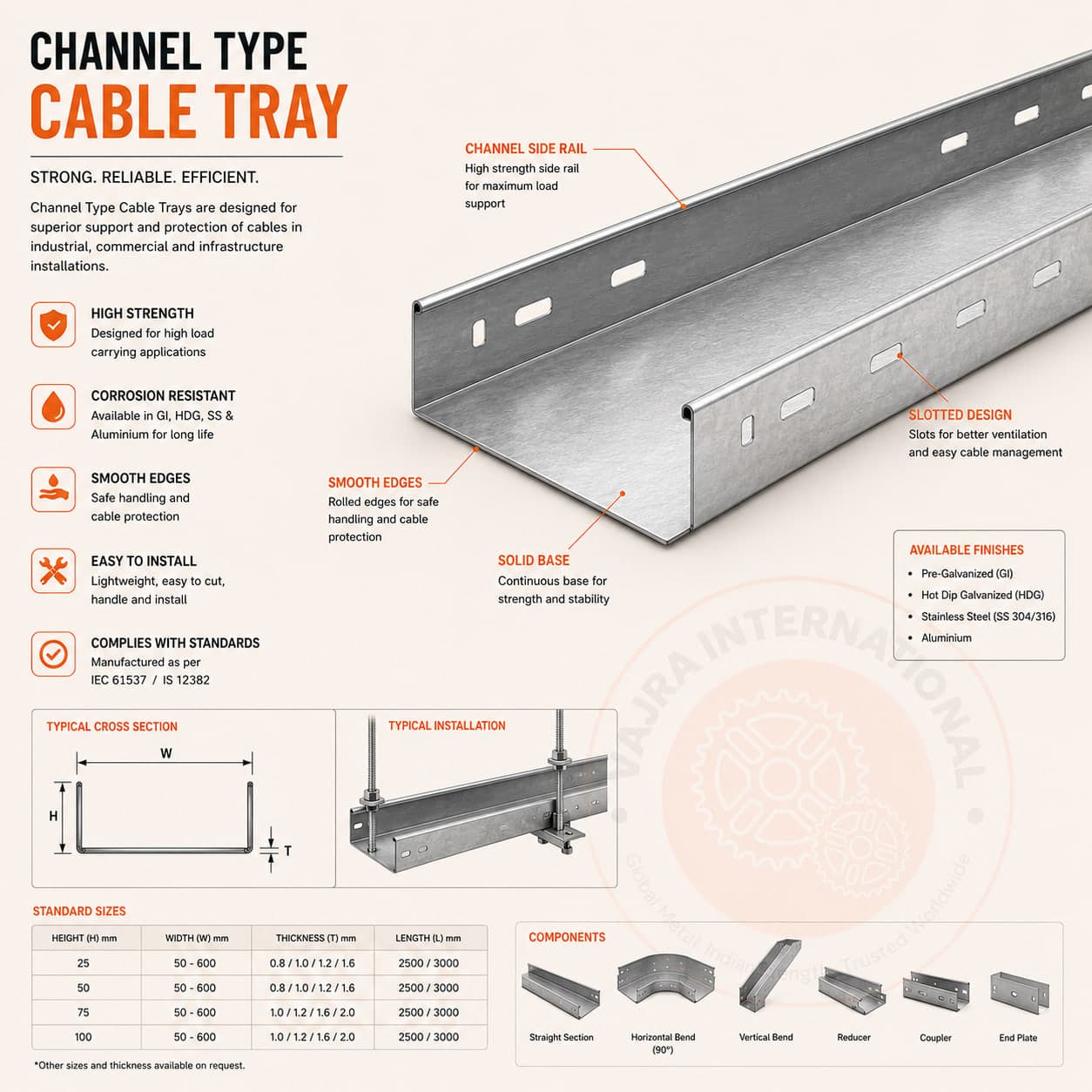
The most reliable indicator of quality-at-port is what happens after the container is opened and a third-party inspector checks the goods against the PO. Based on the experience of EPC contractors who have audited both: pre-galvanized cable tray from Chinese suppliers (without factory audit) more frequently shows sub-specification coating (Z140 delivered instead of Z275), under-gauge sheet thickness (1.2 mm delivered when 1.5 mm was specified), and missing or incorrect accessories. This is not universal, major Chinese manufacturers serving the European market directly (and subject to EU quality audits) produce to specification. The risk is higher in the mid-to-lower price tier which is often the entry point for first-time buyers. Indian manufacturers serving Gulf EPCs are more frequently audited by third-party bodies (SGS, BV, TÜV) directly at the source facility, and this audit pressure is built into the supply chain culture.
When to specify Indian origin: the decision criteria
- Project site in UAE: CEPA 0% duty + established supply corridor = India is the correct choice for nearly all cable management and earthing categories.
- Project site in Saudi Arabia, Nigeria, Kenya, Australia, UK: Indian origin is neutral-to-preferred on documentation and anti-dumping grounds.
- Project site in Philippines, Singapore, Malaysia, Vietnam: Chinese origin may offer 10–15 day transit advantage that matters on fast-track projects. For projects where lead time is not critical and documentation quality is prioritised, Indian origin remains the stronger choice.
- Project requires anti-dumping-free supply chain: India, always.
- First-time buyer, no existing inspection relationship with the Chinese factory: the audit cost and compliance risk tips the balance toward India in nearly all scenarios.
We are not the right manufacturer for every project. If you need cable trays in Manila in 8 days, we cannot help you, the transit time is against us. If you need documented, auditable, ISO 9001:2015 cable management shipped on a CEPA Preferential COO to UAE, we are the correct choice. Tell us your project details and we will tell you honestly if we can serve it.
Tell us your project: destination, quantity, timeline and specification. We'll tell you honestly if we can serve it, and if we can, we'll provide a competitive FOB/CIF quotation within 48 hours.