

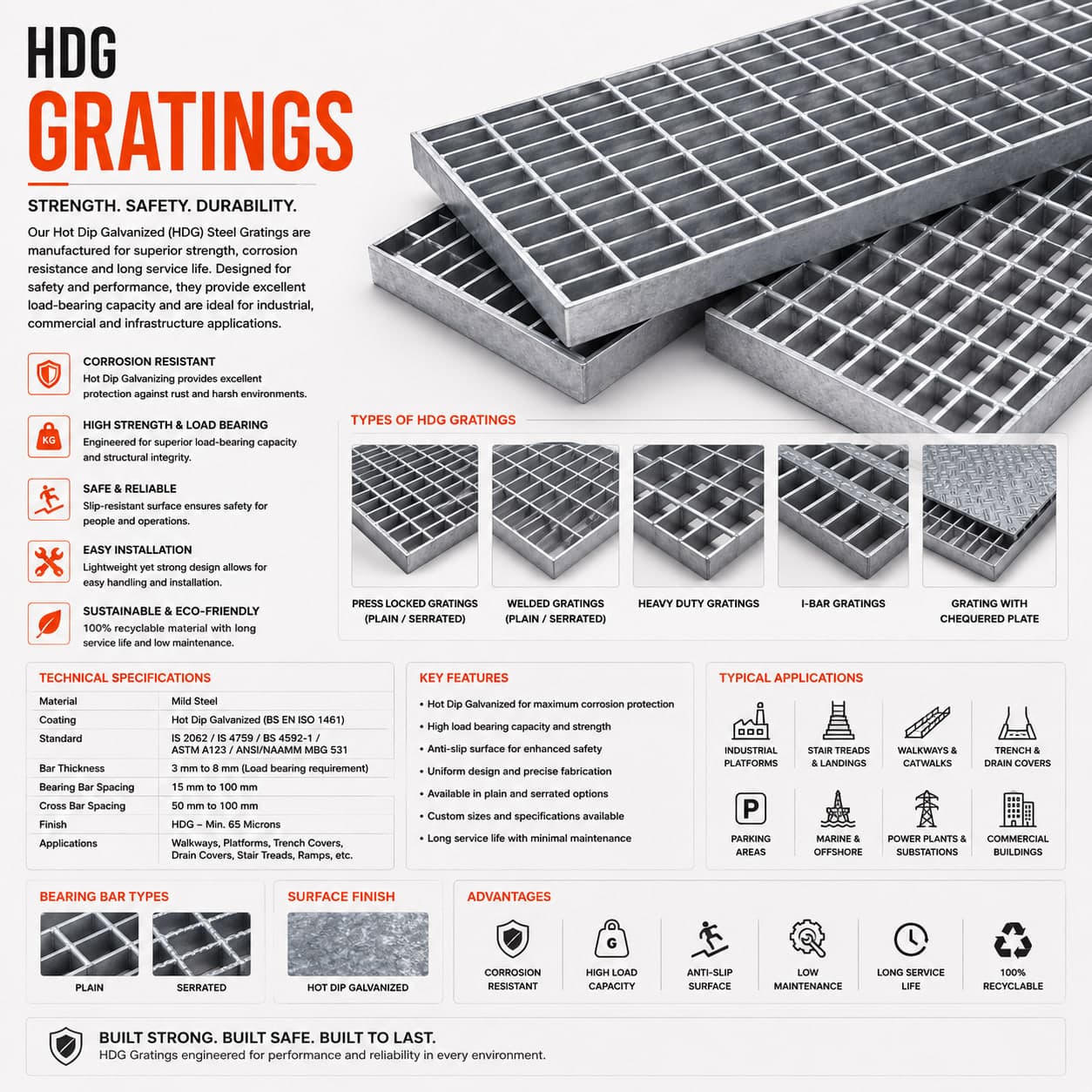
Australian mining clients typically issue the same grating specification document year after year, but sub-contractor procurement teams do not always read it carefully enough to notice what differs from a generic industrial spec. The three most common compliance failures on grating shipments to Australian mining sites: cross bar pitch is 100 mm when the site spec requires 50 mm for heel-safe certification; coating thickness report is missing from the documentation package so customs or site QC holds the container; and end-plates are not welded per drawing because no one checked the BHP or Rio Tinto standard drawing before production started. All three are avoidable if you read the specification before raising the RFQ. Here is what the spec actually says.
AS 1657, what Australia's grating standard actually requires
AS 1657 (Fixed Platforms, Walkways, Stairways and Ladders. Design, Construction and Installation) is the governing Australian standard for industrial grating used in personnel walkways and platforms. Key requirements: uniformly distributed load (UDL) design to either 2.5 kN/m² (light pedestrian) or 4.5 kN/m² (industrial walkway), with the specific design load stated in the project specification. Deflection limit: L/120 under working UDL (more permissive than BS 4592's L/200). This means Australian grating is not automatically under-designed, it follows a different deflection criterion. Maximum opening in the grating surface: 35×35 mm for heel-safe per AS 1657 Appendix A. In practice, this means a maximum cross bar pitch of 50 mm for walkways where heel-safe is specified.
ASTM A123 Grade 85, the coating requirement for Australian mining
- Most Australian mining client specifications (BHP Engineering Standard, Rio Tinto Engineering Minimum Requirements, Fortescue FMG Civil Standard) mandate HDG to ASTM A123 Grade 85 as the minimum for all external gratings and structural steel in coastal, tropical or mine-dust environments.
- ASTM A123 Grade 85 means: average zinc coating ≥ 85 µm, no individual reading below 75 µm (when measured per ASTM A123 Table 1 based on steel thickness category). This is a higher minimum than IS 4759 (which specifies 70 µm average on steel ≥3 mm).
- Third-party coating inspection: most major Australian mining site specs require a coating thickness inspection report, either XRF verification or magnetic gauge per ISO 2178, issued by a NATA-accredited or internationally recognised inspection body (SGS, Bureau Veritas, OMIC) before shipment. This is not optional: Australian border force quarantine inspection may hold containers where coating documentation is incomplete.
- Coating on cut edges: ASTM A123 requires that all fabricated items (including cut panels and notched corners) are hot-dip galvanized after cutting, not before. Cold zinc spray on cut edges after shipment is not acceptable as a substitute for post-fabrication galvanizing.
Bearing bar selection for Australian mining environments
- Pilbara iron ore sites (BHP Mount Whaleback, FMG Cloudbreak, Rio Tinto Brockman): high-dust, high-humidity cycles, strong UV. Standard specification: 32×5 mm or 38×5 mm bearing bars, 40 mm pitch, 50 mm cross bar pitch (heel-safe mandatory), HDG ASTM A123 Grade 85. Span up to 1,000 mm standard.
- Queensland coal (Bowen Basin) and LNG plant (Curtis Island, Gladstone): corrosive environments with H2S and marine atmosphere. Specify 38×5 mm or higher at 50 mm cross bar pitch. Some Shell and Santos LNG specs require SS 316L for platforms within 200 m of the marine boundary, confirm with project specification.
- Western Australian gold and lithium (Kalgoorlie, Goldfields, Greenbushes): similar to Pilbara standard. Occasional chemical spill environments may require SS 304L rather than HDG steel.
- End-plates and toe-plates: mandatory on virtually all Australian mine-site walkway gratings, end-plates prevent cable snagging, toe-plates prevent object rollover. Specify in the RFQ or they will be omitted by default.
Import duty, transit time and documentation for Australia
Australia charges zero import duty on electroforged grating panels (HS 7308.90) under the MFN tariff schedule, no FTA required. Transit time from Kolkata (Haldia Port) to Port Botany (Sydney): 24–28 days; Port of Fremantle (Perth): 18–22 days (shorter via direct service). For Western Australian mining projects: Perth-entry is significantly faster and should be specified as the destination port. Documentation required: EN 10204 Type 3.1 MTC, ASTM A123 coating inspection report (with actual measurement values per m², not a compliance statement), dimensional inspection report confirming bar section, pitch and panel dimensions, and Certificate of Origin from EEPC India or Chamber of Commerce.
We supply gratings to Australian mining specifications. ASTM A123 Grade 85 with third-party coating inspection included in the documentation package. Submit your BHP, Rio Tinto or Fortescue specification reference and we confirm compliance before production starts.
Sourcing electroforged gratings for Australian mining? We supply ASTM A123 Grade 85 HDG with third-party coating inspection and SGS/BV inspection reports available on request.