

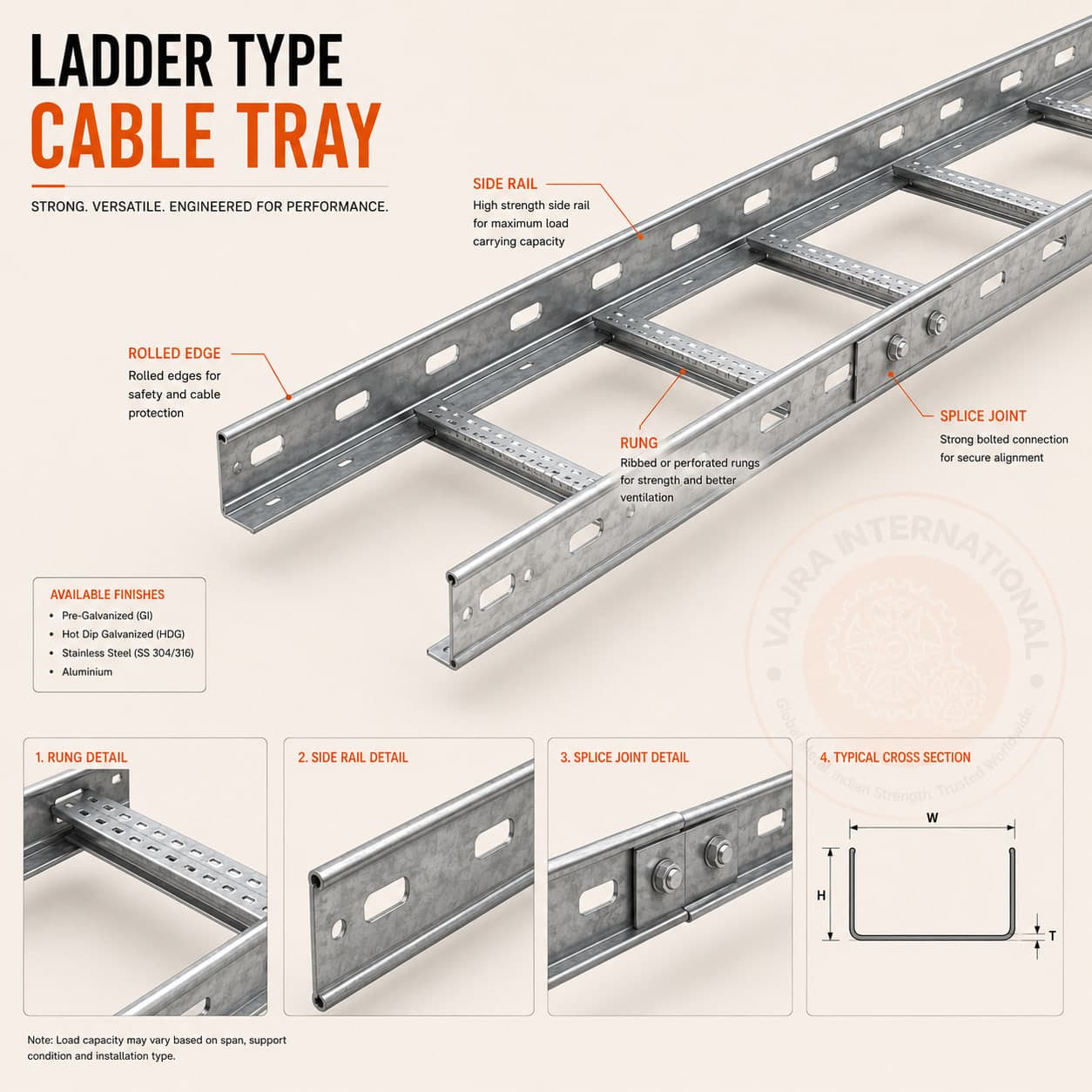
A project manager for a floating storage and offloading vessel refit in the Bombay High once described GI cable trays as 'the most expensive cheap decision the original project team made.' The vessel had been specified with hot-dip galvanized trays throughout, because the original designers did not categorise the exposure environment and GI was cheaper. Within four years, the marine atmosphere (salt spray, humidity, intermittent hydrogen sulphide from crude) had corroded through the zinc coating on the upper-deck trays. Every piece had to be replaced during scheduled dry-dock. The replacement cost was seven times the original tray cost. On an offshore or coastal project, specifying the wrong material is not a budget decision. It is a maintenance liability that gets paid back with interest.
Start with the corrosion category
Before selecting a material, establish the corrosion category of the installation zone using ISO 9223. The standard classifies atmospheric corrosion into C1 (very low, dry interiors) through C5 (very high, industrial marine) and CX (extreme, offshore). The corrosion rate of zinc in a C5-M marine environment is 4 to 8 µm per year. A hot-dip galvanized section with 85 µm zinc (the IS 4759 minimum for structural sections) will deplete in 10 to 21 years under average atmospheric exposure. In the splash zone, alternately wetted and dried by seawater, the depletion rate is three to five times faster (zinc life of 2 to 5 years is realistic, not pessimistic.
- Splash zone (alternately wetted and dried by sea spray): worst environment for zinc. Specify stainless or FRP, not GI.
- Open deck, exposed but not splash zone (C5-M): HDG zinc life approximately 10 to 15 years. Acceptable for secondary structural members with planned replacement programmes, but not for cable trays where a mid-life failure means cable damage.
- Enclosed switchroom, air-conditioned and positively pressured (C1 to C2): GI is fully adequate here.
- Below-deck machinery spaces with oil mist and warm humidity (C3 to C4): GI is borderline. Stainless is preferred for cable management where access for replacement is difficult.
SS 304: the indoor grade that fails offshore
Stainless 304 (18% Cr, 8% Ni) is the workhorse grade for food processing, pharmaceutical and indoor corrosive environments. In chloride-rich environments it is the wrong choice. Corrosion resistance in stainless steel depends on the passive chromium oxide film that forms on the surface. Chloride ions attack this film at microscopic defects) pits, scratches, crevices. Once a pit starts in SS 304, the pit chemistry creates an oxygen-depleted, low-pH zone that sustains continued attack. The pit grows until it perforates the section.
We have supplied replacement trays to a coastal fertiliser plant in Visakhapatnam where original SS 304 cable trays had been installed. The plant sits 400 metres from the Bay of Bengal. At 18 months after installation, the 304 trays showed visible pitting along the flange edges, in the riveted joints, and anywhere chloride-laden moisture had sat. The procurement team had chosen 304 because it was cheaper than 316L and assumed stainless was stainless. It is not.
SS 316L: why the molybdenum matters
The difference between 304 and 316L is 2 to 3% molybdenum. Molybdenum stabilises the passive film against chloride attack. Engineers use PREN (Pitting Resistance Equivalent Number) to compare grades numerically:
- PREN = %Cr + 3.3 x %Mo + 16 x %N
- SS 304: PREN approximately 18 to 20
- SS 316L: PREN approximately 24 to 26
- Duplex 2205 (UNS S32205): PREN approximately 34 to 36
For offshore cable trays in atmospheric and splash zone service, PREN above 25 is the practical minimum. SS 316L just clears this. The 'L' (low carbon) designation, maximum 0.03% carbon, prevents sensitisation during welding. Standard 316 without the L suffix can precipitate chromium carbides at weld heat-affected zones, reducing local corrosion resistance. For cable trays where site welding or site modification is possible, always specify 316L.
FRP cable trays: the third option for chemical environments
Fibreglass reinforced plastic cable trays are used offshore and in chemical plants where both corrosion and weight are concerns. FRP does not corrode, does not conduct electricity, and weighs roughly one-third of equivalent steel. The trade-offs: FRP cannot be site-cut cleanly without proper tooling and dust extraction, load capacity per unit width is lower than steel, and some resin systems degrade under UV unless UV stabilisers are specified. For cable management in hydrocarbon chemical service below deck on offshore vessels, FRP is often the best choice. For earthing-sensitive installations, a separate earthing conductor must run alongside because FRP is non-conductive.
Quick selection guide
- Enclosed switchroom, air-conditioned: HDG GI cable tray.
- Enclosed switchroom, non-air-conditioned, coastal location: SS 316L.
- Open deck, more than 500 m from the sea, inland industrial (C3 to C4): HDG with periodic inspection programme.
- Open deck, within 500 m of the sea or on an offshore platform: SS 316L.
- Splash zone: SS 316L or FRP. Never GI.
- Chemical plant with HCl, HF or halide acid contact: FRP only.
- Submerged or continuous seawater contact: FRP or duplex stainless 2205.
The incremental cost of specifying 316L over GI cable trays is roughly 30 to 40% on material. The cost of replacing corroded trays on an offshore platform mid-contract is ten to twenty times that. The selection decision is straightforward when you frame it that way.
Vajra International supplies SS 316L, SS 304 and HDG cable tray systems from Howrah for offshore, marine and corrosive industrial environments. All orders supplied with MTC, NABL test reports and TPI coordination.