

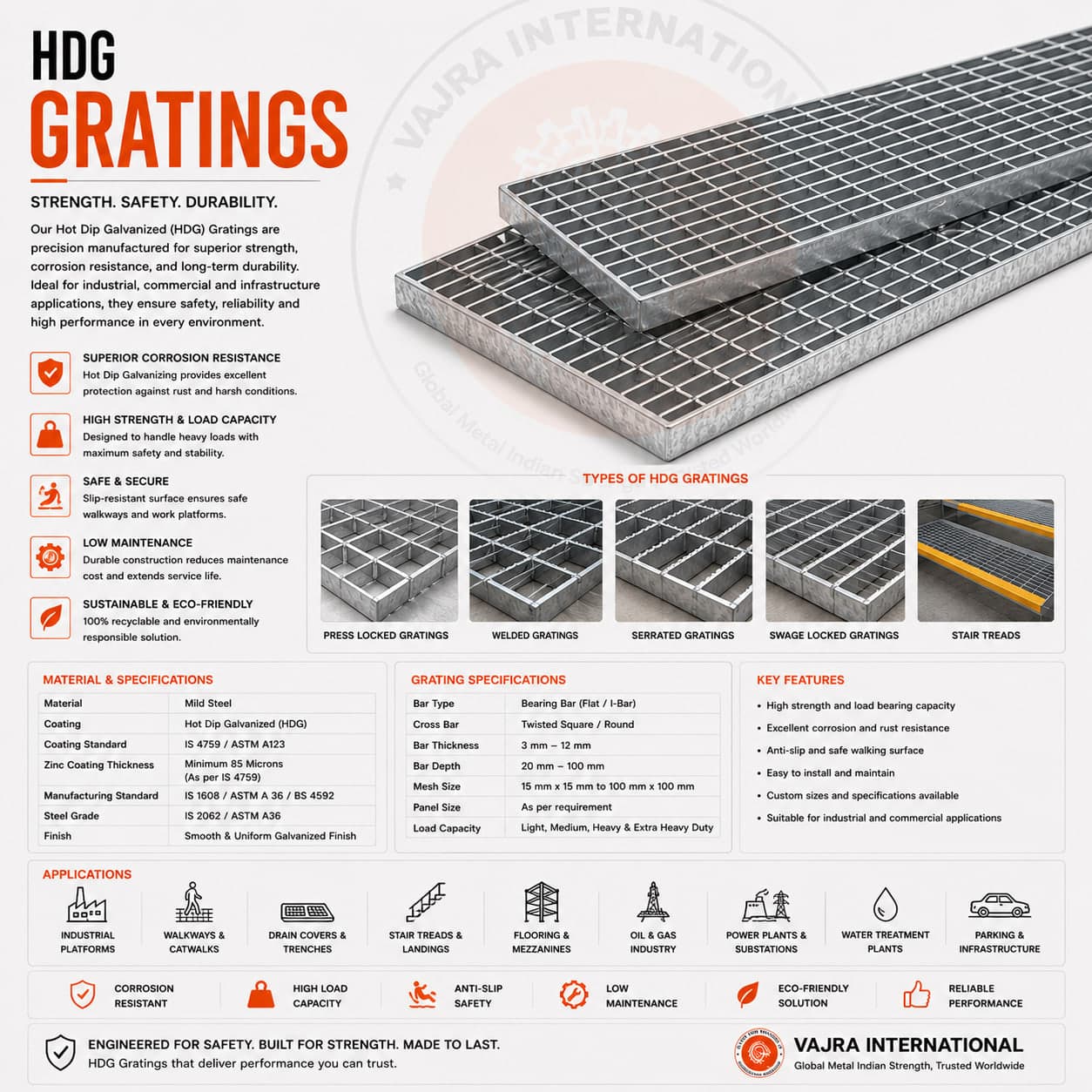
Gratings look deceptively simple: steel bars welded in a grid. But the specification decisions that seem minor at the enquiry stage (bearing bar depth, mesh opening, surface type, coating) have direct safety consequences in a refinery or chemical plant. A grating that deflects too much under dynamic load creates a trip hazard. One with an opening too large lets tools fall onto live pipework below. One with the wrong coating in a hydrogen sulphide environment can corrode through in two years and need replacement during a shutdown window that was supposed to be for something else entirely.
The questions we ask on every refinery grating order: What is the design live load? What is the span between support beams? Is there risk of objects falling onto equipment or people below? What is the chemical exposure? And does the project reference IS 5512, BS 4592, or both?
The two standards: IS 5512 and BS 4592
IS 5512:1969 (with amendments) covers steel bar gratings for industrial platforms, walkways and stair treads. It specifies bearing bar dimensions, cross rod pitch, panel dimensions and tolerances. Most Indian oil and gas projects reference IS 5512.
BS 4592 is a multi-part British standard: Part 0 covers general requirements, Part 1 covers steel, Part 3 covers aluminium, Part 5 covers FRP. For Middle East, UK, and Australian refinery projects with British or European engineering contractors, BS 4592 is the standard you will see in the structural specification. The load tables, test methods and some dimension conventions differ between IS 5512 and BS 4592, so confirm the reference before ordering. A panel supplied to IS 5512 dimensions may not fit the same frame as a BS 4592 panel without adjustment.
Load tables and bearing bar selection
The bearing bar is the main structural element running in the span direction. Selecting the right bearing bar depth requires knowing four things:
- Span: the centre-to-centre distance between the supporting steel beams. Typical refinery walkway spans are 600, 750, 800 or 1000 mm. Longer spans need deeper bearing bars to control deflection.
- Design live load: 5 kPa is the standard for refinery personnel walkways and process plant access platforms. 7.5 or 10 kPa is specified where mechanical equipment or wheeled vehicles access the platform.
- Deflection limit: IS 5512 and BS 4592 both use a span/200 limit under full design load. At a 1000 mm span, this means maximum 5 mm deflection.
- Bearing bar depth: 25 mm depth handles up to 600 mm span at 5 kPa. 30 mm handles 750 mm. 40 mm handles 1000 mm at 5 kPa. 50 mm and 65 mm are for heavy-duty and long-span applications. Always cross-check with the supplier's published load-span table for the specific grating series.
One catch: load tables in catalogues cover uniformly distributed loads. If there is a concentrated load on the platform (a pump, a valve handwheel stand, a fire extinguisher bracket) that needs a separate calculation. Mention it at the enquiry stage.
Mesh opening size: the fall-through question
Standard IS 5512 mesh opening is 41 x 100 mm (41 mm transverse pitch, 100 mm in the bearing bar direction). At this opening, a standard socket wrench can fall through. For refinery platforms above live pipe racks, operating areas, or any zone with personnel below, specify tighter mesh: 30 mm or 25 mm transverse pitch. BS 4592 Part 1 and most project safety specifications set a maximum 30 x 30 mm opening in areas where falling objects are a hazard to equipment or people below. The 41 mm standard opening is only acceptable where nothing of consequence is directly below.
Surface type: serrated vs plain bar top
- Serrated bearing bar: the top edge is notched at 25 mm intervals with a saw-tooth profile. These notches break up liquid films and provide grip on wet, oily or contaminated surfaces. BS 4592 Part 1 requires serrated bars in areas with spillage risk. This is the default for any outdoor or process area walkway.
- Plain bar top: acceptable for dry indoor areas with no contamination risk, such as electrical switchroom floors. Sometimes specified where the flat surface makes cable routing beneath the grating easier.
- Pressure-locked construction: cross rods are swaged into punched slots in the bearing bars rather than welded at intersections. Gives a flatter top surface than welded grating and marginally higher load capacity. Common in high-end offshore and petrochemical project specifications.
Coating for refinery and chemical environments
Standard hot-dip galvanizing at 610 g/m2 (85 µm minimum per IS 2629 and ASTM A123) is adequate for most onshore refinery walkways and platforms in C3 to C4 corrosion categories. For more aggressive environments:
- Epoxy or polyester powder coat over HDG: where colour coding of areas is required or where additional chemical resistance is specified. Typical 60 to 80 µm dry film thickness over the existing zinc.
- Stainless steel 316L: for gratings in direct contact with process chemical splash, marine splash zone, or pharmaceutical/food-grade environments where zinc contamination is not acceptable.
- FRP (GRP) gratings: for areas with hydrochloric acid, hydrofluoric acid, caustic soda, or chlorine service. FRP does not corrode and weighs roughly one-third of equivalent steel. Load capacity is lower than steel, typically 3.5 to 5 kPa depending on panel span and resin system.
What a complete supply package includes
For refinery projects, the supply package should include: fabrication drawings with panel dimensions and bearing bar direction clearly marked, load-span tables for the specific series supplied, EN 10204 Type 3.1 MTC for the steel, HDG inspection report per IS 4759 or ASTM A123 with coating weight readings, and a Certificate of Origin for export orders. If the grating goes into a fired-heater area or a PESO-classified zone, some buyers include PESO compliance documentation in the supply scope (confirm this at enquiry, not at delivery.
The specification document we always look at first is the safety area classification of the platform. A primary egress walkway in a refinery does not get the same bearing bar as an access walkway to a rarely-visited vessel manway. If the supplier does not ask, you should be asking them.
Vajra International supplies IS 5512 and BS 4592 hot-dip galvanized and stainless steel floor gratings from Howrah: plain and serrated bar, standard and close-mesh, with full MTC, HDG reports and export documentation.