

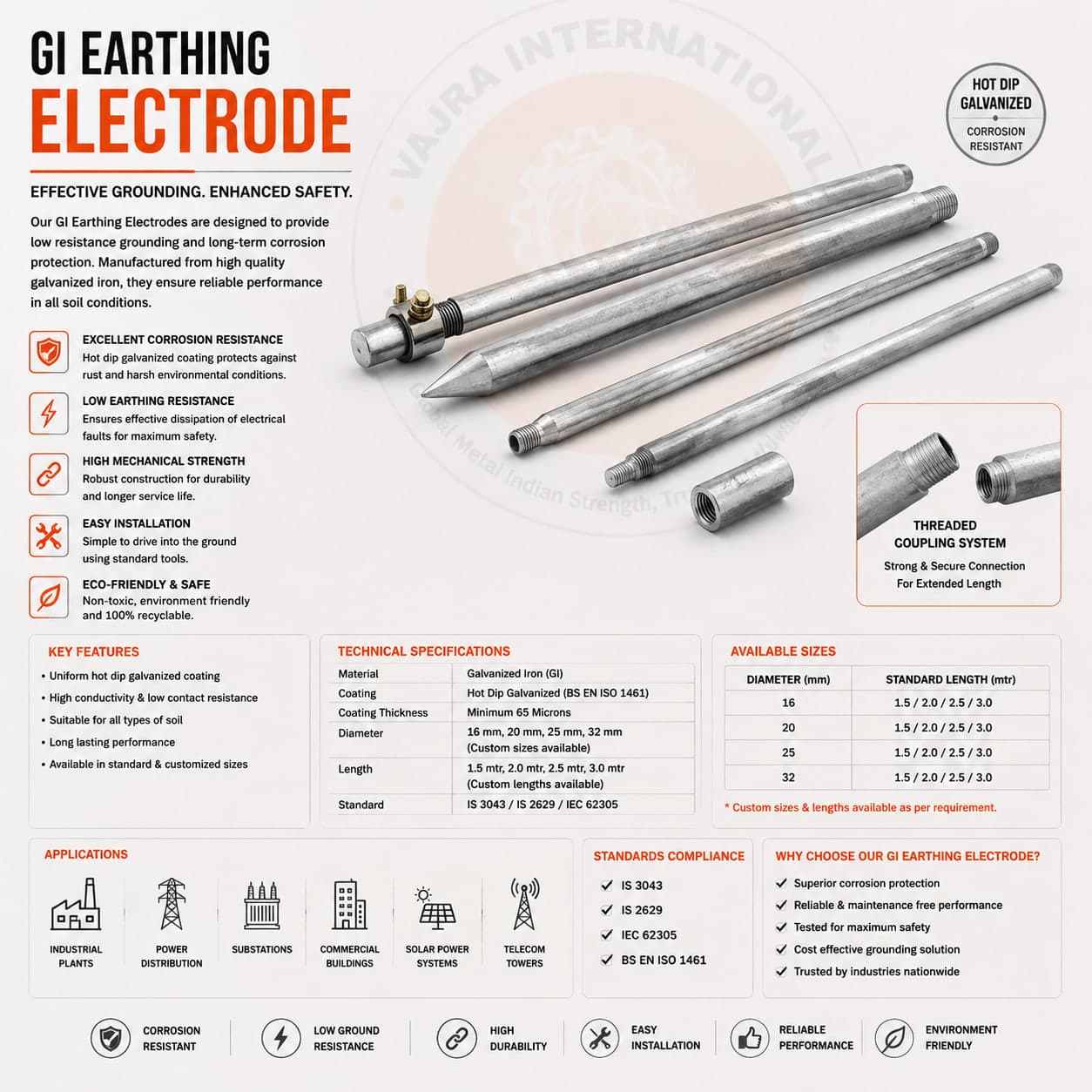
Every earthing project needs to pick one of three IS 3043 electrode types, plate, pipe or driven rod. The choice is often made by habit (we always use pipes), by default (the consultant's standard drawing calls for rods), or by cost (plates are cheapest per electrode). All three are wrong approaches. IS 3043 Clause 4 gives you the framework to make this decision correctly, and the inputs it needs, soil resistivity, site geometry, maintenance plan, fault current, are the same information your MEP engineer should have before commissioning anyway.
What IS 3043 Clause 4 actually specifies for each electrode type
Clause 4.2 covers plate electrodes: minimum 600×600 mm, with 3 mm thickness for copper plates or 6 mm for GI plates. Burial depth is 3.0–3.5 m in a pit with a 600 mm clear bore, backfilled with soil-resistivity-lowering material (salt-and-charcoal per IS 3043 Annex A, or bentonite GEM for GCC projects). The standard requires the plate terminal to be accessible from grade level for resistance measurement and maintenance. Clause 4.3 covers pipe electrodes: minimum 38 mm NB bore (50 mm NB is the working standard), 4–5 mm wall thickness, minimum 2.5 m depth, inner perforated pipe for the watering column, and hot-dip galvanizing per IS 4759. Clause 4.4 covers rod electrodes: metallic, vertical drive, minimum cross-section sufficient to carry the prospective earth fault current without overheating, top accessible in an inspection chamber. IS 3043 does not set a minimum copper-coating thickness for copper-bonded rods, that comes from IEC 62561-2, which specifies 250 µm minimum for Class H rods. That cross-reference is not optional; it is where the corrosion resistance of the rod is actually defined.
Soil and site: the two variables that end the argument
Soil resistivity determines how many electrodes you need and how deep they must go. Site geometry determines which electrode type can physically get to the required depth. Between the two, the choice is usually made without further analysis.
- Soft loamy soil, wide-open site (agricultural, greenfield substation, rural solar): all three electrode types work. Plates give the most surface area per pit, one well-installed plate at 3.5 m depth will typically give 1.5–3 Ω in 100 Ω·m soil. Pipes give slightly more resistance per electrode but require a narrower pit. Driven rods are feasible but need 3+ metres of depth to match plate and pipe performance in soft soil. Cost per electrode usually makes plates or pipes the working choice here.
- Hard compacted or gravelly soil, constrained urban site: plates are eliminated first, you cannot easily excavate a 600 mm wide pit to 3 m depth in paved or hard-standing sites. Pipe electrodes need a rotary-hammer core to 300 mm, still impractical in some urban locations. Driven rods require no excavation at all, they are the default for hard or constrained sites. 17.2 mm diameter rods handle driving in compacted soil and gravelly fill without bending.
- Basalt rock or laterite (Bangalore Electronic City, Whitefield, Pune Chakan): plates and pipes are impractical, you cannot excavate or bore in basalt without diamond-core drilling at project-stopping cost. Driven rods enter basalt only if the rock is fractured or the surface is thick residual soil over rock, below rock the rod stops. In solid basalt, the correct specification is a deep-bore ground rod system using pneumatic percussive driving until the rod hits refusal, combined with a soil-resistance augmentation compound injected into the bore annulus. Most Bangalore data centre earthing grids use arrays of 17.2 mm × 3 m copper-bonded rods in residual laterite above the basalt, at high density (4–6 rods per earth pit) to hit the ≤1 Ω target needed for signal-reference grounding.
- Sandy coastal soil, low resistivity (Chennai port zone, Kochi, Goa): resistance is already low, even a single 3 m pipe or rod often achieves 2–4 Ω without elaborate backfill. Depth and density is not the challenge; long-term stability is. Sandy coastal soil erodes around electrodes, and the electrode needs to remain in firm soil contact for 20+ years. Pipe electrodes with bentonite backfill perform better than plates (which lose soil contact as sand compacts away from the plate face) or rods (which can work loose in mobile sand). Chennai refinery and port projects use 50 mm NB pipe electrodes at 3 m depth as the standard.
- High-resistivity black cotton or red cotton soil (Ahmedabad, Vadodara, interior Maharashtra): reaching <1 Ω is difficult regardless of electrode type, resistivity above 200 Ω·m forces either very deep driving (4.5–6 m) or multiple electrodes in parallel. Driven rods to 4.5 m depth in coupled sections outperform plates at the same depth because they penetrate deeper strata where resistivity is lower. Multiple rods in a triangular or square array, bonded by a buried strip conductor, is the standard design for Ahmedabad chemical plant earthing.
Maintenance: the factor that eliminates plates and pipes from certain applications
Both plate and pipe electrodes require periodic watering to maintain soil moisture around the electrode. IS 3043 recommends watering once a month in summer (March–June), without it, soil dries out and resistivity rises, pulling the installed resistance above the ≤1 Ω target. This maintenance requirement is manageable at a staffed industrial plant with a maintenance department and a procedure. It is not manageable at a telecom tower in a remote field, a highway substation in Rajasthan, a solar plant in Gujarat, or a temporary site. Driven rods need no watering, no pit entry, and no seasonal maintenance, the copper-bonded rod's corrosion resistance comes from the copper bond, not from keeping the surrounding soil wet. For any project where the maintenance regime cannot be guaranteed, driven rods are the operationally correct choice. The entire Indian telecom tower fleet uses driven rod earthing for this reason.
What city-specific projects are actually specifying right now
Bangalore data centres at Electronic City and Whitefield (CtrlS, Yotta, NxtGen, GPX) specify copper-bonded rods, 17.2 mm × 3 m, array grids of 6–12 rods per earth point, because the basalt or laterite soil makes plates and pipes impractical and the per-pit resistance target (≤1 Ω for signal reference ground) demands density, not depth. Hyderabad pharma API areas (Divi's, Dr Reddy's, Aurobindo process blocks) specify copper plates at every transformer body and neutral point. GMP audit documentation requires stated corrosion resistance, and copper plates meet it without ambiguity. Chennai port and IOCL refinery projects specify 50 mm NB GI pipe electrodes at 3.0 m depth, the sandy coastal soil gives low resistivity and pipes are accessible for annual resistance tests required by the refinery's electrical safety plan. Rajasthan solar plants (100+ MW sites in Jaisalmer, Jodhpur) are the largest volume user of driven rods. 2,000 to 4,000 rods per plant in red sandy soil at 3.0 m depth, bonded by 25×3 mm GI strip grid, drives the earthing design because the soil is high-resistivity and no maintenance is planned for 25 years.
What to put on the purchase order, the five specification lines that matter
- Electrode type and IS 3043 clause reference (e.g., 'Pipe electrode per IS 3043 Cl. 4.3, 50 mm NB, 4 mm wall, 3.0 m length, HDG per ASTM A123 85 µm minimum'). A generic 'IS 3043 earthing electrode' PO line leaves the supplier free to send the cheapest variant.
- Material and surface treatment: copper plate (IS 1897) or GI plate (IS 2062 + IS 4759); GI pipe (IS 3589 + IS 4759) or copper-bonded rod (IEC 62561-2 Class H, 250 µm copper bond). State the standard and minimum thickness, not just 'as applicable'.
- MTC requirement: IS 3043 projects within India need IS-standard material certificates; export projects (Saudi, UAE, Kenya) need IEC 62561-2 certificates and SASO/ESMA conformity declarations. State the standard on the PO so the MTC arrives with the shipment, not months later.
- Pit kit scope: whether you need the electrode only, or the complete pit kit (electrode + watering pipe + backfill compound + inspection chamber + terminal lug). Ordering the electrode and sourcing accessories separately is the most common cause of site installation delay.
- Test report: IS 3043 Cl. 5.3 requires a measured resistance value of <1 Ω at commissioning. State that the supplier must include the fall-of-potential test procedure sheet and a blank commissioning certificate in every shipment, this prevents the on-site discovery that no one knows how to conduct the test.
The cheapest earthing electrode is the one that hits the IS 3043 ≤1 Ω target with the fewest units in the ground, stays there for the design life without maintenance failures, and comes with a complete document pack that satisfies TPI at commissioning. In Bangalore basalt, that electrode is a driven copper-bonded rod at 3 m. In Chennai coastal sand, that electrode is a GI pipe at 3 m. In a Hyderabad pharma API area, it is a copper plate. The soil and the site make the decision, the IS 3043 clause gives you the framework to read them correctly.
Need IS 3043 earthing plates, GI pipe electrodes or copper-bonded earth rods with complete pit kits and documentation? We manufacture and export all three from our Howrah facility, with soil-matched sizing guidance included with each quotation.