

DC string earthing in a utility-scale solar farm is a separate design problem from the AC earthing of the distribution transformer, and confusing them is the most common cause of ground fault relay misoperation in inverter systems. In a transformer-isolated string inverter system, the DC string floats relative to earth, neither terminal is intentionally grounded during normal operation. In a central inverter system, the DC bus may be mid-point grounded through the inverter design. These two architectures produce completely different fault current paths, different touch potential profiles, and different earthing electrode requirements. The design approach that is correct for one is wrong for the other.
DC earthing architecture: string inverters vs central inverters
String inverters (common in rooftop and commercial C&I solar, and in distributed utility-scale): typically ungrounded DC input, the string's positive and negative terminals float relative to earth during normal operation. Ground faults on the DC string produce a fault current path through the module frame and mounting structure to the earthing system, detected by the inverter's ground fault detection circuit (GFDI) or isolation resistance monitor (IRM). The earthing design objective for string inverter systems is: provide a low-impedance fault current return path from any point in the string to the inverter's GFDI, while maintaining the required touch potential limits per IEC 62305 and IEC 60364-4-41.
What IEC 62446-1 requires, the commissioning and documentation standard
- IEC 62446-1 (Grid Connected PV Systems. Minimum Requirements for System Documentation, Commissioning Tests and Inspection) requires: earth continuity verification between all metal parts (module frames, mounting structures, cable management, inverter enclosures). Minimum test: visual inspection plus continuity test between module frame and main earthing terminal using a ≤200 mA test current, resistance must be below the limit specified in IEC 60364-6.
- Insulation resistance test: DC string must be isolated from earth and tested for insulation resistance before first energisation. Minimum 1 MΩ per IEC 62446-1 Table B.1 for systems <1000V DC.
- Earth electrode resistance measurement: measured with fall-of-potential method or clamp meter. The target is project-specific, but the Specific Earthing Resistance (SER) required by the grid operator for the DNO connection is typically <1 Ω for substations and <10 Ω for inverter station earthing.
- Anti-islanding earthing requirement: for systems connected to the public grid, the inverter must incorporate an anti-islanding protection mechanism. The earthing design must not create any reference that allows the system to sustain an unintended island, this affects whether a solid neutral earth is required at the transformer secondary.
Lightning protection for a solar farm, design principles
A 50-hectare solar farm has no natural earth points distributed across the array, the only earthing is the earthing grid under and around the inverter station, supplemented by earth stakes at the array perimeter. Lightning protection design per IEC 62305-3 for a ground-mount solar farm requires: (1) Earth termination type B ring electrode around the inverter station and transformer enclosure. (2) Equipotential bonding of all module frames and mounting structures to the ring electrode via the earthing grid conductors running along the cable management below the arrays. (3) Surge protection devices (SPD) per IEC 61643-11 on the DC string input to every inverter, and on the AC output connection. (4) If overhead lightning protection masts are used (to protect inverter stations): LPL II rolling sphere analysis per IEC 62305-3, with down conductors to the ring electrode and separation distance to the PV cable management confirmed per IEC 62305-3 Cl. 6.3.
Earthing electrode specification for solar farms
- Array earthing grid: 25×4 mm GI flat strip (or 50 mm² bare copper conductor for coastal / corrosive environments) laid horizontally at 0.5 m depth along the array cable management routes. Connected to each row mounting structure at ≤30 m intervals.
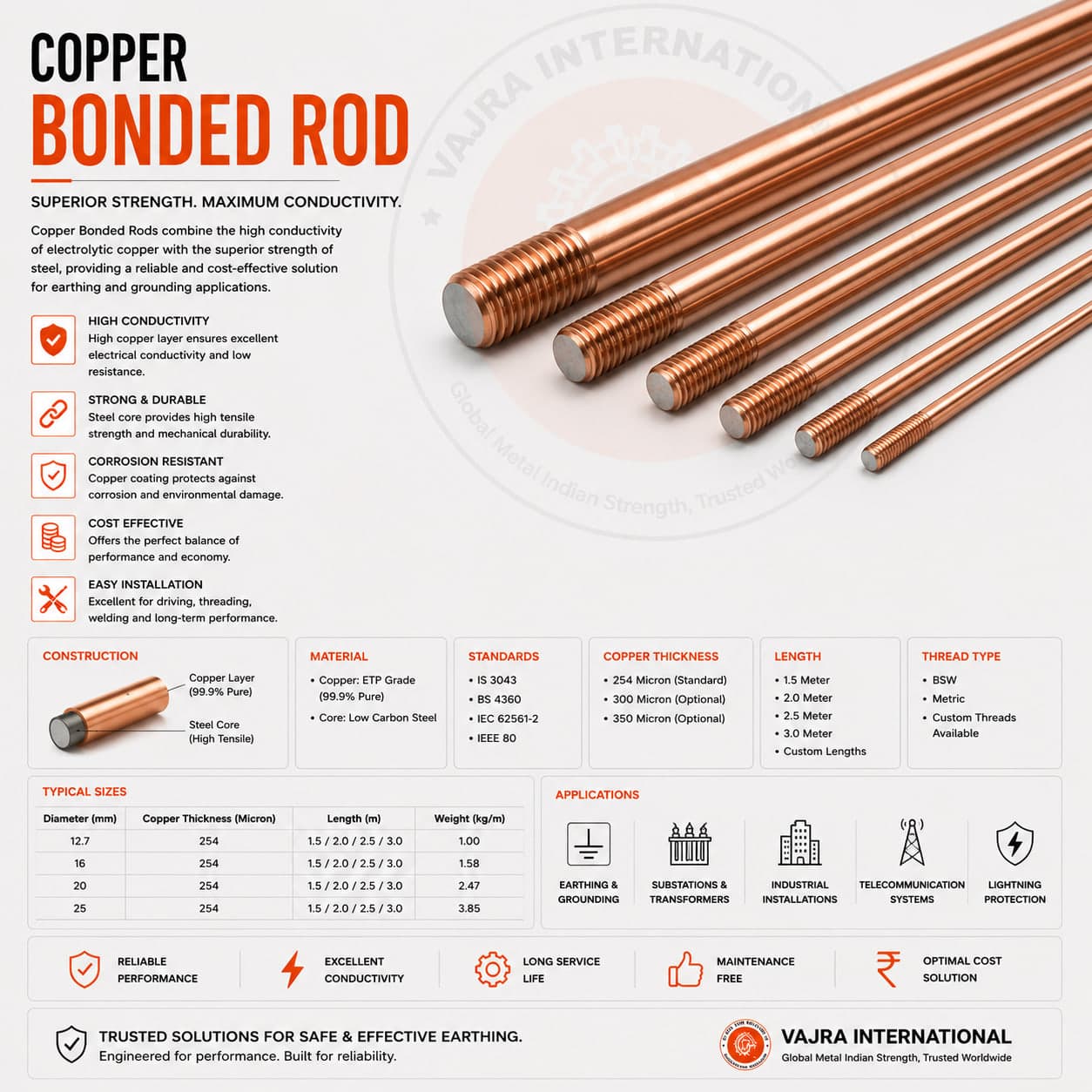
- Inverter station earthing: Type B ring electrode. 25×4 mm copper strip at 0.5 m depth, minimum 5 m from the inverter building perimeter. Earth rods at each corner of the ring: minimum 14.2 mm × 3 m copper-bonded rods.
- Substation earthing: per IEC 61936-1 (Power Installations Exceeding 1 kV AC), step and touch potential calculations required for the HV/MV transformer yard. The earthing resistance here is typically specified by the grid operator in the G99/GC0014 or equivalent connection agreement.
- Material selection: GI flat strip is the cost-effective standard for most inland solar farm applications. Copper-bonded rods and copper strip should be specified for: coastal sites within 5 km of the sea, sites with soil resistivity >200 Ω·m (high resistivity soils such as sandy desert require driven copper-bonded rods and potentially bentonite compound fill), and sites with aggressive soil chemistry (pH <4 or >9).
We supply complete solar farm earthing packages. GI and copper flat strip, copper-bonded earth rods, earthing clamps, bonding conductors and surge protection device (SPD) base plates. For utility-scale projects, we supply as a kit against your BOM or lay-out drawing, with COO and MTC included.
We supply IEC 62446-compliant solar farm earthing packages against your BOM or lay-out drawing. GI strip, copper-bonded rods, clamps and SPD base plates with MTC and COO included.