Most earthing manufacturers will not tell you when GI is the correct choice over copper because copper is more profitable to sell. Here is the honest answer: a copper-bonded earth rod costs 8–12× a GI earth pipe of equivalent drive depth, and in the majority of Indian and Gulf project soil conditions, pH 6–8, resistivity 50–200 Ω·m, moderate chloride, GI meets the IS 3043 service life requirement without compromise. On a 100-electrode earthing grid, specifying copper over GI when GI is adequate adds substantial cost for no engineering benefit. Understanding the three specific conditions where copper genuinely outperforms GI is what makes this a specification decision rather than a habit.
The electrochemical reality of zinc vs copper corrosion in soil
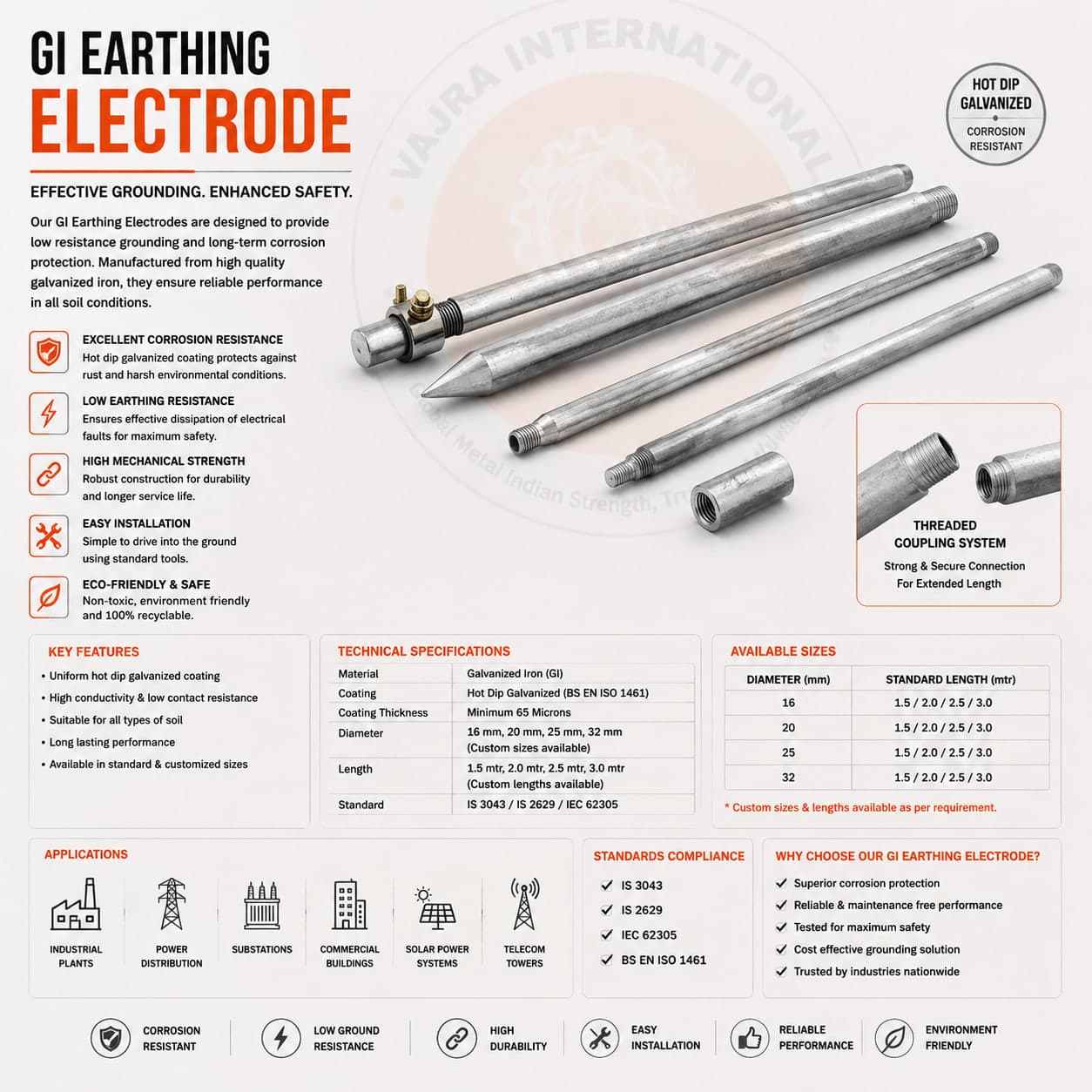
Galvanized iron (GI) earthing relies on the zinc coating as a sacrificial anode, zinc corrodes preferentially to the steel core. In standard Indian soil conditions (pH 6–8, resistivity 50–200 Ω·m, moderate chloride content), a hot-dip galvanized earth pipe (85 µm zinc coating) typically achieves 15–25 years of service before the zinc is consumed and steel corrosion begins. IS 3043 Annex D gives soil corrosivity classification, a Type C3 or higher soil (pH <5 or >9, high chloride, high sulphate, marshy or waterlogged) will reduce zinc life to 5–10 years. Copper has essentially unlimited life in soil corrosion, its corrosion rate in typical soil is 0.001–0.002 mm/year. In a C3 soil environment, the service life comparison reverses dramatically: GI fails in under 10 years; copper remains serviceable for 50+ years.
IS 3043 electrode requirements, what the standard actually specifies
- GI earth pipe (IS 3043 Cl. 8.2.2): minimum 40 mm nominal bore, 2.5 mm wall thickness. Hot-dip galvanized per IS 4736. Length minimum 2.5 m. Suitable for moderate soil conditions (Type C1/C2 per IS 3043).
- GI earth plate (IS 3043 Cl. 8.1): 600×600 mm minimum, 6 mm minimum thickness, HDG. Depth minimum 3 m below surface. Effective in waterlogged soils where driven rods cannot achieve sufficient depth.
- Copper-bonded earth rod (IS 3043 Cl. 8.2.3): 14.2 mm or 17.2 mm diameter, minimum 0.25 mm electrolytic copper bond (99.9% Cu purity). Drive depth 1.5–6 m in sections. Suitable for all soil types including C3 and C4 corrosive classifications.
- Solid copper conductor grid (IS 3043 Cl. 8.3): 25×3 mm minimum copper flat strip for grid earthing in high-fault-current installations (HV substations, generating stations). Used where ground fault current >1,000 A and soil conditions are corrosive.
When copper is the correct choice, the three conditions
- Condition 1. Corrosive soil (IS 3043 Type C3/C4): pH <5 or >9, high sulphate or chloride content, permanently waterlogged or marshy ground. In these conditions, GI zinc coating may be fully consumed within 5–8 years. Coastal sites within 1 km of the sea, chemical plant sites with acid or alkaline ground contamination, and sites in equatorial marshy terrain all typically fall in C3 or C4. Specify copper-bonded rods and copper strip grid.
- Condition 2. High fault current duty (HV substation earthing): IS 3043 specifies copper conductor for earthing grids in substations where the maximum earth fault current exceeds 1,000 A. The higher conductivity of copper (100% IACS vs approximately 8% IACS for GI) is relevant at these current levels. GI flat strip of equivalent CSA cannot carry the fault current without excessive heating.
- Condition 3. Long design life with no practical maintenance access: if the earthing grid is buried under permanent structures (concrete foundations, roads) with no practical excavation access for replacement, specify copper, the cost premium over 50 years is substantially less than the cost of excavation and replacement at year 20.
When GI is adequate, the vast majority of applications
GI earth pipes and plates to IS 3043 are adequate for: residential and commercial building earthing in Type C1/C2 soil (normal agricultural, loam, moderate clay); telecom tower earthing in inland sites; power distribution substation earthing in non-corrosive soil; solar farm earthing in inland sandy or loam soils with pH 6–8; and industrial plant earthing in sites without chemical contamination. If your project specification requires copper simply because 'copper is better,' ask the specifying engineer to cite the IS 3043 soil classification that justifies the selection. In the majority of cases, the answer is that GI is the correct and adequate material.
Copper-bonded rods vs solid copper rods
For projects where copper is genuinely required, copper-bonded earth rods (solid steel core with electrolytic copper bond per IS 3043) are technically equivalent to solid copper rods for corrosion performance in soil, the copper bond completely protects the steel core from the soil environment. Solid copper rods are approximately 4× heavier than copper-bonded rods of the same diameter and are significantly more expensive with no performance advantage in soil earthing applications. The only application where solid copper is preferred over copper-bonded is where the rod material is used as a conductor and must carry sustained fault current along its length (unusual for earth rods, which carry current briefly during a fault), solid copper has marginally higher conductivity.
We supply both GI earth pipes (IS 3043 / IS 4736) and copper-bonded earth rods (IS 3043, 14.2 and 17.2 mm, 0.25 mm Cu bond). Tell us the soil classification or site description and we recommend the correct product, without assuming copper is always the right answer.
Uncertain whether GI pipe or copper-bonded rods are right for your soil type? Tell us the site location and environment, we'll recommend the correct electrode and send a quotation.