

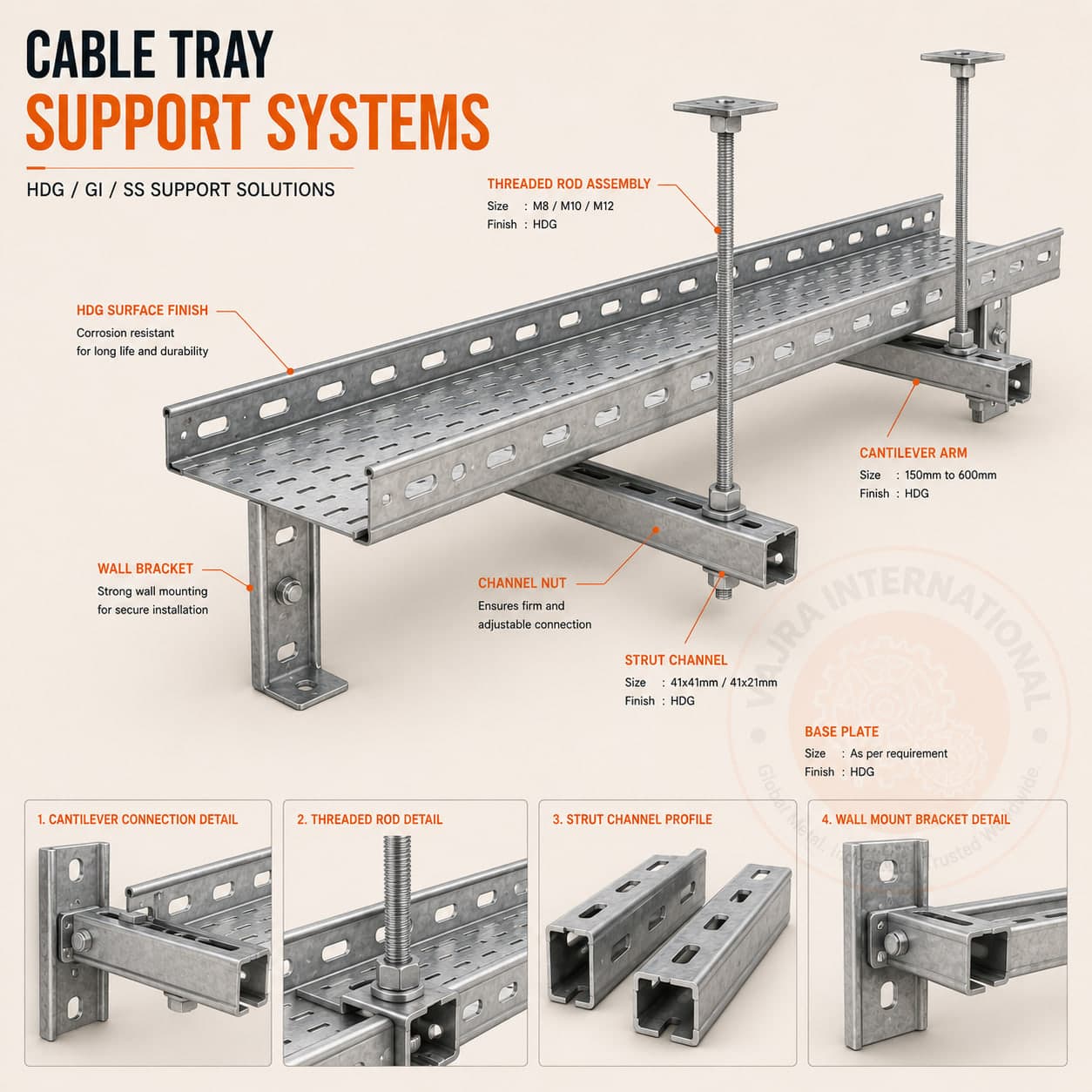
The tray gets all the attention in the specification and the support gets almost none, which is backwards. A cable tray does not hold cable up. The support holds the tray up, and the tray just keeps the cable tidy in between. When a run sags or drops, nine times out of ten the tray itself is fine and the support spacing, the bracket, or the fixing into the wall was the weak link. On one warehouse job a run of perfectly good ladder tray bellied down between supports set at four metres, because someone read the tray load chart and ignored the support span. Same tray, supports at two metres, and it would have sat dead level.
The three ways to hold a tray up
- Cantilever arm: a single arm bolted to a wall, a column or a vertical channel, carrying the tray from one side. Quick and economical, good for runs along a wall, but the load is capped by the bending strength of the arm and its fixing.
- Trapeze hanger: a horizontal strut channel slung from two threaded rods off the soffit, with the tray sitting on top. This is the workhorse for runs in the middle of a space, and the way to stack several trays on one support.
- Wall and floor brackets: fixed brackets and floor-mounted stands for short runs, risers and the points where a tray turns down to equipment.
Span and safe working load are a pair
Every support type has a safe working load that falls as the span grows, exactly like the tray itself. A trapeze on 1.5 metre rod centres carries far more than the same channel on 3 metre centres. The honest way to design it is to add the cable weight per metre, the tray weight, and an allowance for a worker standing on the run during install, a real load usually taken as a 90 kg point, and then pick the support and the spacing together so deflection stays small, commonly within span divided by 200. A run that just meets strength but deflects too far looks failed even while it is technically still holding.
Typical spacing, and where to tighten it
As a starting point, many steel tray runs support on 1.5 to 2 metre centres, with lighter trays and baskets a little closer. But that figure is not a constant to be copied across the whole job. Tighten the spacing at every bend, tee and riser, because the fitting concentrates load and the cable changes direction there. Add a support within 300 mm of every joint so the coupler is not left carrying the span on its own. And put a support right where a heavy cable bundle drops in or out, not halfway between the existing ones. The support layout follows the actual cable route, not a tidy grid drawn for neatness.
The fixing is part of the support
A cantilever arm rated for 200 kg is worth nothing if it hangs off two light anchors in weak concrete. The fixing into the structure has to be rated for the load with a proper safety factor, using the right anchor for the base material: mechanical or chemical anchors in concrete, beam clamps on steelwork, and never plastic plugs for anything structural. On hollow block or old concrete, pull-test a sample anchor before the whole run goes up. We size the bracket and state the fixing load it imposes, so the installer knows what the structure has to take, rather than finding out the hard way when it lets go.
Finish, and the seismic question
Match the support finish to the tray and the environment, the same rule that governs the accessories: pre-galvanized indoors, hot-dip galvanized outdoors and in plant, stainless near the coast. A galvanized tray on rusting painted brackets fails at the bracket. And where the project sits in a seismic zone, the supports become the seismic restraint for the whole cable system, so they need bracing against sideways and lengthwise movement, not just the downward weight. For data centres and critical plant in the higher seismic zones we supply braced trapeze designs rather than plain hangers.
Design the support and the span together, then design the fixing for the support. A tray run almost never fails in the tray. It fails at the bracket, the rod centres, or the anchor in the wall.
Routing a cable tray system and need the supports to match? We fabricate cantilever arms, trapeze channel, brackets and seismic bracing in pre-galvanized, hot-dip galvanized and stainless, sized to your load and span with the fixing duty stated.