

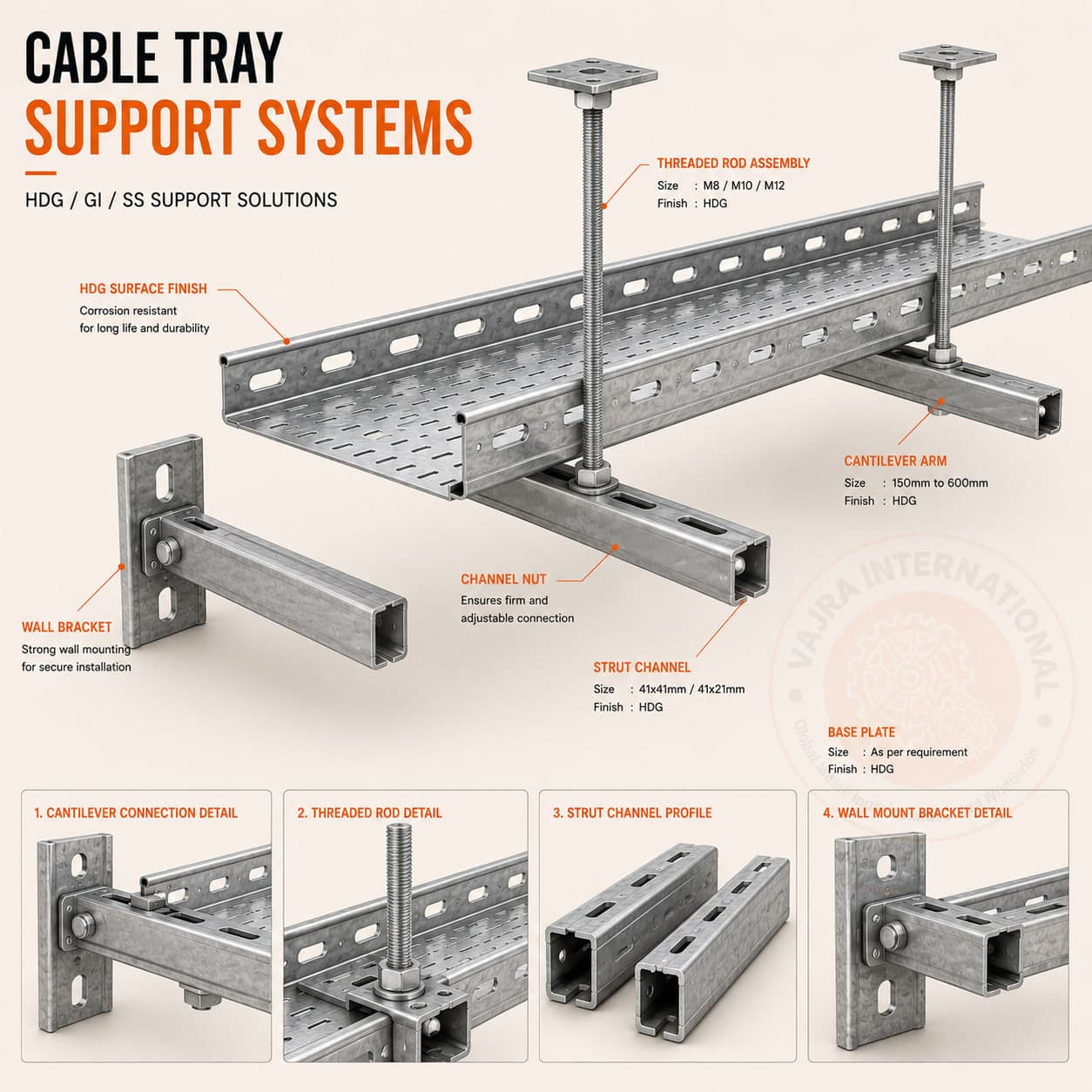
Cable tray sizing does not require a completed cable schedule. It requires the support span, an estimate of cable weight per metre, and a growth margin, three inputs you almost always have before the cable schedule is finalised. Knowing how to read a manufacturer's load table correctly means you can lock in the tray specification weeks earlier on the critical path, and avoid the late-stage replacements that happen when engineers size to Day 1 capacity with no margin. This guide gives you the three-step method, the worked examples, and the specific errors that lead to tray replacement six months into a project.
What the load table tells you, and what it does not
A manufacturer's cable tray load table gives the Safe Working Load (SWL) or uniformly distributed load (UDL) in kg/m (or kN/m) at a specified support span, for a specific tray width and type, to a deflection limit. IEC 61537:2006 Annex B specifies the test method: the tray is loaded to failure and the SWL is set at 1/1.5 of the load at which the defined deflection limit (L/100) is first reached. Important: the UDL figure in the table is the load the tray carries, not the total weight. A 300 mm wide ladder tray rated at 24 kg/m at 1,500 mm span can carry a 36 m run of tray with 24 kg of cable per metre, that is 864 kg of cable on that run, supported at 1,500 mm intervals. It does not mean each bracket sees 24 kg.
Worked example 1: Substation power cable tray
- Cable schedule: 6 × 3-core 185 mm² XLPE cables (approx 10 kg/m each) + 12 × 3-core 70 mm² cables (approx 4 kg/m each). Total cable weight per metre: 6×10 + 12×4 = 108 kg/m.
- Tray span: 1,500 mm (standard substation tray span).
- From load table (600 mm wide ladder tray, IS 2062 E250A, 2 mm sheet): SWL at 1,500 mm span = approximately 100 kg/m. Insufficient, cable weight exceeds SWL.
- Solution: increase to 800 mm wide tray (SWL at 1,500 mm approximately 130 kg/m) → fits with 20% margin. Alternative: reduce span to 1,200 mm (SWL of 600 mm tray increases to approximately 130 kg/m).
- With 25% growth margin: use 800 mm wide tray at 1,500 mm span. This is the correct specification.
Worked example 2: Instrumentation cable tray, refinery
- Cable schedule: 120 × 2-core 1.5 mm² twisted pair instrument cables (approx 0.2 kg/m each) + 24 × 4-core 2.5 mm² cables (0.4 kg/m each). Total: 120×0.2 + 24×0.4 = 33.6 kg/m.
- Tray span: 2,000 mm (pipe rack typical span).
- From load table (300 mm wide perforated tray, 1.5 mm sheet): SWL at 2,000 mm span approximately 28 kg/m. Insufficient.
- Solution: 400 mm wide perforated tray (SWL at 2,000 mm approximately 40 kg/m) → fits with 19% margin. With 25% growth margin: 400 mm is marginal, use 500 mm for correct sizing.
Common errors that lead to tray replacement
- Error 1, specifying at 100% of the SWL: any cable additions after commissioning immediately overload the tray. Always apply minimum 25% margin.
- Error 2, using span = tray length: the design span is the distance between support brackets, not the total run length. A 6 m run with 3 brackets at 1.5 m spacing has a 1.5 m design span, not 6 m.
- Error 3, comparing UDL values from different manufacturers at different deflection limits: IEC 61537 sets L/100 as the test criterion, but some manufacturers publish values to L/200 (stiffer limit) which are lower, and not comparable to IEC-basis tables.
- Error 4, ignoring the weight of the tray itself: the tray's self-weight is typically 4–8 kg/m depending on width and sheet thickness. For long spans with heavy cable loading, this adds meaningfully to the bracket load calculation.
Submit your cable schedule (even partial) and span dimensions and we return a tray width recommendation with the load calculation in 24 hours. We build to IEC 61537 and publish load tables for every standard product, ask for the load data sheet with your quotation.
Send us your cable schedule and span dimensions, even partial. We'll return a tray width recommendation with the IEC 61537 load calculation and a quotation within 24 hours.