

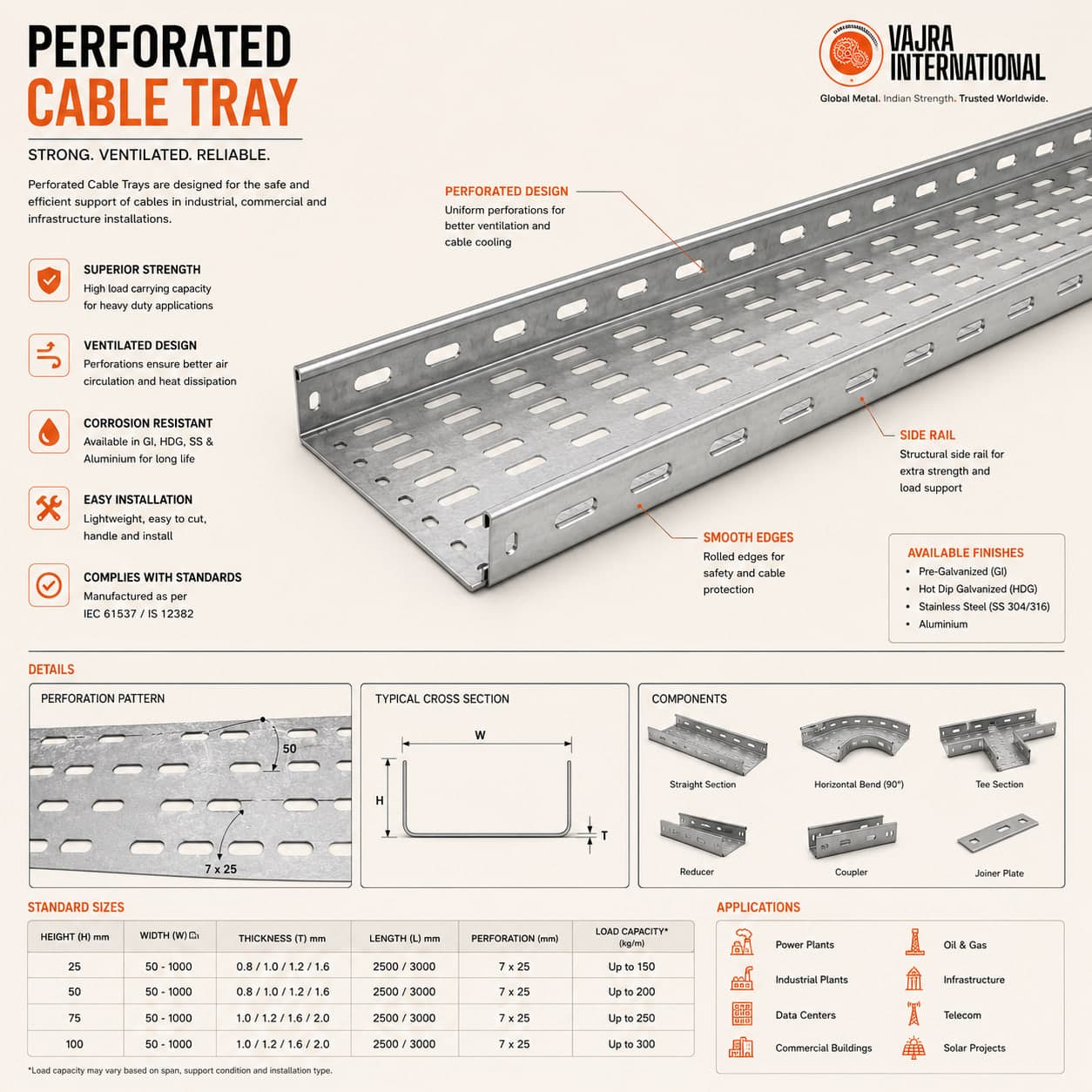
India is now among the world's top five data centre markets by planned capacity. Hyderabad, Pune, Navi Mumbai, Bangalore and Chennai are adding hyperscale and colocation capacity at a pace that has made data centre cable tray specification one of the fastest-growing segments for Indian manufacturers. Yotta, CtrlS, NxtGen, GPX, ATC, Princeton Digital, Macrotech and the hyperscale anchors (Microsoft Azure Region Hyderabad, Google Cloud Pune, AWS Mumbai) are all building simultaneously. The MEP contractors on these projects, L&T Construction, Larsen, Shapoorji, Bombardier, Kirloskar, KEC, Techno Electric, need cable tray that meets IEC 61537 or NEMA VE 1, carries mixed loads in segregated runs, survives 25-year design lives in climate-controlled halls, and can be specified on a PO that satisfies TPI and project QA. This guide covers what separates a correct data centre cable tray specification from an industrial one.
Why data centre cable tray is a different specification from industrial
The key differences are not immediately obvious from a drawing. Data centres run at low temperature and controlled humidity, which might seem to relax the finish requirement. But the design life (20–25 years for Tier III+ infrastructure), the density of cable fill (a 600 mm wide ladder tray on a data hall floor runs at 70–80% fill under power at steady state), and the regulatory environment (TIA-942, BICSI TDMM, IS 3043 bonding requirements, seismic bracing per IS 1893) all push the specification in a direction that ordinary industrial cable tray, IS 277 pre-galvanized, nominal spans, arbitrary bonding, does not meet. The three most common specification errors on Indian data centre cable tray orders are: specifying pre-galvanized tray for a 25-year build, omitting seismic bracing from the BOM, and specifying cable tray without continuity bonding straps at splice plates.
Load class selection. IEC 61537 and what the numbers mean on the floor
IEC 61537 classifies cable trays by load class, the rated distributed load in kg per metre at a reference span. Data centre tray selection by zone:
- Power cable routes (UPS output feeders, PDU to rack cabling, busway tap-offs): 600 mm wide ladder tray, IEC 61537 Load Class B (70 kg/m at 450 mm span) as a minimum. At full fill with 4×95 mm² XLPE multicore cables, the load exceeds 50 kg/m. Class B has adequate margin. Risers feeding multiple floors: Class C (110 kg/m) for shaft sections where feeder density peaks.
- Copper data cabling (Cat 6A, RJ45 structured cabling, trunk assemblies): 150–300 mm perforated tray, Load Class A (35 kg/m at 300 mm span). Cat 6A 10GbE bundles weigh approximately 0.7 kg/m per 24-cable bundle. Class A holds comfortably at normal fill.
- Fibre and low-voltage signal (OM4/OS2 trunk cables, 400GbE DAC, out-of-band management): wire basket / cable basket tray or 150 mm perforated tray, Load Class A. These are the lightest routes by far, but basket tray deflection at mid-span must stay below L/200 to protect bend-sensitive fibre.
- Overhead busway (busduct) support: overhead busway in a data hall typically runs on its own dedicated support channel, it is not typically supported on cable tray. Where cable tray supports bus drop-offs or metering equipment, specify Load Class C and check the tray manufacturer's point-load vs. distributed-load tables, a single tap-off box can impose 30+ kg at a single point.
Finish. HDG vs pre-galvanized for a 25-year data hall
Indian data halls run at ASHRAE Class A2 (15–35°C, 8–80% non-condensing RH in the allowable range), with A1 (15–32°C, 20–80% non-condensing RH) as the recommended range. In a tightly controlled data hall, pre-galvanized IS 277 Z275 (70–100 g/m² coating weight, approximately 10–14 µm per side) is technically acceptable for corrosion resistance. The problem is not the data hall itself, it is everything outside it. Generator yards, chiller plant, cooling towers, cable entry routes through external walls, UPS room ventilation perimeters, and commissioning periods before HVAC comes online are all humid, corrosive or both. Hot-dip galvanized ASTM A123 / IS 4759 (85–110 µm average zinc coating) provides a service life of 25+ years in C3 atmospheric class (heavy industrial/coastal), which is above what a data hall interior requires, but below what the external plant areas need. Most data centre MEP specifications in India now standardise on HDG for the entire cable tray system including indoor runs, to eliminate the boundary between indoor and outdoor zones on the drawing, a single spec, zero ambiguity for TPI.
Cable segregation. IEC 60364-5-52 requirements and how they drive tray layout
IEC 60364-5-52 Section 528 requires physical separation between power cables (Class 1 circuits) and low-voltage data circuits (Class 2) to prevent electromagnetic interference. The minimum separation without a metallic barrier is 200 mm. With a continuous earthed metallic divider within the same tray, the separation can reduce to 50 mm. In data centre practice, the separation is achieved by using two separate tray systems at different vertical heights: typically power tray above the raised floor and data tray below the ceiling, or power tray at a higher elevation in the ceiling plenum with data tray at a lower level, depending on the data hall cooling architecture.
The hot-aisle / cold-aisle containment systems used in most Indian hyperscale builds (with hot-aisle containment chimneys on the rack rows) place constraints on overhead cable routing that a standard industrial tray layout ignores. Power and data cable trays must route above the containment chimneys rather than through the cold aisle overhead space. This typically means the main cable tray grid runs at 3.5–4.0 m AFF (above finished floor), with drop cables entering the containment through controlled entry points. Specify the tray grid elevation and the entry saddle / waterfall detail on your tray layout drawing before ordering, it determines the span length and the load at each support point.
Seismic bracing. IS 1893 requirements for Indian data centre locations
Most first-time data centre cable tray specifiers in India are surprised to discover that IS 1893 (Part 1) applies to cable tray support systems in seismic zones. IS 1893 places Hyderabad (Rangareddy District, Shamshabad) in Zone II. Bangalore (Electronic City, Whitefield) is in Zone II–III depending on the specific subdistrict. Mumbai (Navi Mumbai, Airoli, Turbhe industrial areas) is Zone III. Delhi NCR (Noida, Greater Noida) is Zone IV, the highest zone on the Indian scale. Seismic Importance Category (IC) for critical infrastructure including data centres is typically IC-II or IC-III, which applies a multiplying factor to the seismic design coefficient and mandates bracing for all cable support systems with tray wider than 150 mm. In practice, seismic bracing for cable tray means diagonal sway braces on the support hangers at 6 m (horizontal) and 3.6 m (transverse) centres, using cleats and threaded rod to the building structure. For US-spec builds (Equinix, Digital Realty, Vertiv) using ASME seismic requirements, the IBC Chapter 16 provisions apply, the detail is similar but uses American notation and the bracing centres are expressed in feet. Our cable tray accessories range includes all standard cleats, splice plates, riser sections and bonding straps needed for a complete seismically-braced tray installation.
City-level buying patterns, what Indian data centre projects are specifying
Hyderabad (Hitec City, Shamshabad, Patancheru): the dominant builds are hyperscale anchors (Microsoft Azure) and colocation (CtrlS, Yotta INF1 and INF2, ST Telemedia). MEP contractors on these projects specify 600 mm ladder tray HDG ASTM A123 for power runs (typically in 2.4 m lengths for modular BMS), 300 mm perforated HDG for Cat 6A structured cabling, and 150 mm perforated or wire mesh for fibre. Seismic bracing is specified per IS 1893 Zone II. The Hyderabad data centre cluster is the largest in India by total capacity, it has driven significant local demand for compliant cable tray from West Bengal and Maharashtra manufacturers.
Pune (Hinjewadi, Chakan, Ranjangaon): a growing cluster anchored by NTT, Google Cloud (Pune-1), and multiple Indian colocation operators. Pune builds frequently specify NEMA VE 1 alongside IEC 61537 because US-origin OEMs (HPE, Dell, Cisco) specify in NEMA. Vajra manufactures to IEC 61537 as default; NEMA VE 1 dimensional equivalence is confirmed at order for US-origin-spec projects. Pune sites also regularly specify IS 3043-compliant earth grid for the entire data hall, with every tray section bonded to the CBN.
Navi Mumbai / Mumbai (Airoli, Rabale, Mahape): the largest urban data centre cluster in Maharashtra. Waverock, NetMagic, Sify Technologies, Yotta, and NTT all operate in the corridor. Zone III seismic requirements apply. Cable tray specifications here most commonly reference IS 4759 for HDG (rather than ASTM A123) because of the large number of Indian EPC contractors involved. IS 4759 minimum coating is 85 µm, identical to ASTM A123 Class A, and either standard is acceptable.
Bangalore (Electronic City, Whitefield, Devanahalli): data centres here are constrained by rock (basalt and laterite) below the slab, which complicates cable entry and below-slab earthing. The result is more overhead cable tray usage per data hall, with extensive hot-aisle containment chimneys requiring custom tray entry saddles. Load Class B for power and Class A for data is the working standard. Cable tray widths in Bangalore builds tend to run wider (750 mm and 900 mm ladder sections) because the higher rack density in Bangalore hyperscale builds drives heavier cable fill per run.
What to put in the specification, the seven lines that matter on a data centre tray PO
- Standard and load class: 'IEC 61537 Load Class B, minimum (for power runs)' or 'IEC 61537 Load Class A minimum (for data runs)'. A PO that says only 'cable tray to IEC 61537' without load class has no enforceable load requirement.
- Tray type and dimensions: 'Ladder tray, 600 mm × 100 mm (W × D), 2.4 m lengths' or 'Perforated tray, 300 mm × 50 mm'. State the rung/slot spacing for ladder tray (typically 300 mm rung spacing for data centre power), it affects cable support and airflow.
- Material and finish: '2 mm electro-galvanized CRCA (pre-gal IS 277 Z275) for indoor data hall runs' or '2 mm hot-dip galvanized to ASTM A123 / IS 4759 minimum 85 µm average' for all other runs. Be explicit, ambiguous 'GI cable tray' on a PO accepts any finish.
- Accessory scope: list every accessory type, elbows (horizontal/vertical), tees, reducers, end plates, splice plates with bonding straps, support brackets, threaded rod and hanger sets, and seismic bracing cleats. Ordering tray without accessories is the most common cause of installation delay on data centre projects.
- Bonding specification: 'Continuity bonding strap at every splice plate joint (minimum 6 mm² tinned copper or equivalent galvanized wire).' Without this specification, the tray arrives without bonding straps and the earthing contractor must add them separately.
- Certification: 'IEC 61537 load test certificate from NABL-accredited laboratory' for domestic tender compliance; 'NEMA VE 1 dimensional compliance declaration' for US-origin-spec projects. These are different documents, confirm which your TPI will accept at factory inspection.
- Seismic bracing: 'Seismic bracing accessories per IS 1893 Zone [II/III/IV] for site [city].' This is not a standard line on most industrial tray specifications, add it explicitly or the bracing will be missing from the BOM entirely.
The data centre cable tray specification error that costs the most is not the wrong load class, it is missing the seismic bracing accessories from the BOM entirely. The tray ships, goes up, passes inspection, and the certificate of completion is signed. Three years later there's a minor earthquake, Zone II, probably no damage elsewhere on site, and every unsupported tray run in the data hall shifts or falls. At that point the contractor is retrofitting diagonal sway braces on a live data hall, at 10× the cost of specifying them correctly in the original BOM.
Specifying cable trays for a data centre build in India or the GCC? We manufacture IEC 61537 ladder and perforated trays in HDG and pre-galvanized finish, with full accessories, seismic bracing kits and IEC test certificates. FOB/CIF/CFR from Howrah. Tell us the load class, tray dimensions and seismic zone and we'll return a structured quotation.