

The single biggest source of quality disputes in structural steel fabrication from India is not workmanship, it is the confusion between a mill certificate and a qualification package. Buyers receive a mill certificate from the steel mill showing chemistry and properties for a heat of steel, and assume it covers the fabricated product. It does not. A mill certificate proves the raw steel. It says nothing about whether the fabricated structure meets dimensional tolerances, whether the welds are sound, whether the galvanizing achieved the specified thickness, or whether the drilled hole pattern matches your drawing revision. Understanding what a complete qualification package actually contains, and verifying that your Indian supplier can deliver one, eliminates roughly 80% of procurement risk on a structural steel order from India.
What a complete documentation package must contain for structural steel
- Mill MTC (EN 10204 Type 3.1 or IS equivalent): chemical analysis and mechanical properties for the specific heat of steel used. References the heat number. Not a generic 'IS 2062 Grade E250' statement.
- Fabrication inspection report: dimensional check against your approved drawing. Critical dimensions measured and recorded, not checked off against a pass/fail tick sheet.
- Weld inspection report (visual inspection per IS 822; NDT per IS 4853 / ASME Section V where specified): weld inspection signed by a qualified weld inspector, not just QC department.
- HDG coating measurement report: XRF thickness measurement per BS EN ISO 2178 or IS 12777, referencing specific articles and lot number. Average AND minimum values recorded.
- Third-party inspection report (SGS, BV, TÜV or OMIC): independent pre-shipment inspection covering dimensions, coating, marking and packing, signed by an external inspector.
- Packing list: dimensions and weights per bundle/crate. Your freight agent, marine insurer, and customs broker all require this before the vessel sails.
Indian structural steel standards, and which mills can supply to international grades
Indian structural steel is produced to IS 2062 by Tata Steel, JSW Steel, AMNS (ArcelorMittal Nippon Steel India) and SAIL. IS 2062 Grade E250A is the structural workhorse, minimum yield 250 MPa, tensile 410–540 MPa, elongation 23% min. This is directly equivalent to ASTM A36 and very close to EN 10025 S275JR. For projects specifying ASTM A572 Gr50 or EN 10025 S355JR, JSW and Tata Steel can supply on request with mill certificates endorsed for the foreign standard, specify this in the purchase order and allow 2–4 weeks additional lead time for mill scheduling. All IS 2062 steel from major Indian mills includes a 3.1 MTC as standard. The fabrication standard is IS 800 (equivalent to BS 5950 structurally). Welding procedure qualifications follow IS 7280 (WPS) and IS 817/7310 (WQC).
Surface treatment: the galvanizing thickness numbers that matter for export
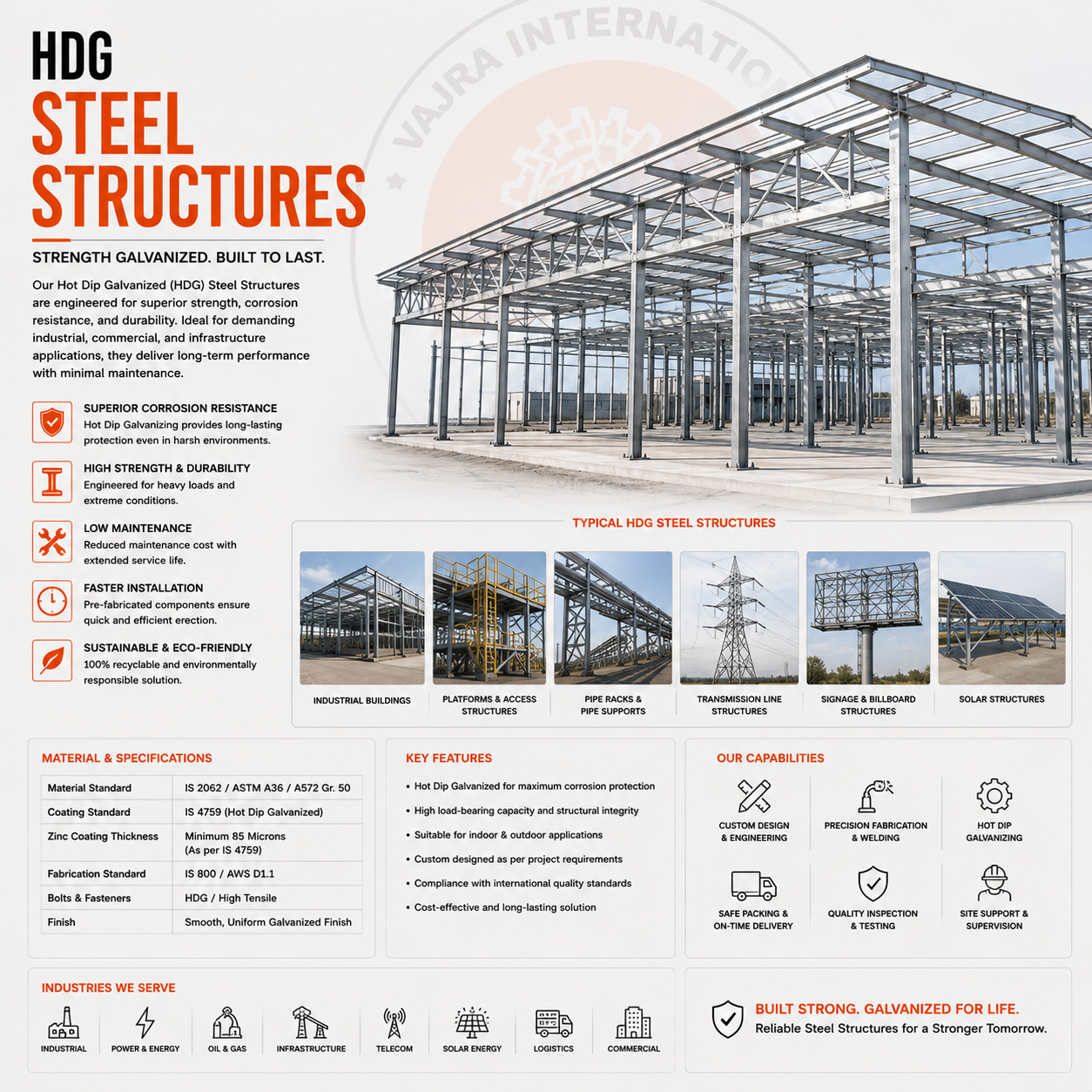
Hot-dip galvanizing to ASTM A123 (US specification) or IS 4759 (Indian) is the standard for outdoor and corrosive-environment structural steel. ASTM A123 specifies minimum average coating thickness by article thickness: for steel ≥ 6 mm, minimum 85 µm average with no individual measurement below 75 µm (Grade 85). The process runs at 445–455°C, the zinc and iron alloy together at the surface, creating four intermetallic layers that are bonded, not applied. For sea-container export, the sealed zinc layer protects the steel during 2–6 weeks at sea and typically 30+ years in service once installed. We measure every batch with an XRF gauge and include the measurement report in the shipment documentation as standard.
Products we fabricate and export from Howrah
- Pipe-rack and cable-rack structures for refineries and chemical plant: custom-fabricated to buyer drawing, IS 2062 steel, HDG or painted finish.
- Electroforged gratings (25×3 mm to 100×8 mm bearing bars, IS 2062 steel, HDG or SS 304/316 finish): standard 6,000×1,000 mm sheets cut to panel sizes.
- Transmission tower components (cross arms, base plates, lattice members for 66 kV–400 kV lines): angular steel to IS 2062, punched and galvanized.
- Solar mounting structures (ground-mount and rooftop, HDG steel and aluminium): engineered to IS 875 Part 3 wind zones, stamped drawings on request.
- Handrails, staircases and access platforms: IS 2062 angle and hollow sections, HDG or painted finish, sea-worthy packing.
- Custom industrial frames and skid structures: to buyer-supplied drawings in DXF, DWG or PDF format.
How to qualify a structural steel exporter in India: the seven-point checklist
- ISO 9001:2015 certificate: confirms documented QMS, ask to see the scope of certification and ensure 'structural fabrication' is in scope.
- RCMC (Registration-cum-Membership Certificate) from EEPC India: confirms registered export status. Exporters without RCMC cannot access export incentives and often take shortcuts on documentation.
- Weld procedure qualification records (WPS + PQR): ask for a sample. If they cannot produce WPS/PQR records, their welding is not procedurally controlled.
- Calibrated instrument records: dimensional gauges and XRF meter calibration certs from an NABL-accredited lab. If instruments aren't calibrated, measurements aren't meaningful.
- Third-party inspection track record: can they name a previous international project with SGS or BV third-party inspection? Ask for a redacted previous inspection report.
- Packing capability: can they supply sea-worthy wooden crating or pallet-pack for ISO containers? For long structural members, diagonal bracing inside the container prevents transit damage.
- Reference from a current international buyer: one name and one project, verifiable. If they cannot provide this, they haven't exported at the quality level you need.
The right structural steel fabricator ships documentation with the steel, mill MTC, fabrication inspection, coating measurement, third-party report, not after the container arrives. Documentation delivered after arrival is worthless for customs clearance and quality disputes.
We fabricate structural steel and tower sections with full 6-document qualification packages: mill MTC, fabrication inspection, HDG coating report, NDT report, dimensional compliance and COO.