

When your customs broker files the import declaration, the HS code determines your duty rate, your eligibility for India–UAE CEPA preferential rates, and whether your goods clear in hours or get held for days while a classification dispute runs. Most buyers trust their broker's code without cross-checking. Most brokers use last year's entry without verifying whether the product description still matches. Both assumptions are expensive: an incorrect HS code on a UAE import declaration costs 5% in unnecessary duty, or triggers a hold that delays the project. This is the 2026 HS code reference for every metal product category we manufacture and export from Howrah, with the classification logic so you can verify it yourself.
Understanding the HS system: 6 digits global, 8 digits in India
The Harmonized System (HS), administered by the World Customs Organization (WCO), is the international tariff classification framework. The first 6 digits are identical across all WCO member countries. Beyond 6 digits, each country adds its own national sub-headings: India uses an 8-digit HSN (Harmonized System of Nomenclature) on export declarations. Import countries add further digits. 10-digit HTS for USA, 8-digit for UAE and UK. If your broker provides only a 4-digit code, they are giving you the chapter heading, not the tariff line. Always use the full 8-digit HSN on the Indian export invoice and the full destination-country tariff line on the import entry.
Cable trays and cable management. HS Chapter 73
- Ladder cable trays (mild steel or SS, HDG or GI finish): HSN 7308.90.90, 'Other structures and parts of structures of iron or steel, not elsewhere specified'. The finish (HDG, PG, powder coat) does not change the heading.
- Perforated cable trays (all materials, all finishes): HSN 7308.90.90, same as ladder. The tray geometry does not create a different classification.
- Aluminium cable trays: HSN 7610.90.90. Chapter 76 (aluminium articles). Critical distinction: aluminium cable trays are NOT classified under Chapter 73 even though they perform the same function as steel ones.
- Cable tray accessories (bends, tees, reducers, couplers, covers): HSN 7308.90.90, 'parts of structures' under the same heading as the tray.
- Cable trunking / enclosed raceways with lids: HSN 8547.90.90, 'Insulating fittings for electrical machines and apparatus'. Classification of enclosed cable management is debated in some jurisdictions; verify with your destination customs authority before declaration.
Earthing and grounding systems. HS Chapters 73 and 74
- GI earthing pipes (HDG mild steel, round pipe): HSN 7306.30.90, 'Tubes and pipes, welded, of circular cross-section, of iron or non-alloy steel, other'.
- GI earthing plates (flat mild steel plate): HSN 7326.90.99, 'Other articles of iron or steel, not elsewhere specified'.
- Copper-bonded earth rods (steel core, electrolytic copper bond): HSN 7326.90.99, the steel core determines the classification, not the copper bonding layer.
- GI earthing flat strip: HSN 7217.90.90, 'Wire of iron or non-alloy steel, flat wire and strip'.
- Bare copper earthing strip and conductor: HSN 7408.11.00, 'Wire of refined copper, maximum cross-sectional dimension exceeds 6 mm'.
- Copper earth plates: HSN 7409.11.00, 'Plates, sheets and strip of refined copper, in coils'.
- Chemical earthing electrodes (bentonite/carbon compound type): HSN 7326.90.99, classified as fabricated articles of steel, not as chemical compounds.
Copper busbars. HS Chapter 74
- Bare copper busbar (flat bar, EC grade, 99.9% purity): HSN 7407.10.10, 'Bars, rods and profiles of refined copper'. The most important code to get right, many brokers incorrectly file copper busbars under 7409 (plate) or 7408 (wire), which carry different duty rates and CEPA treatment.
- Tin-plated copper busbar: HSN 7407.10.10, tin plating does not change the classification; base material (refined copper, bar/rod form) determines the heading.
- Custom-section copper busbar (L, U or T profiles): HSN 7407.10.90, 'Profiles of refined copper, other'.
- Aluminium busbar: HSN 7604.10.90, 'Bars, rods and profiles of aluminium, not alloyed'.
- Copper cable lugs: HSN 8536.90.90, 'Electrical apparatus for connecting, switching or protecting electrical circuits'. Cable lugs are classified as electrical apparatus, not as copper articles.
Electroforged gratings. HS Chapter 73
- Electroforged grating panels (HDG): HSN 7308.90.10, 'Gratings, grill-work and netting of iron or steel'. This specific sub-heading is distinct from general structural steel (7308.90.90); grating panels have their own line and must not be filed under the general structures code.
- Stair treads (grating construction): HSN 7308.90.10, same as panels.
- Chequered plate flooring: HSN 7208.51.00, 'Hot-rolled flat products of iron or steel, width ≥ 600 mm, not further worked, in coils'.
Structural steel and tower fabrication. HS Chapter 73
- Assembled lattice transmission towers and monopoles (HDG): HSN 7308.20.00, 'Towers and lattice masts of iron or steel'. The assembly state is critical: an assembled tower ready to erect is 7308.20.
- Loose angle section members for towers (supplied unassembled): HSN 7216.40.00, 'L or T sections of iron or non-alloy steel, hot-rolled'. When the same material is supplied as unassembled cut-to-length angle sections without assembly fittings, it classifies under 7216, not 7308.
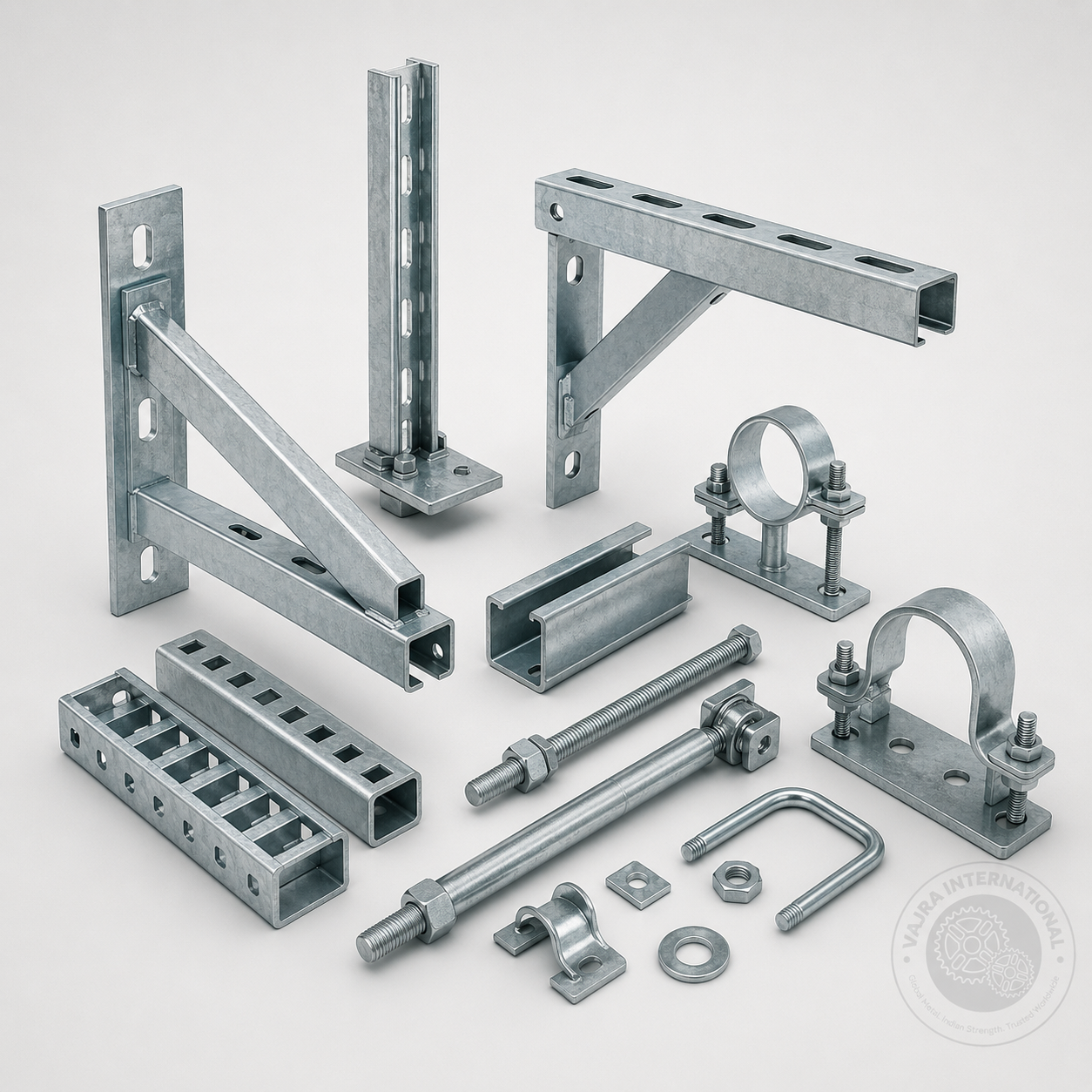
- Pipe-rack frames, cable tray support frames, cantilever brackets: HSN 7308.90.90, 'Other structures and parts of structures of iron or steel'.
- Built-up plate girders and structural frames: HSN 7308.90.90, structural assemblies from fabricated steel plate sections.
Solar mounting structures. HS Chapter 73 or 76
- HDG steel solar mounting structures (ground-mount or rooftop): HSN 7308.90.90, 'Other structures and parts of structures of iron or steel'.
- Aluminium solar mounting extrusions and frames: HSN 7610.90.90, 'Other structures and parts of structures of aluminium'.
- Galvanized C-channel or I-section driven piles for solar: HSN 7228.70.90, 'Other bars and rods of other alloy steel, other'.
Classification rule: Chapter 73 = iron and steel. Chapter 74 = copper. Chapter 76 = aluminium. Within Chapter 73, the assembly state changes the heading, assembled towers are 7308.20, loose members are 7216.40. Getting that wrong changes your duty rate and your CEPA eligibility.
We prepare commercial invoices with the correct HS codes for every shipment and confirm classification with your destination-country broker before the container is sealed. Request a quote with HS code advisory included.
CEPA rate applicability by HS heading
Under India–UAE CEPA (in force May 2022), the following HS headings attract 0% import duty at UAE Customs on presentation of a valid Preferential Certificate of Origin (P-CoO): 7308.90 (cable trays, supports, solar structures), 7308.20 (tower fabrication), 7407.10 (copper busbars), 7408.11 (copper conductors), 7326.90 (earthing plates, electrodes), 7610.90 (aluminium structures), 7306.30 (earthing pipes). The UAE standard MFN tariff rate is 5% on all of these. On a USD 50,000 FOB shipment, correct P-CoO use saves approximately USD 2,500 in import duty at Jebel Ali. Verify specific HS code eligibility for CEPA at the DGFT preferential tariff schedule before ordering, not all 8-digit sub-headings within an eligible heading are automatically covered.