

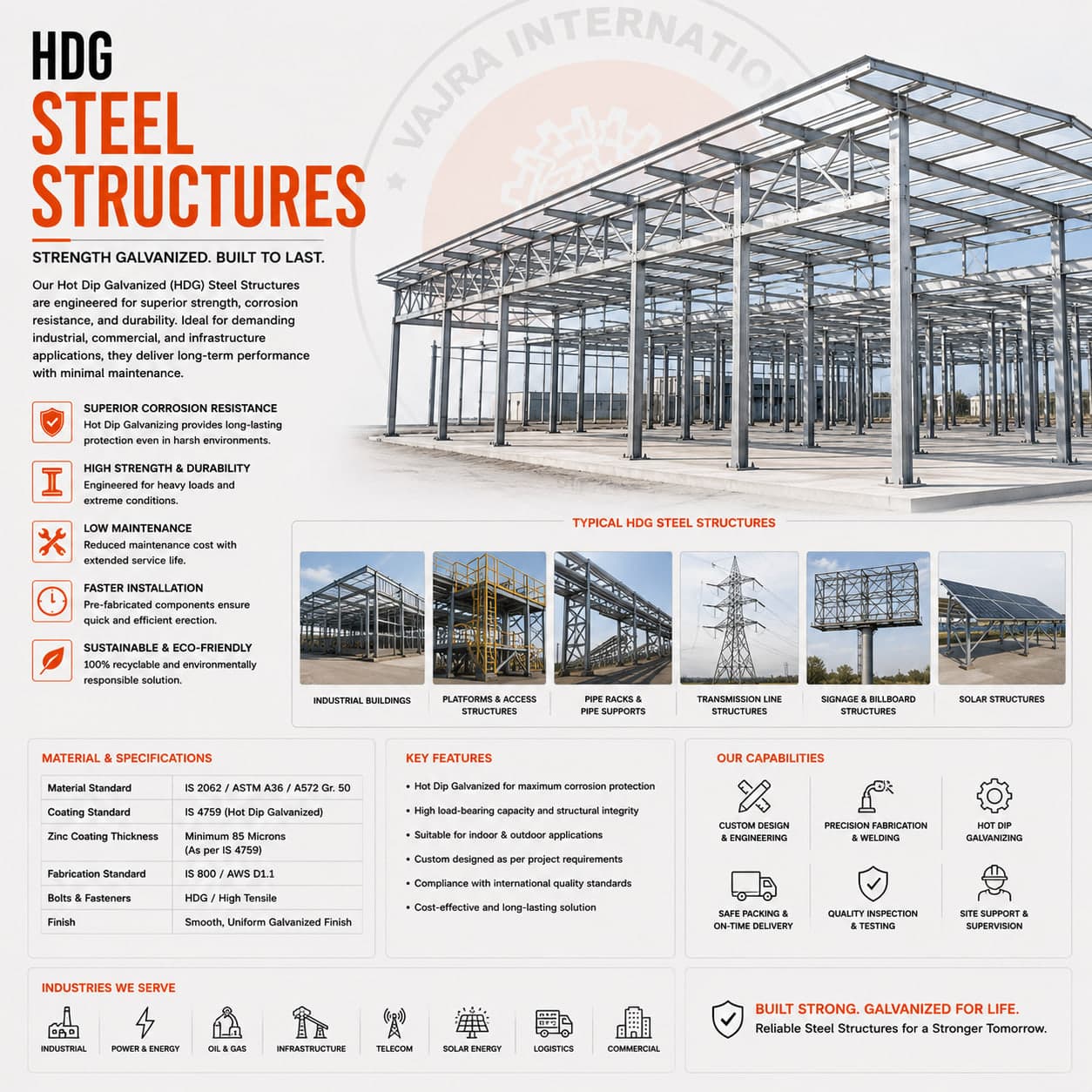
The first time a buyer in Qatar called about an IS 2062 order, he was confused about whether to specify Grade E250 or Grade E300. His vendor had told him both were 'standard IS 2062.' Both appeared in the document. What the vendor had not mentioned was that E250 has four sub-grades: A, B, C, and BR) and that the sub-grade determines whether an impact test is required at low temperatures. For a plant operating in Ras Laffan's overnight winter conditions, where ambient temperatures can fall to 5°C in January, the difference between E250A and E250B is the difference between untested steel and steel that has passed a 27-Joule Charpy impact test at 0°C.
The eight grades in IS 2062:2011
The current version of IS 2062 covers grades E165, E250, E300, E350, E410, E450, E550, and E600. The 'E' prefix denotes minimum yield strength in MPa. For most structural steel fabrication (cable trays, cable tray support systems, earthing frames, solar mounting structures) E250 is the default. E350 and E410 appear in heavy-lifting structures and lattice towers. If your vendor quotes IS 2062 without specifying a grade, ask. That phrase covers a family of eight distinct products, not one material.
Sub-grades: the part most vendors skip
- E250 A: no impact test requirement. The cheapest and most common option for domestic fabrication and non-critical structural work.
- E250 B: impact test at 0°C, minimum energy 27 Joules. Standard for structural steel in cold storage, LNG, and process plant projects where temperatures approach 0°C.
- E250 BR: impact test at 27°C (room temperature). Suitable for general structural work in temperate climates where design temperatures stay above 10°C.
- E250 C: impact test at 0°C with additional restrictions on carbon equivalent and weld repair. Specified for pressure vessel supports and critical welded joints.
For most export orders to the UAE, Saudi Arabia, and Australia, E250B is the right sub-grade. It meets the room-temperature impact test and passes the low-temperature requirement too. E250A is fine for indoor climate-controlled fabrication. The problem is when suppliers ship E250A to a project that needed E250B, because the MTC does not always state the sub-grade clearly and many buyers do not know to look for it.
What the material test certificate must show
A complete MTC under IS 2062 and EN 10204 Type 3.1 should contain all of these:
- Heat number and lot identification, linking the physical product to the test record.
- Chemical composition: carbon, manganese, sulphur, phosphorus, silicon, and any microalloy additions. Compare against IS 2062 Table 1 limits.
- Tensile test results: UTS in MPa, 0.2% proof stress, and elongation percentage. All three, not just UTS.
- Impact test results (Charpy V-notch, in Joules at the test temperature) for sub-grades B and C.
- Heat treatment condition: as-rolled, thermo-mechanically controlled rolling, or normalised.
- BIS licence number or NABL-accredited laboratory stamp on the test report.
A Type 3.2 certificate, where a third-party inspector countersigns alongside the manufacturer's lab, is required on some GCC projects. This is easier to arrange before the steel is cast than after. Ask your buyer's procurement team before placing the order (not three weeks into production.
IS 2062 vs EN 10025: the substitution question
GCC buyers sometimes specify EN 10025-2 Grade S275J0 (the European hot-rolled structural steel standard). IS 2062 E250B and S275J0 are broadly equivalent in yield strength and impact properties, but the chemistry limits differ slightly. IS 2062 allows marginally higher carbon content in some product forms; EN 10025 has tighter controls on carbon equivalent (CEV). Before substituting IS 2062 for an EN 10025 spec, get written confirmation from the project structural engineer. Most will accept the substitution with a side-by-side comparison table showing chemical and mechanical equivalence.
How hot-dip galvanizing changes what you need to specify
Most structural steel exported from India is HDG after fabrication. Galvanizing adds a variable the IS 2062 standard does not address: the silicon content of the steel determines how the zinc reacts at the bath temperature. Steels with silicon between 0.15% and 0.25% give a smooth, adherent coating. High-silicon steel above 0.30% can produce thick, dull-grey, brittle coatings that spall under mechanical stress. When ordering IS 2062 steel for HDG, check the silicon value on the MTC. If the supplier cannot confirm the silicon range, ask them to specify a heat certified suitable for galvanizing. Some mills note this as 'galvanizing quality' on the certificate.
A certificate showing E250A, no impact test, no sub-grade confirmation, and silicon content unstated is not a complete document. Any supplier who cannot produce better than that is not a supplier we would use for an export order.
Vajra International fabricates IS 2062 structural steel components at Howrah: cable tray systems, support structures, solar frames and gratings. All orders ship with EN 10204 Type 3.1 MTC, HDG inspection report and EEPC India Certificate of Origin.