

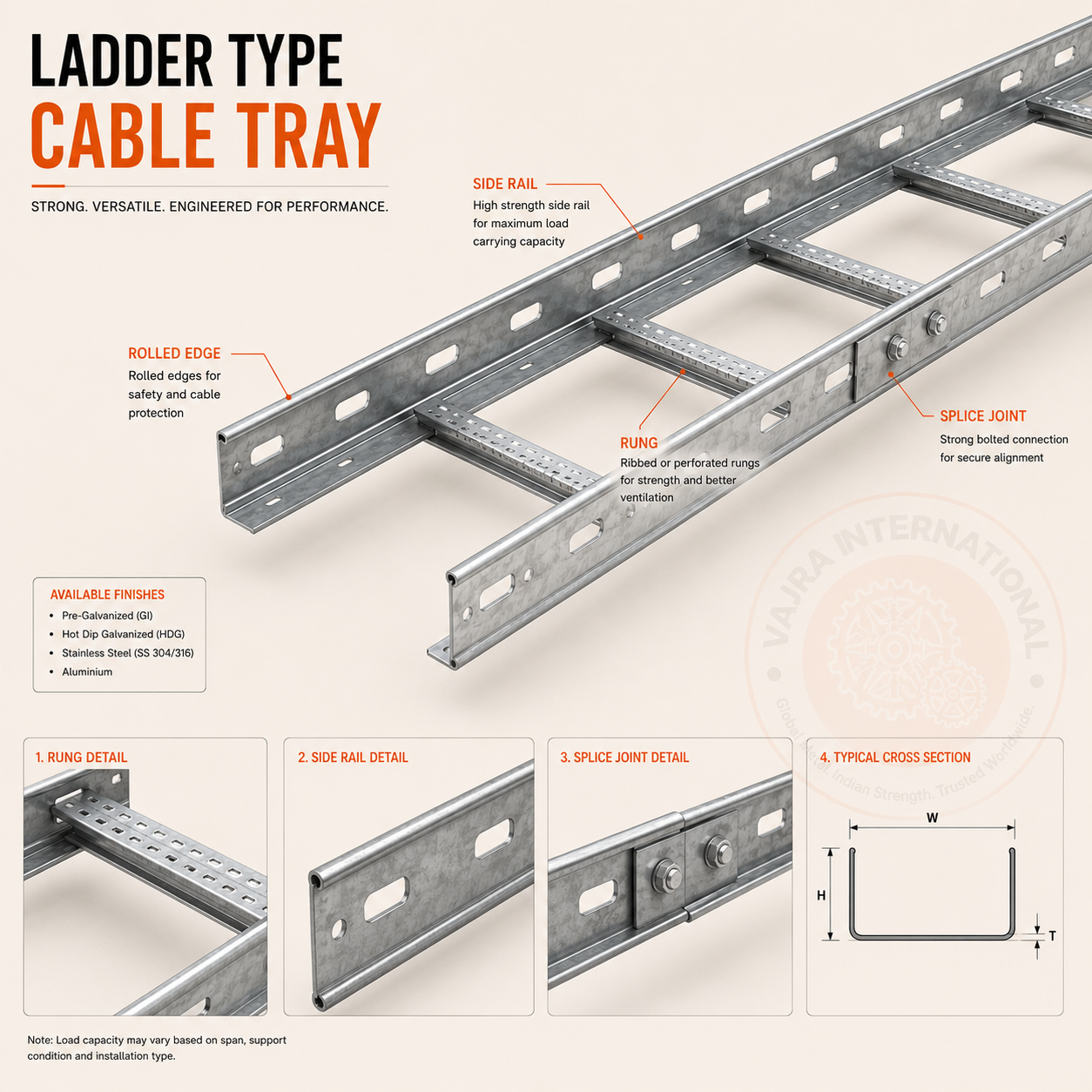
The India–UAE Comprehensive Economic Partnership Agreement entered into force on 1 May 2022, the first bilateral FTA India has signed with a Gulf Cooperation Council country. Under it, 99% of Indian goods by tariff lines attract 0% import duty at UAE Customs, replacing the standard 5% Most Favoured Nation rate. The mechanism requires one action from the buyer: claiming it. UAE Customs does not apply the CEPA rate automatically. Without the Preferential Certificate of Origin (P-CoO), the 5% MFN rate is applied to the CIF value of every shipment. On a container-size cable tray or earthing order, that is USD 1,500–3,000 in avoidable cost left at the port on every single shipment.
Which products qualify, confirmed HS headings
The CEPA tariff schedule specifies eligible HS codes. For the products Vajra exports, the following categories attract 0% duty under CEPA: HS 7308.90, cable trays (ladder, perforated, channel), cable tray accessories, steel supports and frames, solar mounting structures. HS 7308.20, tower fabrication (lattice and monopole). HS 7326.90, earthing plates, earthing pipes and copper-bonded earth rods. HS 7407.10, copper busbars (bare and tin-plated). HS 7408.11, bare copper earthing conductors and strips. HS 7610.90, aluminium solar mounting structures. HS 7314.99, electroforged grating panels (confirm sub-heading with your UAE customs broker as some sub-classifications within 7314 are schedule-dependent). All of these were previously subject to 5% UAE MFN duty.
Rules of origin: what 'Indian origin' requires under CEPA
To qualify for CEPA preferential treatment, goods must be 'originating' from India under the CEPA rules of origin chapter. For fabricated metal products, two criteria apply: (a) wholly obtained in India, raw material is Indian and no third-country input was incorporated in the finished product; or (b) substantial transformation, a minimum of 35% value addition occurs in India on the FOB value of the finished goods, with the product undergoing a qualifying change in tariff heading where applicable. At Vajra's Howrah facility, we manufacture from Indian mill-origin raw material, hot-rolled steel coil from SAIL, JSW or Tata Steel; electrolytic copper rod from Hindalco, processed through our own fabrication, punching, welding, and hot-dip galvanizing. Typical value addition on cable trays is 55–70% of FOB value, and on copper busbars is 40–55%, both substantially above the 35% threshold. Products using third-country fasteners or accessories need individual checking, but the core metal fabrication consistently qualifies.
The Preferential Certificate of Origin: what it is and who issues it
The P-CoO is the document that triggers the CEPA rate at UAE Customs. It is not the same as the standard Certificate of Origin (COO) issued for general export certification, the standard COO demonstrates Indian origin for WTO/MFN purposes but does not activate CEPA preferences. The P-CoO for India–UAE CEPA is issued by: EEPC India (Engineering Export Promotion Council of India) for engineering and metal manufactured goods, which is Vajra's issuing body; or by FICCI, CII, ASSOCHAM or other DGFT-authorised Chambers of Commerce. The P-CoO references the invoice value, HS code, country of origin, and includes a declaration from the manufacturer confirming the rules of origin are satisfied.
Step by step: claiming the CEPA benefit on a Vajra shipment
- Step 1. Confirm eligibility at RFQ stage: when you send us an RFQ, specify the product and destination (UAE). We confirm the applicable HS code and its CEPA status in the quotation response.
- Step 2. Request the P-CoO in the purchase order: include a line in your PO specifying 'Preferential Certificate of Origin (P-CoO) for India–UAE CEPA required'. Without this instruction, we issue a standard COO by default.
- Step 3. We apply to EEPC India: after production is complete and the commercial invoice is raised, we submit the P-CoO application to EEPC India with the manufacturer's origin declaration. EEPC India reviews and issues the P-CoO within 2–5 working days.
- Step 4. P-CoO included in shipment documents: the P-CoO travels with the bill of lading, commercial invoice, packing list, MTC and inspection reports in the document package.
- Step 5. Your UAE customs broker declares CEPA at Jebel Ali: the broker presents the P-CoO with the import Bill of Entry at UAE Customs. The customs system verifies the P-CoO number against EEPC India's online registry.
- Step 6. 0% duty assessed: the preferential rate is applied and the duty payable on the CIF value is AED 0 instead of 5%. The saving appears on the customs clearance settlement.
What the saving is worth in real numbers
On a 40ft container of HDG cable trays. 20 MT, FOB value USD 28,000, freight USD 1,500, insurance USD 50 = CIF value approximately USD 29,550. At 5% MFN rate, UAE import duty = USD 1,477 (AED 5,420). With a valid CEPA P-CoO: USD 0 duty. On a larger project shipment, three 40ft containers of cable trays, earthing systems and steel supports at FOB USD 85,000 total, the CEPA saving across all containers approaches USD 4,500–5,000 in import duty. That is real project cost reduction available on every single shipment from India to UAE, on qualifying products, at no additional cost to the buyer. The P-CoO application cost at EEPC India is borne by the exporter, Vajra, not passed to the buyer.
The 5 mistakes that invalidate the CEPA benefit
- Not requesting the P-CoO before shipment: UAE Customs does not accept retrospective CEPA claims after duty has been assessed at MFN. The P-CoO must be presented at the time of import declaration.
- Presenting a standard COO instead of a P-CoO: the standard COO proves Indian origin but does not trigger the preferential rate. They look similar but are legally different documents.
- HS code mismatch between P-CoO and import declaration: if the P-CoO lists HS 7308.90.90 and the UAE import declaration uses a different sub-heading, customs may deny the preference. Align with your UAE customs broker on the exact 8-digit classification before order confirmation.
- P-CoO dated after the bill of lading date: the P-CoO should be issued on or before the shipment date. Post-dated P-CoOs require a formal back-issue procedure and may be refused at UAE Customs.
- Manufacturer not meeting the 35% value-addition threshold: if you are sourcing re-exported or assembled goods where the Indian value addition is low, the origin declaration may not be valid. This is the manufacturer's responsibility to verify before signing the CEPA declaration.
Ask for the P-CoO on every order to UAE. It costs you nothing additional, we apply for it as standard once you request it on the PO. The only way to lose the benefit is not to ask.
Buying cable trays or earthing systems for UAE? We apply for India-UAE CEPA Preferential COO as standard on every GCC order, zero duty on qualifying products, no extra charge.