The question comes up at every MSME export outreach event: can a medium-sized steel fabricator in Howrah or Pune supply to the defence sector? The answer is yes. But the path is genuinely different from a commercial order and knowing the framework before you make your first approach saves a lot of time and some embarrassing conversations with procurement officers who have heard the same unrealistic pitch before.
The governing document: DAP 2020
The Defence Acquisition Procedure 2020 (DAP 2020, which replaced DPP 2016 and is still widely called DPP 2020 in industry) governs all Indian defence procurement above certain thresholds. For capital procurement (platforms, weapons systems, major equipment) DAP 2020 sets out the categories and vendor qualification routes. For revenue procurement (spares, consumables, maintenance items, structural components) the route is through the CFA (Competent Financial Authority) system, a simpler path that is accessible to established industrial manufacturers.
For a steel component manufacturer making cable trays for communication shelters, earthing grids for forward operating bases, gratings for naval vessel decks, or structural sections for defence housing (the most relevant entry point is usually revenue procurement through Defence Estates, CWC, or directly as a Tier-2 supplier to a DPSU or OEM that holds a DAP 2020 contract.
IDDM: what it means and why it matters
One of the headline changes in DAP 2020 was formalising the IDDM category: Indigenously Designed, Developed and Manufactured. IDDM classification gives domestic manufacturers the highest procurement priority in DAP 2020, ahead of 'Make in India' (manufactured in India to a foreign design) and import categories. For a structural steel fabricator, IDDM applies to products you have genuinely designed yourself: a blast-rated cable management system designed for a hardened shelter, a field-deployable earthing kit developed to a GSQR, a specialised grating for naval vessel deck loads. Standard cable trays made to IS 1079 or IS 5512 sections are not IDDM products. Custom-engineered solutions developed against a defence requirement are.
If your company has done the design work, and can demonstrate it with drawings, FEA reports, prototype test results, and design history documentation, pursuing IDDM classification opens procurement doors that the standard 'manufacture to print' position does not.
DGQA: the quality authority you need to understand
DGQA (Directorate General of Quality Assurance) is the body that approves defence supplier quality systems and signs off on product qualification. For most industrial components entering Indian defence supply, DGQA vendor registration is required before the first shipment. The process:
- Vendor registration with DGQA: submit company profile, manufacturing capability statement, quality system evidence (ISO 9001 or equivalent), equipment list, and relevant product certifications.
- Product evaluation: DGQA may conduct a factory visit, review manufacturing process documentation, and test samples against the applicable specification. The specification might be an IS standard, a MIL-STD, a STANAG equivalent, or a defence-specific GSQR (General Staff Qualitative Requirements).
- Pre-despatch inspection during supply: once registered, DGQA inspectors may be deputed to your facility for inspection before despatch. Calibrated test equipment with current certificates, clear production lot traceability, and organised documentation are the minimum standard expected.
- Re-evaluation: approval is not permanent. DGQA reviews vendor status periodically and can suspend approval if quality lapses appear in supplied product.
The DGQA registration process typically takes 3 to 6 months. Starting it before you win your first enquiry, rather than after receiving an order, is the only realistic approach. Trying to compress 6 months of qualification into 6 weeks because you need to start production rarely works.
DPSU and Ordnance Factory supply: the Tier-2 route
For a mid-size fabricator, the most accessible entry into defence supply is as a Tier-2 supplier to a DPSU (Defence Public Sector Undertaking: HAL, BEL, BEML, BDL, MDL, GRSE) or to an Ordnance Factory unit. DPSUs and Ordnance Factories procure large quantities of structural components, cable management systems, and electrical materials as bought-out items for their main assembly programmes. Order sizes for bought-out items at DPSU level are often in the Rs 50 lakh to 5 crore range per order) accessible for an established fabricator with ISO 9001 and BIS certification.
The approach: check the Approved Vendor List on the target DPSU's website or request it through their materials department. Apply for vendor registration with your quality documentation, ISO certificate, and relevant product approvals or BIS licences. Being IS 2062, IS 1079, or IS 5512 certified is directly relevant because DPSUs reference these standards for bought-out steel items.
Export to allied defence forces: end user certificates and SCOMET
If defence equipment is destined for export to another country's armed forces (directly or via an Indian OEM holding an export order) the product may be subject to India's SCOMET (Special Chemicals, Organisms, Materials, Equipment and Technologies) export control list. Standard structural steel, cable trays, earthing products and gratings are not SCOMET-listed under normal circumstances. But if the product is manufactured to a military specification or integrated into a weapons platform, check with DGFT before shipping.
An End User Certificate (EUC) from the recipient country's defence ministry is required for export of any defence-application product, even if the product itself is a non-SCOMET industrial component. The EUC confirms the end use and end user and is part of the export licence application filed with DGFT.
What a defence buyer will ask for in the documentation package
- DGQA vendor registration certificate or product approval letter for the relevant product category.
- ISO 9001 certificate with scope explicitly covering the manufacturing processes applicable to the supply.
- Material Test Certificates in EN 10204 Type 3.1 or DGQA-accepted format, with NABL lab endorsement.
- Calibration certificates for all measurement and test equipment used in inspection of the supplied product.
- Process qualification records and First Article Inspection (FAI) report if the GSQR specifies one.
- Packing and marking compliance per the relevant defence standard or MIL-STD-2073 equivalent.
Defence supply is a discipline builder. The documentation requirements (calibrated instruments, controlled MTCs, DGQA-stamped inspection reports, traceability from raw material to despatch) are more demanding than most commercial export specifications. Manufacturers who build these habits tend to win commercial export business too, because the same evidence that satisfies DGQA also satisfies a European or GCC project buyer.
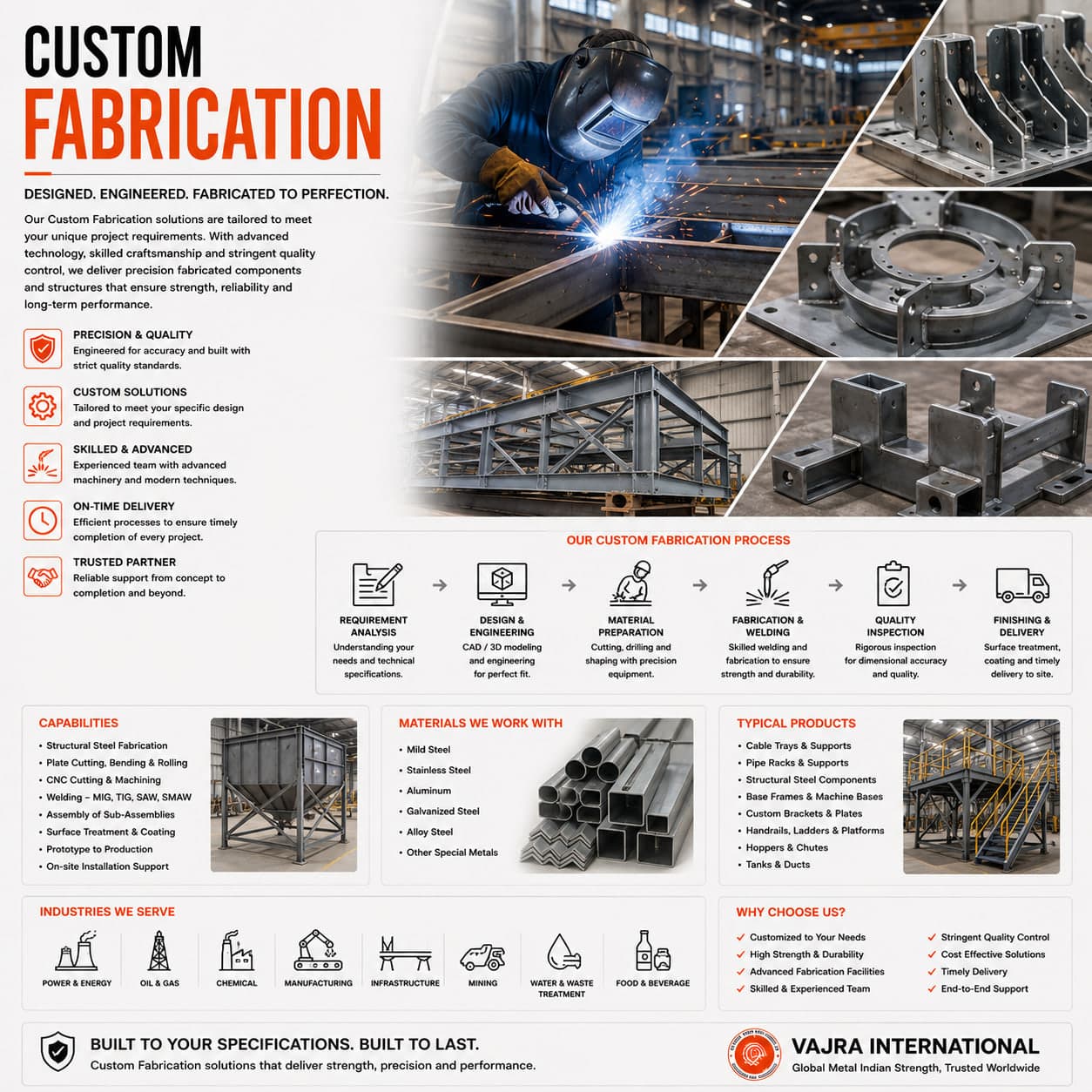
Vajra International holds ISO 9001 and manufactures IS 2062 structural steel, cable tray systems, earthing grids and gratings at Howrah. We are available for DGQA vendor registration enquiries and Tier-2 defence supply qualification discussions.