

The most common installation failure in cable management systems is not the cable tray itself, it is the support bracket at a span that slightly exceeds the tray's rated deflection limit at full load, causing progressive sagging over 3–5 years until the coupler joint fails and the cable bundle drops. The support spacing calculation is one page of arithmetic, but most project site supervisors skip it and use a rule-of-thumb of 3 metres between supports that was correct for 20 mm steel angle purlin systems in the 1990s and is not correct for modern 1.2–1.5 mm formed sheet-steel ladder trays carrying fibre, Cat6A and 16 mm² power cables at design fill.
IEC 61537 span tables, how to read them
IEC 61537 defines five load classes (A through E) based on the Uniformly Distributed Load (UDL) that a tray can carry at a given span with deflection not exceeding L/100 (span divided by 100). A manufacturer's span table presents these numbers as a matrix: tray width × sheet gauge × span length → UDL capacity. Reading example: a 300 mm wide, 1.5 mm gauge ladder tray at a 3,000 mm span might carry 85 kg/m of cables (Class B). Increasing the gauge to 2.0 mm lifts the same tray to 130 kg/m (Class C) at the same span. The L/100 deflection limit means a 3 m span can deflect maximum 30 mm at the rated UDL, acceptable for cable containment without kinking the cable. At 5 m spans the deflection limit drops to L/100 = 50 mm; the tray must be heavier-gauge or the span must be reduced.
Calculating the UDL for your cable schedule
Step 1: compile the cable schedule, every cable routed in the tray, its outer diameter (OD in mm) and weight per metre (kg/m) from the manufacturer's data sheet. Step 2: sum the total weight per metre of all cables. Step 3: add the tray self-weight per metre (from the manufacturer's data sheet, typically 3.5–7.5 kg/m for standard 1.2–2.0 mm sheet ladder trays depending on width). Step 4: the sum is your design UDL. Step 5: look up the span table for your tray gauge and width, find the maximum span that satisfies your UDL at the L/100 deflection limit. This is your maximum support spacing.
Standard support spacings for common applications
- Indoor plant rooms, light cable loading (control and instrumentation cables, fill <40%): 3,000 mm span, Class A or B tray, 1.2–1.5 mm gauge. Standard 1.5 mm ladder tray, 300 mm wide, typically satisfies this.
- Power distribution runs (35–150 mm² cables, fill 30–40%): 1,500–2,000 mm span recommended. Increase gauge to 2.0 mm for spans exceeding 1,500 mm with heavy power cable loading. Class C or D tray.
- Outdoor runs on pipe rack (wind load added): reduce span to 1,200–1,500 mm for standard gauge trays. Wind uplift on full cable tray in C5-I industrial atmosphere can add 15–25 kg/m equivalent to the structural load on the cantilever brackets.
- Vertical riser runs: maximum span = 50% of horizontal rated span. For a 3,000 mm horizontal span tray: maximum 1,500 mm support spacing on vertical runs. Add a dedicated bracket at every floor penetration point regardless of vertical run length.
- At changes of direction (bends, tees, reducers): support bracket required within 300 mm either side of each fitting. Never allow a fitting to carry a free span, fittings are not load-rated for unsupported deflection.
- Data centre overhead runs (high fill, Cat6A + fibre + 10 mm² power): 1,500 mm maximum span with 1.5 mm gauge 300–600 mm wide perforated tray. Data cables are lighter per cable but fill ratios are high, total UDL at 60% fill in a 600 mm wide tray can reach 60–80 kg/m.
Bracket selection: wall, trapeze, cantilever
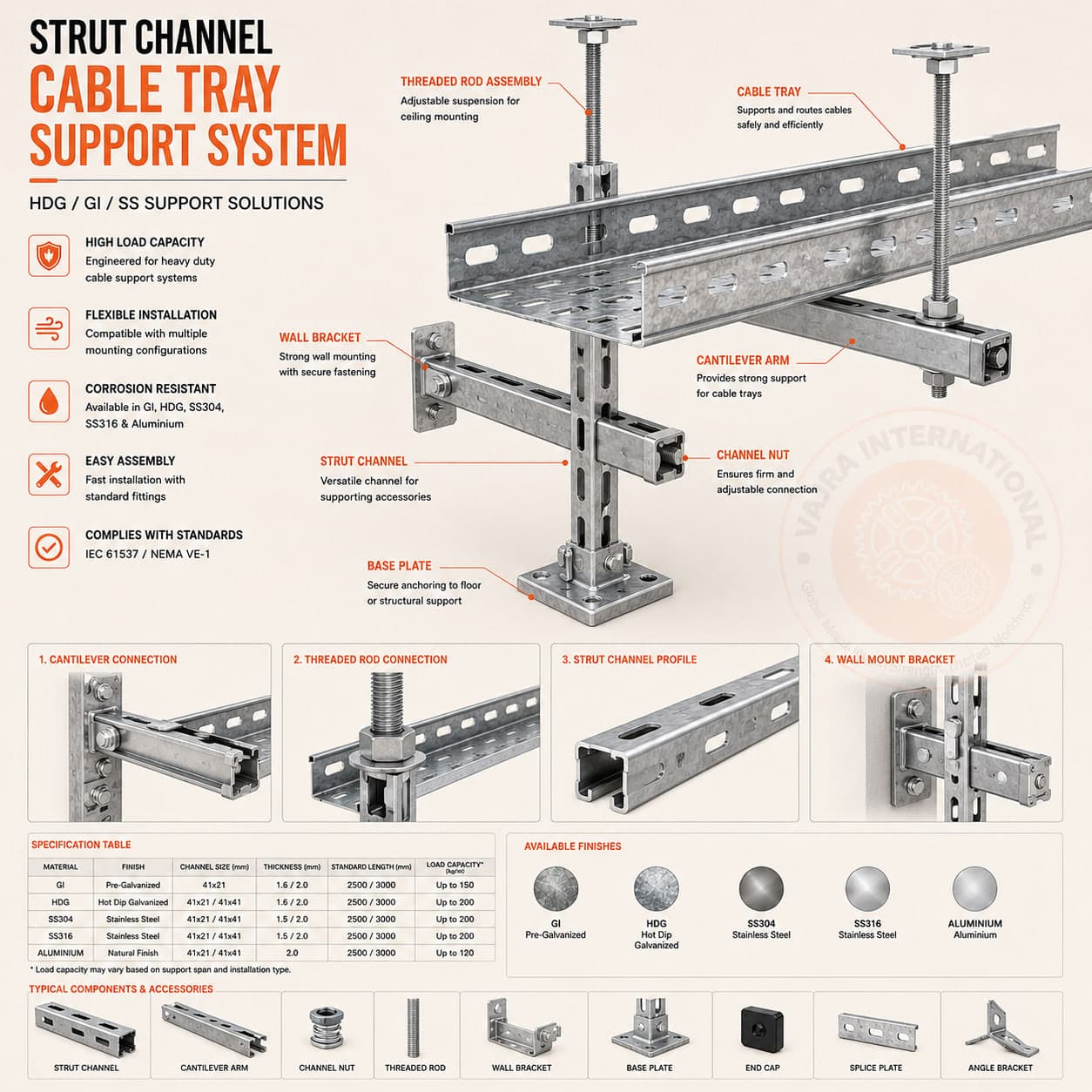
Single-sided wall brackets (L-bracket or Z-bracket) are correct for runs within 400 mm of a concrete or masonry wall, anchor bolt pull-out capacity must be calculated for the UDL × span ÷ 2 at each bracket. For high-density cable floors and data centre overhead runs, trapeze hangers (two threaded rods, M10 or M12, with a hot-rolled or formed crossbar) are standard, they allow multiple cable tray tiers on a single hanger set and are easy to modify later. For outdoor pipe rack runs: cantilever brackets welded or bolted to structural steel pipe rack beams, with hot-dip galvanized finish to match the cable tray. All bracket-to-structure fasteners must be stainless steel where the tray finish is stainless; HDG or galvanized-coated hardware for HDG tray installations.
The finish match rule, one most installations ignore
Every bracket, coupler, splice plate and support hanger in a cable tray installation must carry the same corrosion protection finish as the tray. A hot-dip galvanized tray on a pre-galvanized bracket corrodes first at the bracket-to-tray contact point, galvanic incompatibility at bi-metallic junctions is the second most common installation failure after incorrect support spacing. For HDG tray installations: all hardware must be HDG (minimum 85 µm coating) or equivalent. Pre-galvanized Z275 brackets carry only 18–25 µm zinc, they corrode significantly faster in outdoor or humid environments and will need replacement before the tray itself.
The maximum support spacing is not a budget parameter, it is a structural specification derived from your cable schedule and the tray's rated span table. If you increase support spacing to save bracket material costs, you are transferring the cost to a mid-run tray replacement 4–7 years later.
Need a cable tray installation that includes support brackets, bends, tees and accessories matched to your cable schedule? We supply complete cable tray packages from Howrah, pre-configured to IEC 61537 span table requirements. Submit your cable schedule and we'll return a matched specification with our quote.