

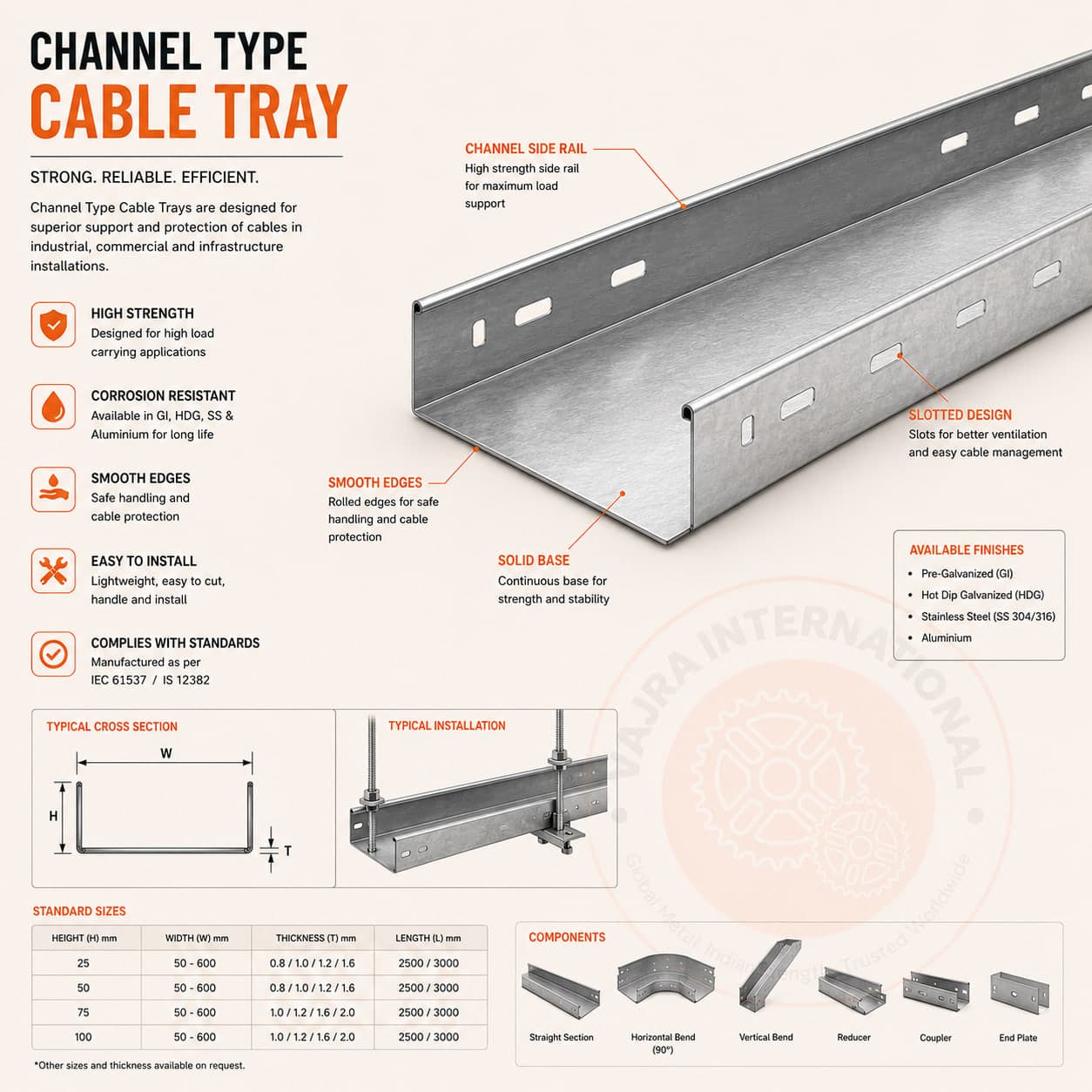
Most cable tray specifications default to steel without a material comparison. For 80% of industrial projects, that default is correct, hot-dip galvanized steel cable trays are the right answer for cost, load capacity and lifecycle. But for the other 20%, specifying steel in an environment where aluminium is the correct choice leads to either early failure or massively over-engineered structural support costs. The decision is not about material preference, it is about understanding what property of the material you are paying for and whether the installation actually needs it.
Where aluminium cable trays are the correct specification
- Offshore oil and gas platforms and FPSO vessels: aluminium alloy 6063-T5 cable trays weigh approximately 2.7 kg/m for a 300 mm wide ladder tray vs approximately 9.5 kg/m for an equivalent HDG steel tray. On a vessel or platform where every kilogram of structural load requires engineered support steel and where deck plate loading is limited, the 70% weight reduction is directly bankable. Major platform operators including Shell, BP and PETRONAS use aluminium tray as the default on topsides cable management. Material: alloy 6063-T5 or 6061-T6. Finish: mill-extruded, clear anodised or polyester powder-coated for salt-spray resistance.
- Chemical plants with chlorine, acid vapour or halide exposure: hot-dip galvanized steel corrodes rapidly in chlorine atmospheres (zinc chloride forms and is water-soluble, the protective layer is stripped). Aluminium forms a self-repairing aluminium oxide passive layer in the same chlorine environment. Petrochemical and pharmaceutical plants with Cl₂ or HCl processing specify 316L stainless or aluminium, the choice depending on structural requirements and budget. Aluminium is typically preferred where halide corrosion is the primary concern but structural loads are moderate.
- High-bay warehouses with suspended tray above finished ceilings: where the structural ceiling can carry only limited point loads and the tray run requires no intermediate supports over long spans, the weight reduction from aluminium allows a wider support spacing. An HDG steel 600 mm wide ladder tray at 1.2 mm gauge weighs approximately 13 kg/m fully loaded; the aluminium equivalent is approximately 4 kg/m unloaded. This is relevant for cold-storage facilities, food processing plants and logistics warehouses with light steel roof structures.
- Marine vessels (IEC 60092 applications): the IEC 60092 series (Electrical Installations in Ships) requires cable management systems to comply with IMO and classification society requirements. Most classification societies (Lloyd's Register, DNV GL, Bureau Veritas) have type-approved aluminium cable tray systems for marine use. Aluminium's corrosion resistance in the marine atmosphere (salt spray, humidity) without the galvanizing that fails at welds and cut edges is the specification driver.
Where steel cable trays are the correct specification
- Industrial plant, substations and power distribution rooms: steel's higher tensile strength (mild steel 250–350 MPa vs aluminium 6063-T5 at 145–195 MPa) and elastic modulus (210 GPa vs 69 GPa for aluminium) means that HDG steel trays carry heavier cable schedules on wider support spans without excessive deflection. A standard 600 mm wide HDG ladder tray at 2 mm gauge can carry 15 kN/m on a 1.5 m span. The aluminium equivalent requires a heavier section or closer support spacing to carry the same load. For power plant cable routes with 3×300 mm² HV cables, steel is the only cost-effective choice.
- High-temperature environments (above 150°C): aluminium's yield strength degrades significantly above 150°C. In environments near furnaces, steam lines or high-heat process equipment, HDG steel cable trays are rated for ambient temperatures up to 500°C (structural integrity maintained; galvanizing partially consumed above 250°C but base steel remains). Aluminium cable trays are limited to approximately 120–150°C continuous service.
- Cost-sensitive projects where weight is not a constraint: aluminium cable trays cost 40–60% more per metre (raw material price) than equivalent HDG steel. In a typical industrial or commercial building where the structure can support the steel tray weight without redesign, HDG steel is the correct default on cost. The weight premium in aluminium is only cost-justified when it directly reduces structural cost or is mandated by weight constraints.
- Fire-rated cable management routes: BS EN 50085 and IEC 61537 fire performance testing of cable management systems is generally done with steel trays for fire-critical routes. Where fire performance certification is required, confirm that your aluminium system holds the necessary test evidence, not all do. HDG steel is the lower-risk default for fire-rated routes.
Joining and earthing aluminium cable trays
The two most common site problems with aluminium cable trays are electrolytic corrosion at connections and earthing continuity failures. Both are preventable. Electrolytic corrosion: aluminium is far below steel and copper in the galvanic series. Any direct contact between aluminium tray and carbon steel support steelwork in a wet environment will cause galvanic corrosion of the aluminium. Use aluminium-to-steel isolation sleeves at support clamp positions, or specify 316L stainless steel fasteners throughout. Earthing: aluminium is not a compatible conductor for bonding to copper earthing systems without bi-metallic washers or dedicated transition terminals. Al/Cu bimetallic connectors (crimped or bolted with bitumen anti-corrosion compound) are the correct joint at every aluminium-to-copper earthing connection. Do not bond aluminium trays directly to copper earth conductors, the galvanic pair corrodes the aluminium in the contact zone.
Alloy specifications for cable trays
- 6063-T5 (most common): good extrusion characteristics, moderate strength, excellent corrosion resistance. Yield strength ~145 MPa. Standard for ladder and perforated trays in general industrial and marine applications.
- 6061-T6: higher strength (yield ~275 MPa) for heavier structural sections and cover supports. Used on offshore and where wide spans are required with minimum material weight.
- 5052-H32: excellent resistance to saltwater and marine atmospheres, high fatigue strength. Less commonly used for cable trays but specified for high-corrosion marine environments.
Ask the right question before writing the specification: is this installation weight-critical, or corrosion-environment-critical, or both? If neither, you are probably specifying HDG steel and the decision is settled.
Need a quote for aluminium cable trays in alloy 6063-T5 or 6061-T6? We supply both aluminium and HDG steel cable trays from Howrah, tell us your environment and we'll recommend the right material.