

The United States is the largest single market in the world for industrial cable management and grounding, and also the most procedurally specific. An Indian manufacturer competes well on price and lead time, but only after the buyer clears two gates that most other markets do not have: the Buy America funding test and UL/NEMA conformity. Get those two right and India is highly competitive on private US projects; get them wrong and the material is unusable the day it lands.
Where India competes, and where it cannot: the Buy America line
The most expensive mistake a US buyer can make with imported steel is using it on a project where Buy America applies. The Build America, Buy America Act (BABA), part of the 2021 Infrastructure Investment and Jobs Act, requires that the iron and steel used in federally-funded infrastructure be produced domestically. That removes imported cable tray and steel structures from federal-aid highways, public transit, municipal water and many grid-modernization projects unless the funding agency grants a waiver. But the bulk of US cable management demand is private: hyperscale and colocation data centers in Northern Virginia, Dallas, Phoenix and Atlanta; oil, gas and petrochemical work along the Houston Gulf Coast and the Permian Basin; private power, semiconductor fabs and commercial construction. None of those carry a Buy America restriction, and that is exactly where Indian-manufactured cable trays and earthing compete head to head on price and delivery.
Specify in the US system: NEMA VE 1, not IEC 61537
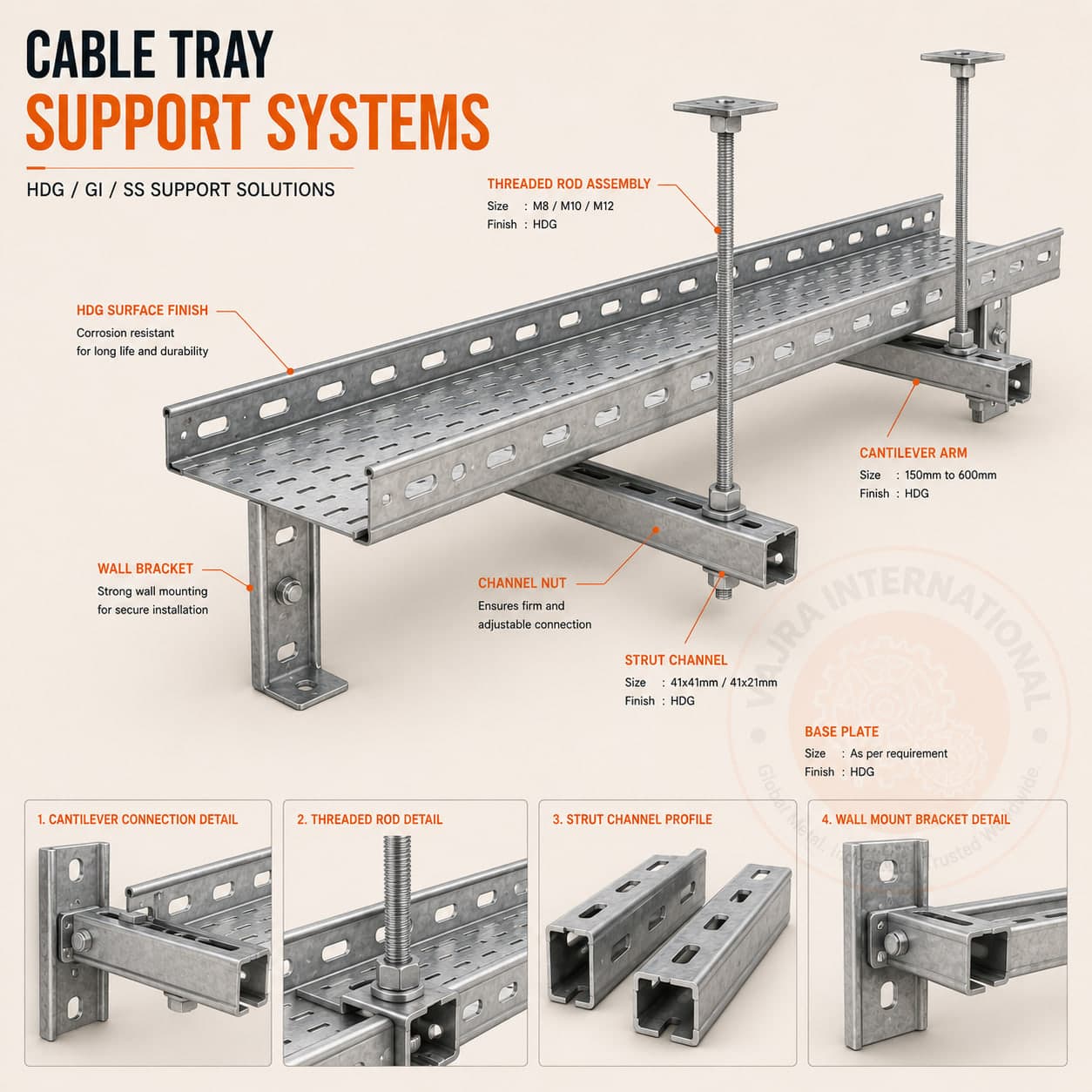
US cable tray specifications use NEMA VE 1 (Metal Cable Tray Systems), with installation guidance in NEMA VE 2 and permitted use governed by NEC (NFPA 70) Article 392. NEMA load and span designations do not translate directly into IEC 61537 load classes, a tray built to an IEC class must be re-engineered and re-documented against the NEMA designation on the US drawing. Finishes follow US and ASTM references: pre-galvanized strip to ASTM A653, hot-dip galvanizing after fabrication to ASTM A123, and stainless 304 or 316 for corrosive and coastal service. Quote against the NEMA class, the span, and the ASTM finish the spec names, not the equivalent you would use for a Gulf or European job.
Grounding to UL 467 and NEC Article 250
US grounding is governed by NEC Article 250, with grounding and bonding equipment listed to UL 467. The UL 467 copper-bonded ground rod requires a minimum 10 mil (0.254 mm) copper coating over a steel core, a heavier copper layer than the 100 to 250 µm used in many other markets, and the figure a US distributor verifies first. Standard rods are 5/8 in and 3/4 in diameter in 8 ft and 10 ft lengths. Substation grounding grids are designed to IEEE 80, with conductor connections to IEEE 837. Indian manufacturers produce UL-467-dimension copper-bonded rods and IEEE-80 grounding conductors as a matter of routine, the discipline that matters for the US is documenting the 10 mil coating on the material test certificate, because under-coated rods are the most common reason a US receiving dock rejects an earthing shipment.
Ports, duty and the landed-cost comparison
Route the shipment to the coast nearest the project: Los Angeles or Long Beach for the western US (shortest transit from India, roughly 22 to 26 days), Houston for the Gulf energy corridor, and New York/New Jersey, Savannah or Charleston for the East Coast. The delivered-price comparison against a US domestic supplier has to include the Section 232 steel tariff where it applies, plus the standard import duty and ocean freight. A customs broker's written landed-cost estimate against the exact HTS code for the product is worth getting before the first order, on some line items India saves a clear margin even after duty, and on others the domestic quote wins. Knowing which is which, per product, is the difference between a profitable import and a stranded one.
On a US project the first two questions are not about price. They are: is this project federally funded, so does Buy America apply, and does the specification require UL Classification? Answer both before you quote. They decide whether Indian steel is even eligible.
Supplying a US data center, refinery or private industrial project from India? We manufacture cable trays to NEMA VE 1 with ASTM finishes, and copper-bonded ground rods to UL 467 dimensions, with mill test certificates and Certificate of Origin. Tell us the specification and destination port and we'll return a landed-cost-aware quotation.