
The UAE imported approximately USD 45 million of cable trays, earthing systems, busbars and related metal products from India in the 12 months to March 2026, the largest single GCC market and one of the top three global destinations for Indian cable management exports. The demand is driven by DEWA (Dubai Electricity and Water Authority) infrastructure and generation expansion, ADNOC's Ruwais and Abu Dhabi industrial complex build-out, the UAE's data centre cluster (equinix, G42, Khazna) expanding across Dubai and Abu Dhabi, and a continuous cycle of commercial and industrial real estate development with active EPCs (ENEC, Samsung C&T, L&T Construction, Petrofac, Saipem) operating across all seven emirates.
DEWA Technical Standards: what they require for cable trays
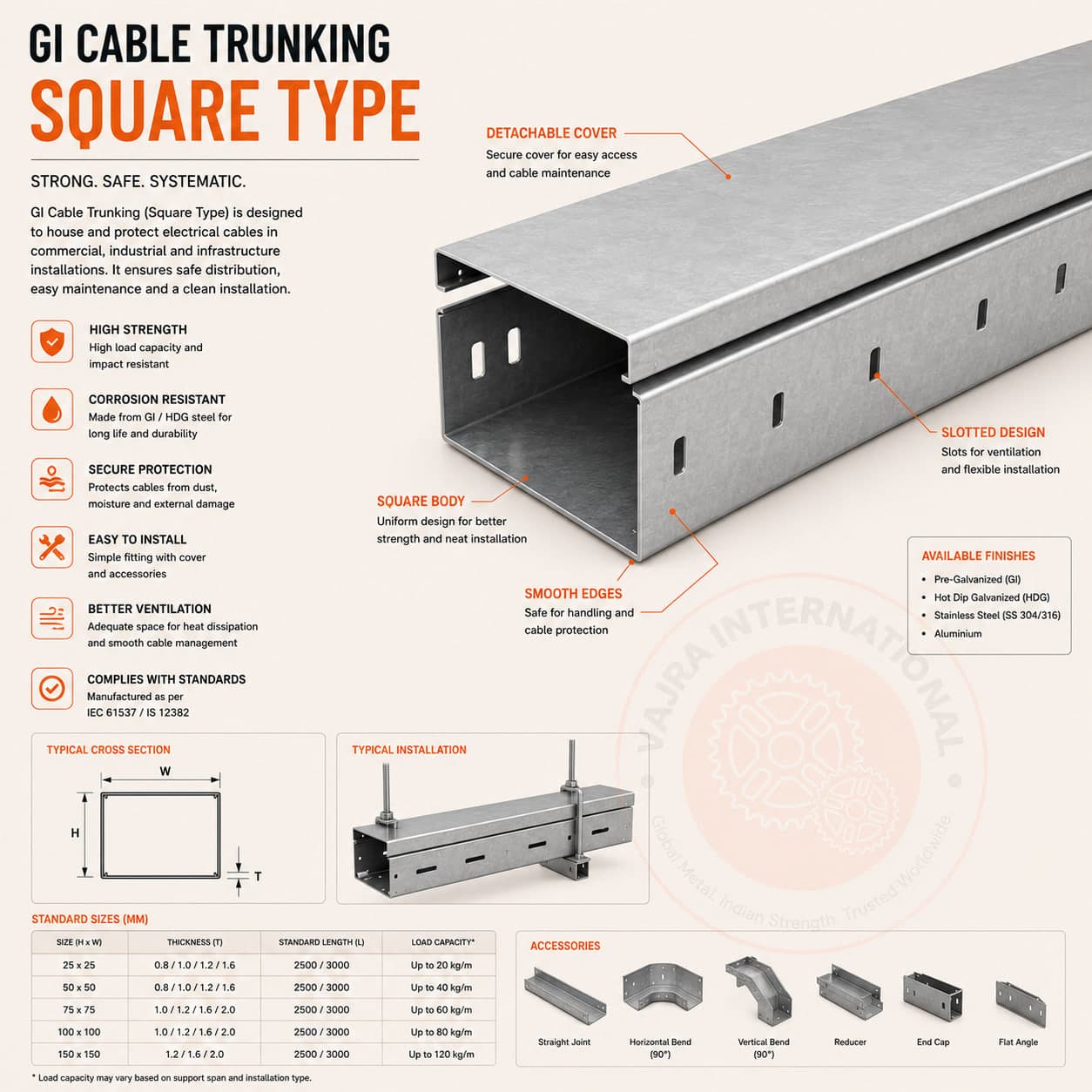
Dubai Electricity and Water Authority (DEWA) issues Technical Standards and Specifications (TSS) documents covering approved materials for all grid-connected and distribution projects within the Emirate of Dubai. For cable management systems: DEWA TSS references IEC 61537 as the applicable product standard. DEWA specifications require hot-dip galvanizing to ISO 1461 (equivalent: ASTM A123), pre-galvanized materials are not accepted for DEWA outdoor or underground installations. DEWA requires an EN 10204 Type 3.1 MTC for all structural steel and cable management materials. The standard does not mandate a specific HDG thickness beyond ISO 1461 minimums (85 µm average), but DEWA contractor quality plans routinely add a requirement for XRF confirmation on delivery. DEWA vendor approval is conducted at the project contractor level. DEWA-approved main contractors (Al Nabooda, Voltas ME, ETA-Melco, Balfour Beatty, Samsung C&T) procure materials from qualified suppliers, and the technical documentation package must satisfy the main contractor's quality plan before material release.
ADNOC procurement: GSP standards and Eastern Region specifications
Abu Dhabi National Oil Company (ADNOC) and its downstream affiliates (Borouge, ADNOC Refining, ADNOC Distribution, ADNOC Gas) procure cable management under ADNOC's own General Specification for Procurement (GSP) documents, supplemented by project-specific Engineering Technical Specifications (ETS) issued by the project management consultant (usually Worley, AECOM, Technip or Wood). ADNOC GSP for electrical materials references IEC 61537 for cable trays and IEC 62561 for earthing and lightning protection systems. The key difference from DEWA: ADNOC projects in the Abu Dhabi Industrial Area (ICAD), Ruwais Industrial Complex, Mussafah and Das Island are classed as hydrocarbon facility environments, which triggers additional earthing continuity and bonding requirements equivalent to ARAMCO SAES-P-104 (earthing at every tray joint, 4 mm² bonding conductor across all couplers). ADNOC's Approved Vendor List (AVL) is managed centrally and updated annually; Indian manufacturers not on the AVL supply through ADNOC-approved EPC or material supply contractors.
India–UAE CEPA: the duty saving most importers are not claiming
The India–UAE Comprehensive Economic Partnership Agreement entered into force on 1 May 2022. Under CEPA, cable trays (HS 7308.90), earthing electrode products (HS 7326.90), copper busbars (HS 7407.10) and structural steel items (HS 7308.40) attract 0% import duty when imported from India. The standard UAE customs duty on these HS categories is 5%, a meaningful saving on large-volume orders. To access the CEPA rate, the Indian exporter must issue a CEPA Certificate of Origin, which confirms that the product meets CEPA Rules of Origin (typically: manufactured in India, with sufficient domestic value addition). The CEPA COO is issued by EEPC India, it must be specifically requested on the purchase order and is separate from a standard non-preferential COO. A 2024 survey of UAE importers found that approximately 35% of eligible Indian metal products were still being cleared at the 5% MFN rate because the CEPA COO was not being requested. On a USD 200,000 cable tray order, the unclaimed CEPA saving is USD 10,000.
UAE documentation requirements
- CEPA Certificate of Origin: EEPC India-issued COO claiming preferential CEPA rate. Saves 5% import duty on most metal product HS categories. Must be requested on the PO.
- EN 10204 Type 3.1 MTC: heat number, chemical composition, tensile strength, yield strength, elongation. Both DEWA and ADNOC projects require Type 3.1, not Type 2.2. Issued under the manufacturer's QC department letterhead by a qualified person.
- HDG Coating Inspection Report: XRF measurements per ISO 1461 / ASTM A123, minimum 5 readings per m², minimum 85 µm average. DEWA contractors typically verify on delivery; provide the report with the shipping documents.
- Commercial Invoice: AED or USD value, accurate HS code (8-digit UAE tariff schedule), country of origin (India), Incoterm. For CIF Jebel Ali shipments: freight and insurance must be stated separately from FOB value.
- Packing List: bundle-level detail with dimensions and weights. UAE customs spot-checks, ensure packing list weights are accurate.
- Bill of Lading: Kolkata or Mundra to Jebel Ali or Khalifa Port. Transit: 10–14 days. Multiple carriers operate direct services (MSC, Evergreen, CMA CGM) on Kolkata/Mundra–Jebel Ali lane.
Port routing: Jebel Ali vs Khalifa Port vs Hamriyah
Jebel Ali Port (Dubai, DP World) is the region's dominant transshipment and import hub, correct for all Dubai, Sharjah and Northern Emirates project destinations. Abu Dhabi projects route through Khalifa Port (Abu Dhabi Ports / COSCO joint venture), faster inland delivery to Abu Dhabi City, Mussafah, ICAD and the Abu Dhabi mainland than Jebel Ali. ADNOC Ruwais projects: Ruwais has its own industrial jetty for bulk and project cargo, large EPC packages destined for Ruwais should be discussed with the project logistics coordinator before routing via Jebel Ali, as direct Ruwais cargo has shorter inland transit. Hamriyah Free Zone (Sharjah): some UAE distributors operate re-export warehouses from Hamriyah, relevant only if the shipment is destined for a GCC regional distribution network rather than a UAE end project.
Request the CEPA Certificate of Origin on every Indian purchase order. It is not issued automatically, you have to ask for it. On a typical 1×20ft container of cable trays (approximately USD 35,000–50,000 FOB value), the CEPA saving is USD 1,750–2,500 per container, real money on repeat orders.
Sourcing cable trays, earthing or busbars for a DEWA, ADNOC or UAE EPC project? We supply with full UAE documentation: EN 10204 Type 3.1 MTC, CEPA COO, HDG coating report and DEWA-compliant data sheets. Submit your specification and we'll return a quotation within 24 hours.