

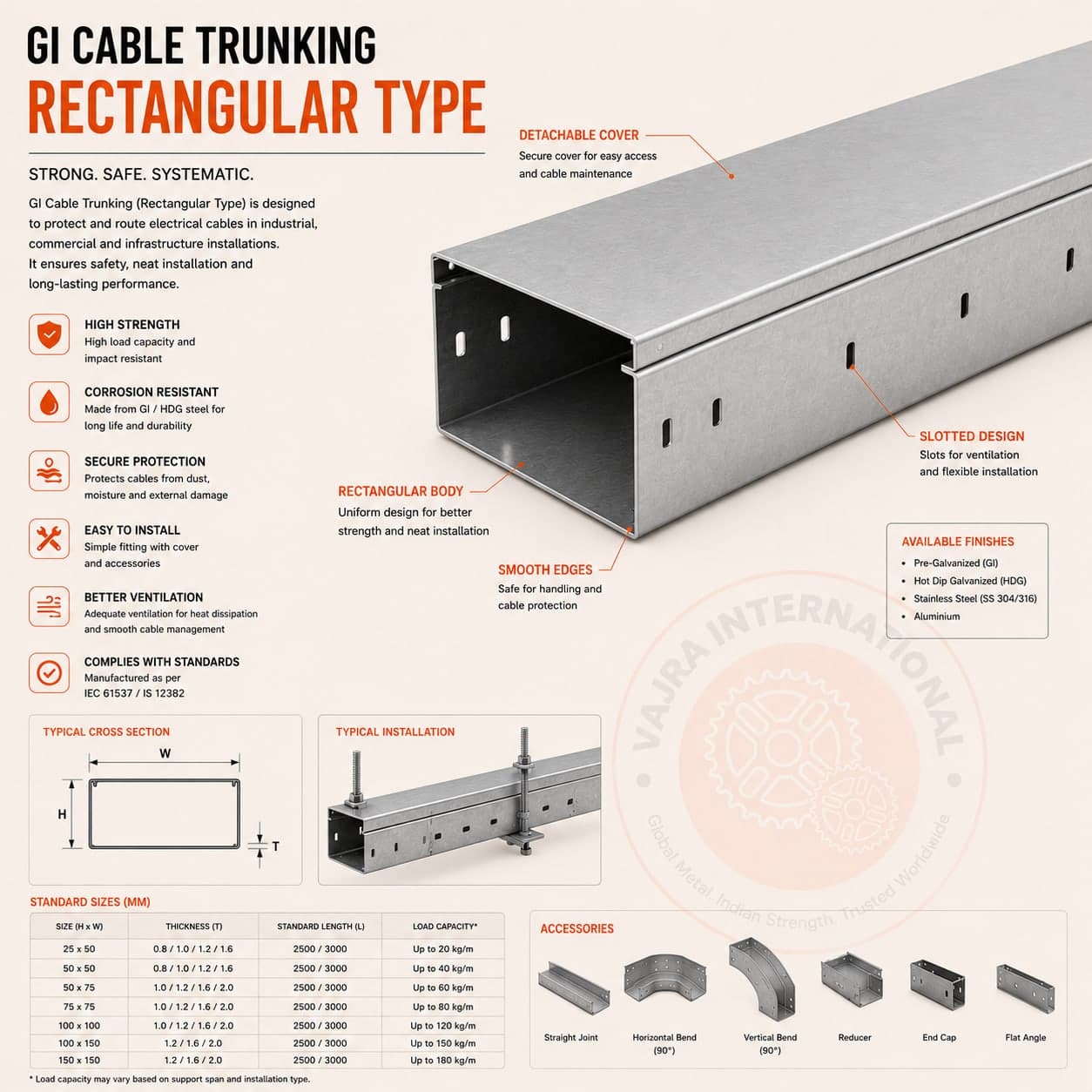
Saudi Arabia is the largest single destination for Indian cable management exports to the Middle East, approximately USD 38 million of cable trays, earthing systems and related metal products from India entered Saudi Arabia in the 12 months to March 2026. Three buyer segments drive the majority of this volume: Saudi Aramco and its EPC contractors operating in the Eastern Province (Jubail, Dhahran, Ras Tanura), SABIC affiliates and downstream petrochemicals in Jubail Industrial City, and the Saudi Electricity Company (SEC) building out transmission and distribution infrastructure under Vision 2030. Each segment has distinct procurement procedures, vendor qualification requirements and technical specifications, and the documentation requirements are among the most rigorous for any export destination worldwide.
Saudi Aramco vendor qualification, what it actually involves
Saudi Aramco operates a centralised Supplier Qualification System (SAQAS). Cable tray manufacturers seeking direct Aramco supply must apply through the Supplier Relationship Management (SRM) portal, provide ISO 9001:2015 certification, submit product-level technical data sheets referencing Aramco's Materials System (MESC codes), and pass a quality management system audit, either documentary or on-site at the manufacturer's facility. The audit assesses process controls, inspection records, MTC traceability and the ability to produce project-specific quality documentation to Aramco's General Instructions for Materials (GI numbers). For most Indian cable tray exports to ARAMCO projects, the practical route is indirect: supply to an ARAMCO-approved EPC contractor (Saipem, Samsung C&T, Larsen & Toubro, Archirodon, Técnicas Reunidas) who holds the direct vendor qualification and places the purchase order on behalf of the project. The EPC contractor's quality surveillance team or a nominated third-party inspection agency (Bureau Veritas, SGS, Intertek) then witnesses production at the Indian manufacturer's facility.
SABIC and Jubail Industrial City procurement
SABIC affiliates (SADAF, Al-Jubail Fertiliser Company, Ibn Zahr, Sahara Petrochemicals) procure through their individual materials management departments, with vendor qualification handled at the SABIC affiliate level rather than centrally. Cable trays for SABIC projects must meet ARAMCO SAES-P-104 as a default for cable management in petrochemical environments, plus any project-specific supplements issued by the affiliate. The Jubail Industrial City (Royal Commission for Jubail and Yanbu) has its own building and electrical codes that reference SEC standards for distribution infrastructure within the industrial city grid, for mixed industrial-utility projects in Jubail, confirm which standards apply (SEC or SABIC project specification) with the EPC's lead electrical engineer before finalising the specification.
SEC transmission and distribution projects
The Saudi Electricity Company is building approximately 18,000 km of new transmission lines and 1,200 new substations under the Vision 2030 infrastructure programme. SEC cable management specifications reference IEC 61537 and SEC's own Materials Specifications, which are issued to pre-qualified suppliers. The SEC Approved Vendor List (AVL) is the primary qualification route for direct supply. Indian manufacturers not on the SEC AVL can supply through SEC-approved material supply companies (MSCs) which hold the AVL accreditation and import materials for SEC-connected projects. For earthing systems: SEC substations require IS 3043 or IEC 62561-compliant earthing electrode systems with EN 10204 Type 3.1 MTC, the copper-bonded electrode specification, in particular, requires the copper layer thickness and bond strength to be documented on the MTC.
SASO and Saudi Standards: what's actually required for cable trays
SASO (Saudi Standards, Metrology and Quality Organisation) issues technical regulations for products placed on the Saudi market. Cable trays (HS 7308.90) are not classified as SASO-regulated products requiring mandatory conformity assessment or import certification. This means cable trays do not require a SASO Certificate of Conformity (CoC) from an approved certification body as a condition of import. What Saudi import customs requires for cable trays is: commercial invoice, packing list, bill of lading, and a Certificate of Origin. EN 10204 Type 3.1 MTC, HDG coating reports and other technical documentation are typically required by the EPC or end client, not by Saudi customs. Some SASO product categories, electrical wiring accessories, fire detection equipment, do require mandatory CoC. Cable trays, structural steel and earthing systems are not in this category as of June 2026, though SASO technical regulations evolve and should be confirmed with a Saudi customs broker for each shipment.
India–Saudi trade documentation and import duty
- Certificate of Origin: Non-preferential COO issued by EEPC India or authorised chamber. Saudi Arabia is a member of the Arab League, and India does not have a bilateral FTA with Saudi Arabia directly. The GCC Unified Customs Tariff applies. MFN import duty on HS 7308.90 (cable trays) into Saudi Arabia: 5%. This applies to Indian cable trays unless a specific project is under a government-to-government exemption.
- Commercial Invoice: must show FOB or CIF value in USD or SAR, full product description, HS code, gross and net weight, and country of origin (India). Saudi customs require the invoice to be attested by a Saudi Embassy or equivalent in India for shipments above certain thresholds, confirm current attestation requirements with your freight forwarder before shipment.
- EN 10204 Type 3.1 MTC: signed by the manufacturer's qualified QC personnel. Must show heat number, chemical analysis, tensile/yield strength, elongation and impact values for the base steel. Aramco and SEC projects additionally require the HDG coating inspection report with XRF measurements per ASTM A123.
- Packing List and Weight Certificate: required for all container shipments. Saudi customs weigh containers, packing list weights must be accurate.
- Bill of Lading: Kolkata or Mundra to Dammam (King Abdulaziz Port, KAPP) or Jeddah Islamic Port. Transit time: 12–18 days Kolkata–Dammam direct; 16–22 days via transshipment through Dubai Port or Singapore.
Port of entry: Dammam vs Jeddah
Eastern Province projects (Jubail, Dhahran, Ras Tanura, Al Khobar) should route through Dammam/King Abdulaziz Port, shortest inland haulage, direct trucking to all Eastern Province industrial sites. Riyadh projects can use either Dammam (6-hour trucking) or Jeddah (8-hour trucking across Riyadh via the Makkah Road), with Dammam typically slightly preferred for construction materials logistics. Western Province and Jeddah Industrial City projects use Jeddah Islamic Port. Yanbu Industrial City (SABIC Yanbu affiliate) routes through Yanbu Commercial Port, which handles general cargo, confirm with the Saudi freight agent whether out-of-gauge or overweight loads require the Yanbu oil export terminal instead.
The Saudi documentation burden is heavier than most markets: attested commercial invoice, Type 3.1 MTC with heat number traceability, HDG coating report, and COO are all typically required by the EPC client before goods are released from the vessel. Plan document preparation in parallel with production, not after.
Supplying an ARAMCO, SABIC or SEC project in Saudi Arabia? We have supplied Eastern Province EPC contractors with full documentation packages. MTC, COO, coating report, data sheets. Submit your project specification and we'll return a matched quotation.