
Qatar imported approximately USD 12 million of cable trays, earthing systems and structural metal from India in the 12 months to March 2026. The demand is driven by two parallel programmes: QatarEnergy's North Field LNG expansion, the largest single LNG project in the world, targeting 126 MTPA capacity by 2030, and KAHRAMAA's national grid expansion and substation build-out under the Qatar National Vision 2030 infrastructure programme. Both procurement channels require Indian manufacturers to meet stringent documentation standards, use IEC-compliant materials, and provide third-party inspection certification at origin.
KAHRAMAA transmission standards: what they require
KAHRAMAA (Qatar General Electricity and Water Corporation) is the electricity and water utility for Qatar. For transmission and distribution infrastructure, substations, overhead lines, underground cable networks, KAHRAMAA issues its own Engineering and Technical Specifications. For cable management: KAHRAMAA references IEC 61537 as the product standard and requires hot-dip galvanizing to ISO 1461 with coating thickness above 100 µm average (more conservative than the ISO 1461 minimum of 85 µm) due to Qatar's harsh Gulf atmosphere. KAHRAMAA requires vendor registration before direct supply, but as with most Gulf utilities, the practical route for Indian manufacturers is to supply through a KAHRAMAA-registered EPC or materials supply company, with all technical documentation included in the EPC's supply package.
QatarEnergy North Field LNG expansion: project scale and requirements
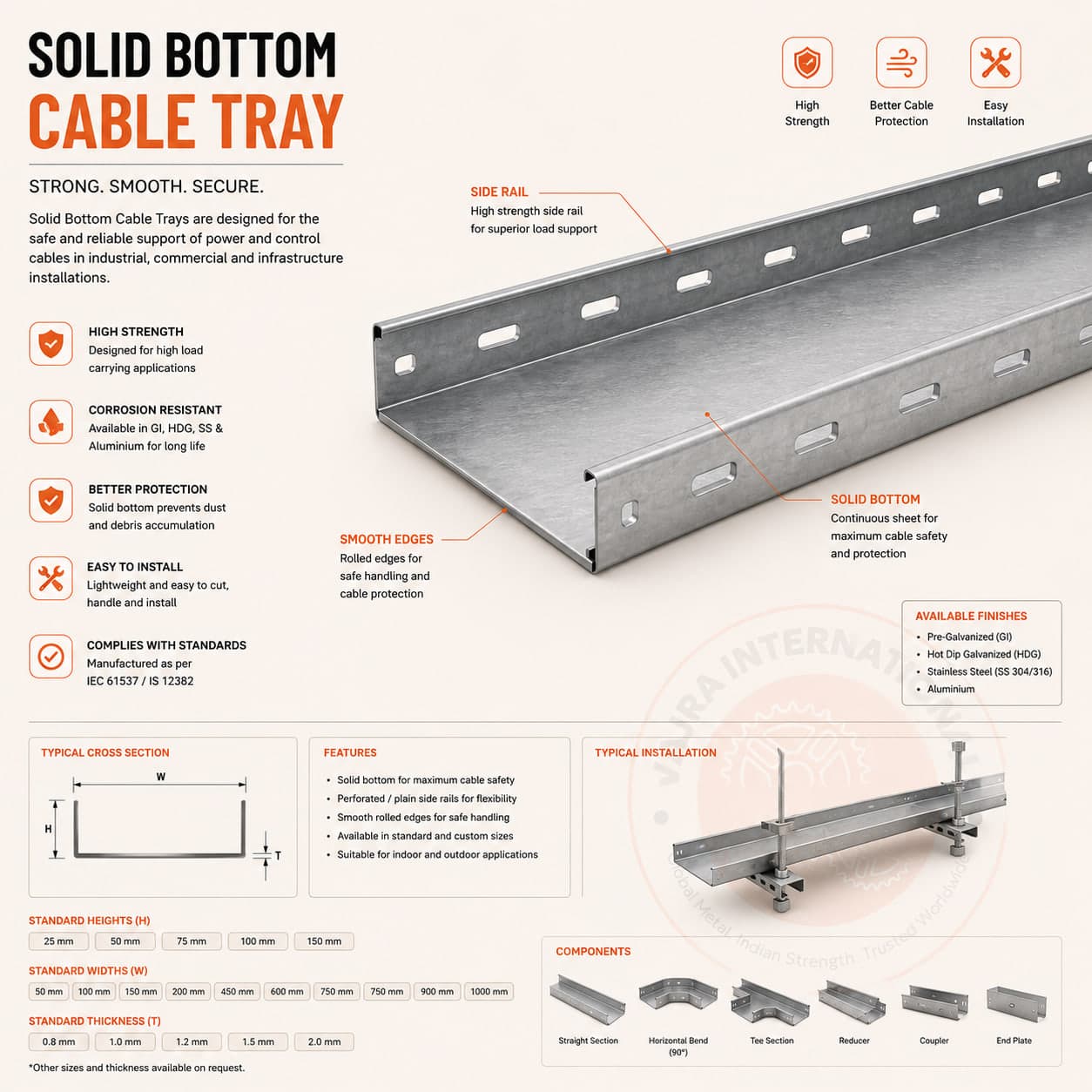
The QatarEnergy North Field South (NFS) and North Field North (NFN) LNG expansions involve six new LNG trains at Ras Laffan Industrial City, each at approximately 8 MTPA, with associated gas processing, pipeline infrastructure and offshore wellhead platform upgrades. The EPC contractors for these projects include major international firms (TotalEnergies, Chiyoda, McDermott, JGC, Saipem, Samsung C&T) who procure materials against QatarEnergy's General Specification for Civil, Mechanical and Electrical (CME) materials. For cable trays in Ras Laffan industrial facilities: the specification references IEC 61537 plus QatarEnergy's supplement requiring HDG to ASTM A123 minimum 100 µm, fireproof tray specification for cable routes within 15 m of process equipment, and third-party pre-shipment inspection by a nominated TPI agency. The fireproof cable tray requirement is typically met by a 25 mm mineral wool lining inside standard ladder trays, this is a fitted accessory, not a material change to the tray itself.
Ras Laffan Industrial City: infrastructure procurement specifics
Ras Laffan Industrial City (RLC) is the world's largest LNG and gas-to-liquids complex, located 80 km north of Doha. Procurement for RLC projects is managed by QatarEnergy directly or through appointed EPCs under long-term frame agreements. Most RLC infrastructure cable management is procured in large packages, a single NFS LNG train typically requires 15,000–30,000 metres of cable tray in various widths plus associated earthing and support steel. RLC projects require that all material MTC serial numbers be cross-referenced to shipping mark numbers on the packing list, material traceability is enforced at the project gate (QatarEnergy entry inspection). Vajra International has prepared RLC-format documentation packages for several Ras Laffan projects through our EPC customers.
Documentation for a Qatar shipment
- Certificate of Origin: Qatar is a GCC member. Standard UAE/GCC 5% import duty applies to cable trays (HS 7308.90) from India. India does not have a bilateral FTA with Qatar or the GCC directly, standard MFN 5% duty applies. A non-preferential COO from EEPC India is sufficient.
- EN 10204 Type 3.1 MTC: with heat number, chemical analysis, tensile, yield and elongation values. QatarEnergy and KAHRAMAA specifications both require Type 3.1, not Type 2.2. The heat number must be stencilled on all bundles and cross-referenced in the packing list.
- HDG Coating Inspection Report: XRF or magnetic gauge, minimum 5 readings per m², average ≥ 100 µm (Qatar spec), minimum single reading ≥ 85 µm. This is more stringent than the standard ASTM A123 requirement.
- Third-Party Inspection Report: Bureau Veritas or Lloyd's Register (nominated by the project). Production witnessing, dimensional check and coating verification at the Howrah facility before shipping.
- Bill of Lading: Kolkata or Mundra to Hamad Port, Doha. Transit: 12–18 days via Jebel Ali transshipment or 14–20 days direct. Multiple carriers serve this route.
Qatar's coating specification is 100 µm average minimum. 15 µm more than ASTM A123's 85 µm minimum. This requires a longer dip time in the galvanizing bath and a slightly heavier zinc consumption per tonne of steel. Confirm the 100 µm requirement is in your purchase order before your factory runs the batch.
Sourcing cable trays or earthing for a QatarEnergy or KAHRAMAA project? We supply Ras Laffan format documentation packages. Type 3.1 MTC, 100 µm HDG coating report, TPI witnessing and COO. Submit your specification and we'll return a quotation within 24 hours.