

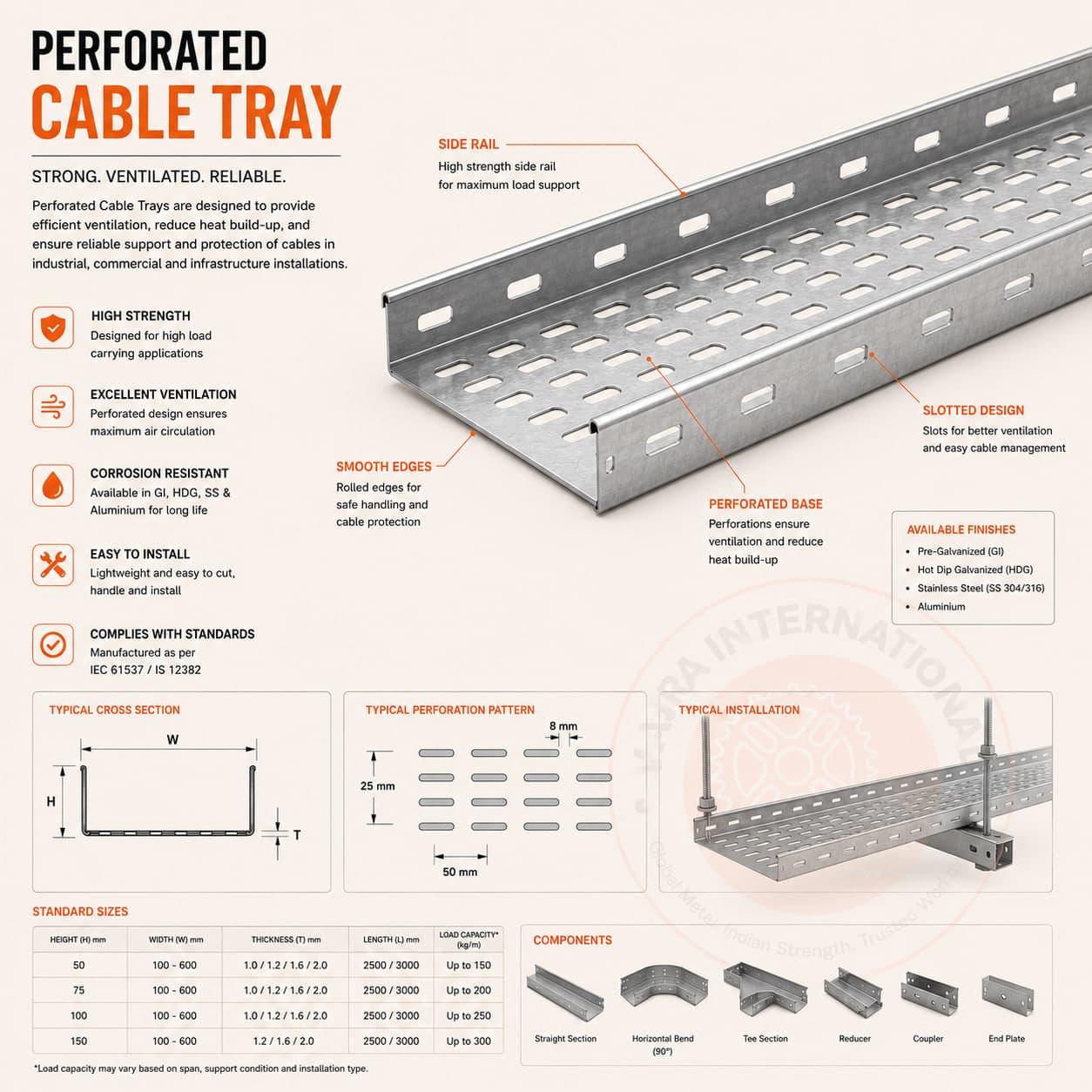
The Philippines imported approximately USD 24 million of cable trays and associated metal products from India in the 12 months to March 2026, making it the sixth-largest Asian market for Indian cable management exports. The demand drivers are specific: the SMC-DMCI-PHINMA MRT 7 metro rail project running north from Quezon City through Bulacan, ongoing power infrastructure expansion by MERALCO and the National Grid Corporation of the Philippines (NGCP), the Cebu-Visayas Interconnection Project, and continued data centre build-out in Metro Manila and Cebu. Each of these buyer segments has its own procurement specification, documentation requirement and approval process, and they are different from each other.
MERALCO and NGCP: what their specifications actually require
Manila Electric Company (MERALCO) and the National Grid Corporation of the Philippines specify electrical and structural materials under their own Material Standards and Specifications documents, which are available to pre-qualified suppliers. For cable trays and earthing systems, the key requirements are: material certification to IEC 61537 (cable management systems) or equivalent PNS (Philippine National Standard) reference; hot-dip galvanizing to ASTM A123 or ISO 1461 with coating thickness report (XRF or magnetic gauge, not visual assessment); Mill Test Certificate for the base steel showing yield strength, tensile strength, chemical composition and elongation. MERALCO's procurement process requires vendor pre-qualification, you need to be on their Accredited Suppliers List (ASL) or supply through a local Philippine distributor who holds the ASL accreditation. Vajra International's typical approach for MERALCO projects is supply to a Philippine EPC or distributor who holds the relevant ASL accreditation, with all technical documentation provided under the EPC's requisition number.
MRT 7 project: what rail projects require in addition
The SMC–DMCI–PHINMA Metro Rail Transit Line 7 (MRT 7) project, running from North Avenue in Quezon City to San Jose del Monte City in Bulacan (22.8 km, 14 stations), is the largest single cable management procurement driver in the Philippines currently. Rail projects in ASEAN markets require third-party inspection at origin (usually Bureau Veritas, Intertek or SGS nominated by the project), compliance with the project-specific Cable Tray Design Standard which references EN 61537 / IEC 61537, and fire performance certification per EN 50085-1 for cable management systems in tunnels and stations. Third-party inspection for MRT 7 cable tray orders is typically done at the manufacturer's facility in India before shipment. Vajra's Howrah plant accommodates inspector visits for production witnessing, dimensional checks and coating verification. We provide the test reports, coating certificates and MTC in the format specified in the project's QAP (Quality Assurance Plan).
Philippine customs documentation for a cable tray shipment
- Commercial Invoice: FOB or CIF value in USD, HS code, net and gross weight, description must match the shipping marks on the packages.
- Packing List: carton-by-carton breakdown with individual weights and dimensions for container stuffing documentation.
- Bill of Lading: issued by the shipping line at Kolkata Port. Common routes: Kolkata–Singapore transshipment–Manila (via ICTSI Manila International Container Terminal) or Kolkata–Port Klang–Manila. Transit time: 16–22 days.
- Material Test Certificate (MTC): EN 10204 Type 3.1 (witnessed and certified by the manufacturer's QC department). Must show heat number traceable to the steel coil used in production.
- Certificate of Origin (COO): Issued by EEPC India or authorised chamber. Required for all shipments to confirm Indian origin. The Philippines is not a GSP-eligible trade partner for India's standard GSTP rate, but India–ASEAN FTA (IAIFTA) provides preferential rates on some HS categories, confirm with your Philippines customs broker.
- Hot-Dip Galvanizing Inspection Report: XRF or magnetic gauge measurements on a per-batch basis. MERALCO-supplied projects and most contractor specifications require a minimum 85 µm average coating thickness to ASTM A123.
- Third-Party Inspection Report: if nominated inspector (BV, SGS, Intertek) has visited the factory, their report accompanies the shipment. This is project-specific and required on public infrastructure projects.
Port of entry and import duty
Shipments to Metro Manila land at Manila International Container Terminal (ICTSI, South Harbour) or the MICT North. For Cebu and Visayas projects, the primary port is Cebu International Port or the PHIVIDEC Industrial Port in Misamis Oriental for Mindanao destinations. Under India–ASEAN FTA (IAIFTA), cable trays (HS 7308.90) attract 0% to 5% ASEAN preference rate depending on the specific sub-heading and the Philippine concession schedule, confirm the exact rate with a Manila customs broker before order confirmation, as HS sub-heading matters at the 8-digit level. The standard MFN rate for HS 7308 in the Philippines is typically 3–5%. India–ASEAN FTA preferential treatment requires an IAIFTA Certificate of Origin (Form AI) issued by EEPC India or a designated issuing body, this is different from the standard COO and must be requested specifically on the purchase order.
Local distribution versus direct import
Smaller Philippine EPC contractors and project developers often prefer to buy through a local Manila or Cebu distributor who holds inventory and can supply in smaller quantities with local delivery and credit terms. Larger EPCs and international contractors working on MERALCO, NGCP, or MRT 7-scale projects typically do direct container imports with source-country inspection. Vajra International handles both routes: direct FOB or CIF shipments to accredited Philippine importers, and technical documentation support for local distributor orders where the end client requires origin certification.
For MERALCO-connected or NGCP projects, the documentation burden is heavier than most Asian markets, third-party inspection, EN 10204 Type 3.1 MTC, and IAIFTA COO if claiming FTA rates. Plan for 6–8 working days of document preparation after shipment release.
Procuring cable trays or earthing for a Philippines EPC project? We have supplied MERALCO-connected and rail infrastructure projects, tell us the project and we'll prepare a quotation with the right documentation package.